Books/Buddha-Nature: Mahayana-Uttaratantra-Shastra (Khyentse Commentary)
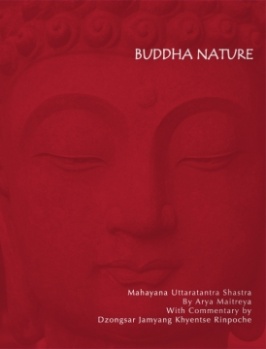
Arya Maitreya’s Mahayana-Uttaratantra-Shastra is one of the most important teachings on buddhanature and enlightenment. It is revered by buddhist masters as a very special text, one of the five great teachings given by Lord Maitreya to Asanga, and part of the third turning of the wheel of the Dharma. Within the traditional buddhist shedras for monastic education, it is often taught as the final text in the curriculum, and many masters say it can be considered a bridge between the sutras and tantra. It provides an important philosophical foundation for understanding the workings of the buddhist path, particularly for Vajrayana practitioners. We are particularly fortunate to have these teachings by Dzongsar Khyentse Rinpoche, rich with his usual clarity, warmth, humour and wisdom because, despite its beauty and profundity, this text is rarely taught in the West, and there are few translations.
Rinpoche gave these teachings on the Uttaratantra at the Centre d’Etudes de Chanteloube in Dordogne, France during the summers of 2003 and 2004, after completing a four-year teaching cycle on Chandrakirti’s Madhyamakavatara. He has often emphasised the value of a grounding in the Madhyamika or ‘Middle Way’ philosophy of emptiness, as without this foundation beginners can easily misunderstand Buddha’s teaching that all sentient beings have buddhanature. For example, many of us who have grown up in a Western cultural context can easily confuse buddhanature with ideas like God or a personal soul or essence. These teachings allow us to dispel these kinds of misunderstanding. And despite their very different presentations, both the Madhyamika and Uttaratantra are teachings on the buddhist view of emptiness. As Rinpoche says, “You could say that when Nagarjuna explains the Prajñaparamita, he concentrates more on its ‘empty’ aspect (“form is emptiness” in the Heart Sutra), whereas when Maitreya explains the same thing, he concentrates more on the ‘ness’ aspect (emptiness is form).” In showing us how emptiness and buddhanature are different ways of talking about the same thing, this text gives us the grounding we need to understand buddhanature.
In this way, the Uttaratantra gives us another way to understand the Four Seals that comprise the buddhist view, which Rinpoche teaches in his book “What Makes You Not a Buddhist.” It also offers a way to make sense of what modern physics has discovered about the magically “full” quality of “empty” space (e.g. vacuum particles and quantum optics). But like all buddhist philosophy, it is not intended simply to provoke an academic discussion that we leave behind as we return to our everyday lives. It is taught as a path for us to attain liberation. For practitioners, the Uttaratantra clearly explains what it means to accumulate merit and purify defilements, and it offers a safety net to protect our path from falling into all-too-common eternalist or nihilist extremes. It also tackles many of the basic questions that practitioners ask as they consider the nature of the path, questions like: What is the ultimate destination of this path? Who is this person travelling on the path? What are the defilements that are eliminated on the path? What is experience of enlightenment like? Rinpoche answers these questions and many others in this commentary on the Uttaratantra-Shastra. (Source: Siddhartha's Intent)
| Citation | Khyentse, Dzongsar. Buddha-Nature: Mahayana-Uttaratantra-Shastra. By Arya Maitreya. With commentary by Dzongsar Jamyang Khyentse Rinpoche. Given at the Centre d'Études de Chanteloube, Dordogne, France. Edited by Alex Trisoglio. n.p.: Siddhartha's Intent, 2007. https://www.dropbox.com/sh/zerz908dsq48lm4/AACBgmKw93qB1PldbrEW8NwVa?dl=0&preview=UttaratantraDJKR+Siddhartha%27s+Intent.pdf |
|---|---|
- Introduction and Preliminaries 1
- 2003 Teachings: Day 1 – Introduction 1
- Day 2 – Introduction 8
- The First Vajra Point: Buddha 13
- The Second Vajra Point: Dharma 20
- The Third Vajra Point: Sangha 24
- Day 3 – Introduction 26
- The Three Refuges 29
- The Last Four Vajra Points 33
- The Four Paradoxes 34
- The Fourth Vajra Point: The Element 37
- Day 4 – Introduction 38
- The Ten Aspects (of Buddha-nature) 40
- #1: Essence 41
- #2: Cause 42
- The four obscurations that wrap the kham 43
- #3: Result 44
- #4: Action/Function 48
- #5: Container/Endowment 49
- #6: Entry 50
- #7: Occasions 51
- #8: All-pervasive 52
- #9: Unchanging 53
- Day 5 – Introduction 61
- The example of the lotus growing in the water 63
- #10: Inseparable 70
- The example of the sun and its rays 70
- The example of the painters 73
- Day 6 – Introduction 76
- The Nine Examples (of essence and defilements) 78
- Example #1: The Buddha and the Lotus 79
- Example #2: The Honey and the Bees 81
- Example #3: The Grain and the Husk 82
- Example #4: The Gold and the Filth 83
- Day 7 – Introduction 88
- Example #5: The Treasure and the Earth 90
- Example #6: The Shoot and the Fruit-skin 92
- Example #7: The Statue and the Tattered Rag 93
- Example #8: The Chakravartin and the Woman 95
- Example #9: The Golden Image and the Clay Mould 96
- Day 8 – Introduction 99
- Day 9 – Introduction 113
- The Fifth Vajra Point – Enlightenment 127
- 2004 Teachings: Day 1 – Introduction 133
- Day 2 – Introduction 150
- Day 3 – Introduction 169
- The Sixth Vajra Point: Qualities 180
- The Ten Powers 182
- The Four Fearlessnesses 186
- Day 4 – Introduction 188
- The Eighteen Distinctive Qualities 190
- The Fruit of Maturation (the 32 Major Marks) 193
- How the examples and the qualities complement each other 199
- The Seventh Vajra Point: Activity 206
- Day 5 – Introduction 206
- The Nine Examples for the Buddha’s Activity 216
- Example #1: Indra’s Reflection On The Lapis Lazuli Floor 217
- Day 6 – Introduction 219
- Example #2: The Heavenly Drum 225
- Example #3: The Cloud 232
- Day 7 – Introduction 236
- Example #4: Brahma 239
- Example #5: The Sun 242
- Example #6: The Wishfulfilling Jewel 247
- Day 8 – Introduction 249
- Example #7: The Echo 250
- Example #8: The Sky/Space 251
- Example #9: The Earth 252
- Day 9 – Introduction 261
- Day 10 – Introduction 276
- Example #1: Indra’s Reflection On The Lapis Lazuli Floor 217
- Questions & Answers 287
- The Fourth Vajra Point: The Element 287
- Do animals have Buddha-nature? 287
- Do plants and stones have Buddha-nature? 287
- Kham and Buddha-nature 293
- Kham and the gross & subtle elements 295
- Buddha-nature, mind & wisdom 297
- The Fifth Vajra Point: Enlightenment 299
- Is Buddha-nature permanent? 299
- Is Buddha-nature uncompounded? 302
- The Sixth Vajra Point: Qualities 306
- The 32 major marks 306
- The activity of the nirmanakaya 313
- The Seventh Vajra Point: Activity 315
- The reflection in the lapis lazuli floor 315
- Effortlessness 320
- View and Path 322
- Blessings & genuine heart of sadness 322
- How does prayer work? 324
- Uttaratantra and the Vajrayana 325
- Why does the path have two accumulations? 327
- Defilements, emotions & the origin of suffering 328
- Are there other sentient beings? 337
- Study & Practice 338
- Buddha-nature & atman in Hinduism 347
- Practice and the Four Seals 350
- The Fourth Vajra Point: The Element 287
- Tibetan Words & Phrases 351
- Index 367
Based on teachings given by Dzongsar Khyentse Rinpoche in Dordogne, France in 2003-2004, this commentary contains side-by-side copies of the translations of the The Mahayana Uttaratantra Shastra from Rosemarie Fuchs and Ken and Katia Holmes, together with the Tibetan verses.
The book includes a lengthy question and answer section organized around the chapters of the root text, but found at the end of the book. Also included are a Tibetan-Sanskrit-English glossary and an index.
- Maitreya. An Analysis of the Jewel Disposition, A Treatise on the Ultimate Continuum of the Mahāyāna - mahāyānottaratantraśāstra-ratnagotra-vibhāga (theg pa chen po rgyud bla ma'i bstan bcos). (D 4024) sems tsam, phi 54b1-73a7. (Q 5525) sems tsam, phi 54b7-74b6 (vol.108, p.24-32); (N 4293) sems tsam, phi 48b3-69a3. In bstan 'gyur (sde dge), Vol. 123: 107-146. Delhi: delhi karmapae choedhey, gyalwae sungrab partun khang, 1982-1985.