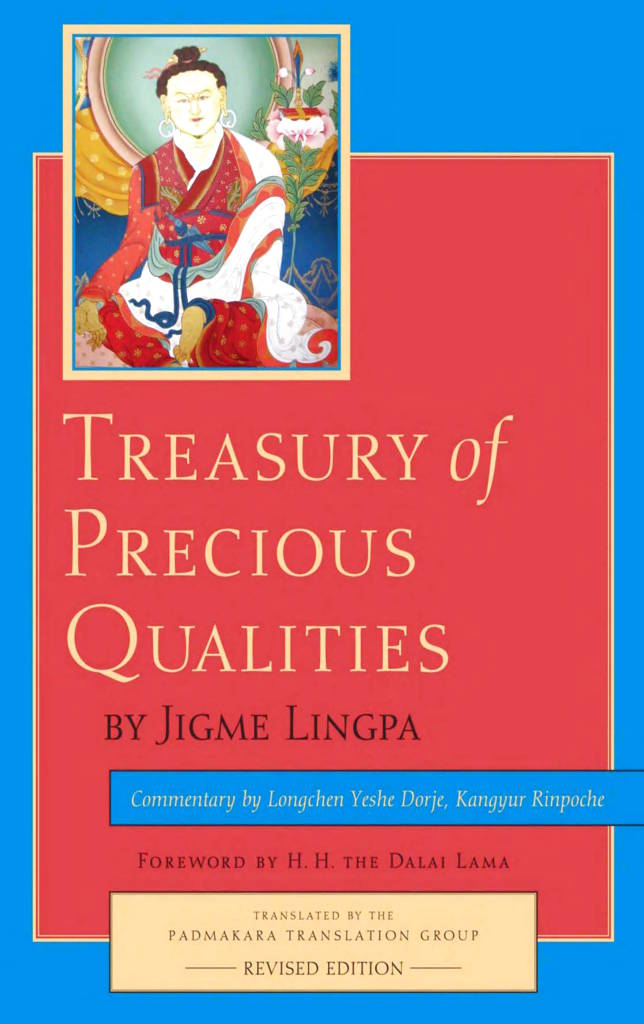
Treasury of Precious Qualities: Book One (2010)

From Buddha-Nature
LibraryBooksTreasury of Precious Qualities: Book One (2010)
< Books
No edit summary
No edit summary
Line 180: Line 180:
*{{i|How to meditate on the four boundless attitudes|242}}
*{{i|The benefits of this meditation|242}}
*{{i|CHAPTER 8 The Vow of Bodhichitta|247}}
*{{i|What is bodhichitta?|247}}
*{{i|Classifications of bodhichitta|249}}
**{{i|''Bodhichitta in aspiration and action''|249}}
**{{i|''Other classifications of bodhichitta''|249}}
**{{i|''Bodhichitta classified according to twenty-two similes''|250}}
**{{i|''Bodhichitta classified according to its benefits''|251}}
**{{i|''Bodhichitta classified according to the speed of progression''|253}}
*{{i|How to cultivate bodhichitta|253}}
**{{i|''The causes of bodhichitta''|254}}
**{{i|''Who can generate bodhichitta?''|254}}
**{{i|''The ritual for taking the vow of bodhichitta''|255}}
***{{i|Inculcating the correct attitude|255}}
***{{i|Accumulating merit|256}}
****{{i|''Preparing the place''|256}}
****{{i|Inviting the field of merit''|256}}
****{{i|''Offering cleansing waters and clothes''|257}}
****{{i|''Requesting to be seated''|260}}
****{{i|''Expressions of respect''|260}}
****{{i|''The prayer of seven branches''|261}}
****{{i|''Offering oneself in service''|264}}
****{{i|''Conclusion''|265}}
***{{i|The ritual of the bodhisattva vow|266}}
***{{i|The conclusion of the ritual: the uplifting of one's own and others' minds|269}}
CHAPTER 9 The Precepts of Bodhichitta in Aspiration
and Action 271
The Bodhisattva commitment 271
The precepts concerning what is to be avoided 27~
Repairingfaults 274
The precepts to be implemented 275
The four precepts oj aspiration bodhichitta 275
The first precept: taking suffering and giving happiness 275
The second precept: the seven-point causal sequence giving birth to the attitude
of bodhichitta 276
The third precept: the four black and four white factors 278
The fourth precept: the four attitudes that strengthen bodhichitta 279
The precepts oj bodhichitta in action 280
A brief explanation of the paramitas 280
A categorization of Bodhisattvas according to their strength of mind 280
The Paramita of Generosity 281
The gift of material things 281
The gift of protection from fear 282
The gift of Dharma 283
The Paramita of Discipline 284
The diScipline of avoiding negative actions 284
The difference between the vows of the Hinayana and Mahayana 284
Avoiding negativity according to the Mahayana 286
The levels of ordination 287
Tht Prtctpts of Layptoplt 287
Tht Monastic Prtctpts 288
The precepts of shramaneras 288
The precepts of a woman novice in training for full ordination 290
The precepts of full monastic ordination 290
Tht prtctpts conctrning what is to bt avoidtd 290
Tht prtctpts conctrning what is to bt dont 291
How the three kinds of vow may be observed simultaneously 293
Tht obstrvanct of tht thru vows as taught in tht Nyingma tradition 296
I. The aspects remain distinct 297
2. The three vows are the same both in purpose and as antidote 297
3. The transmutation of the vows 299
4. The gradual qualitative enhancement of the three vows 305
5. The absence of contradiction in the practice of the three vows 306
6. Observance should be appropriate to the moment 306
Tht thrtt vows as prtstnttd in othtr traditions 308
Concluding summary 312
The diScipline of gathering virtue 316
The discipline of bentjiting others 318
The Paramita of Patience 319
The Paramita of Diligence 322
The three kinds of laziness 322
The three kinds of diligence 32 3
The Paramita of Concentration 324
The prerequisites for concentration 324
In praise of forest dwellings 324
Giving up attachment to wealth 324
Giving up attachment to bad company 325
Giving up attachment to objects of the senses 326
In praise of solitude 327
Concentration itself 328
The essence of concentration 328
The categories of concentration 329
Childish concentration 329
Clearly disc"ning concentration 332
The excellent concentration of the Tathagatas 332
The qualities resulting from concentration 333
The Paramita of Wisdom 335
The categories of wisdom 335
The wisdom resultingjrom hearing the teachings 335
The keys that open the treasure chest of Dharma 336
The drjrnitivt and expedient teachings 336
The implied teachings and indirect teachings 337
Implied teachings 337
Indirect teachings 338
The difference between implied and indirect teachings 342
An explanation of the treasury of Dharma 342
A general exposition of the two truths 342
The fou r tentl systems 345
The Vaibhashikas 345
The Sautrantikas 345
The Chittamatrins, the Mind Only school 346
The Svatantrika Madhyamikas 346
The Prasangika Madhyamikas 347
Conclusion 349
The wisdom resultingjrom reflection 351
Dependent arising with regard to the ground nature 351
The dependent arising of samsara 353
The dependent arising of nirvana 354
The wisdom resultingjrom meditation 355
Wisdom itself 355
Progress on the paths and the attainment of the result 356
A concluding summary of the six paramitas 357
APPENDIX I Impermanence demonstrated by the formation and
destruction of the universe according to Buddhist cosmology 359
The gradual formation of the universe 359
The gradual formation of animate beings 360
The duration of the universe 362
The destruction of beings 363
The destruction of the universe 364
The period of voidness 364
The four periods reflected in the existence of an individual being 365
The ceaseless continuity of the process of formation and destruction 366
APPENDIX 2 The bardo 369
The four bardos 369
The six uncertainties of the bardo of becoming 369
How to benefit the consciousness of beings in the bardo 371
APPENDIX 3 The four truths 373
Essential definitions and aspects of the four truths 373
The meaning of the term "four truths" 374
A sequential exposition of the four truths 374
APPENDIX 4 The five aggregates 377
APPENDIX 5 A Buddha's qualities of realization 387
APPENDIX 6 The five paths and the thirty-seven elements leading to
enlightenment 391
APPENDIX 7 The two truths 397
The two truths according to the Madhyamika view 397
The specificity of the two truths 398
Their literal, etymological meaning 398
Their necessarily binary character 399
The kinds of cognition that validly ascertain the two truths 400
Divisions and categories of the two truths 400
The necessity and benefits of establishing the two truths 410
APPENDIX 8 The Madhyamika school 413
The Svatantrika Madhyamikas 413
The Prasangika Madhyamikas 417
Establishing the ground Madhyamika 417
IJentifying the object oj rifutation: the two selves 421
The difference between the "self" and "apprehension of
(or clinging to) self" 421
Ana9'sis through the application oj reason 422
The four arguments 424
An investigation of causes: the Diamond Splinters argument 425
An investigation of results: no effects, whether existent or nonexistent, can be
said to be produced 426
An investigation of the causal process itself: a refutation of origination related
to four possible alternatives 426
An investigation into the nature of phenomena: the Great Interdependence
argument and the argument of "Neither One nor Many" 427
Wiry the Madlryamika dialectic is superior to all other tenet systems 428
APPENDIX 9 The twenty-one qualities of Dharmakaya wisdom 431
APPENDIX 10 The three doors of perfect liberation 437
Notes 439
Glossary 491
Bibliography 531
Index 537
|AddRelatedTab=No
|AddRelatedTab=No
|ExtraCategories=Tsadra Foundation Series
|ExtraCategories=Tsadra Foundation Series
|StopPersonRedirects=No
|StopPersonRedirects=No
}}
}}

Revision as of 11:30, 28 August 2020


Treasury of Precious Qualities: Book One (2010)
Book
Book

This book is a translation of the first part of Jigme Lingpa's Treasury of Precious Qualities, which in a slender volume of elegant verses sets out briefly but comprehensively the Buddhist path according to the Nyingma school. The concision of the root text and its use of elaborate poetic language, rich in metaphor, require extensive explanation, amply supplied here by the commentary of Kangyur Rinpoche.

The present volume lays out the teachings of the sutras in gradual stages according to the traditional three levels, or scopes, of spiritual endeavor. It begins with essential teachings on impermanence, karma, and ethics. Then, from the Hinayana standpoint, it describes the essential Buddhist teachings of the four noble truths and the twelve links of dependent arising. Moving on, finally, to the Mahayana perspective, it expounds fully the teachings on bodhichitta and the path of the six paramitas, and gives an unusually detailed exposition of Buddhist vows. (Source: Shambhala Publications)

Citation Fletcher, Wulstan, and Helena Blankleder (Padmakara Translation Group), trans. Treasury of Precious Qualities: The Rain of Joy; Book One. By Jigme Lingpa ('jigs med gling pa). With The Quintessence of the Three Paths, a commentary by Longchen Yeshe Dorje, Kangyur Rinpoche (klong chen ye shes rdo rje, bka' 'gyur rin po che). Boston: Shambhala Publications, 2010.


  • Foreword by His Holiness the Dalai Lamaxvii
  • Foreword by Jigme Khyentse Rinpochexix
  • Introduction1
  • Treasury of Precious Qualities15
  • by Jigme Lingpa
  • The Quintessence of the Three Paths105
  • by Longchen Yeshe Dorje, Kangyur Rinpoche
  • Prologue107
  • The title107
  • Homage to the Three Jewels108
  • Commitment to Compose the Text110
  • PART ONE: Turning the Mind to the Dharma115
  • CHAPTER 1 The Value of Human Existence117
  • Samsaric existence117
  • Eight conditions in which there is no freedom to practice the Dharma117
  • Five individual and five circumstantial advantages121
  • The rarity of a precious human existence121
  • PART TWO: An Incentive for the Practice123
  • CHAPTER 2 Impermanence125
  • The impermanence of the outer world125
  • The impermanence of living beings126
  • PART THREE: The Gradual Path of the Three Kinds of Beings131
  • The Path of Beings of Lesser Scope
  • Ethical Teachings in Relation to the Karmic Law of Cause and Effect
  • CHAPTER 3 The Law of Karma133
  • The karmic process in general133
    • Actions never fail to produce an effect133
    • The karmic process is irresistible134
    • Karmic effects are not transferable from one mindstream to another135
    • An explanation of the eight worldly concerns and thirteen influential factors135
    • The proliferating tendency of karmic results136
    • Assessing the gravity of positive and negative actions138
    • The basis of the karmic phenomenon139
    • Propelling and completing actions140
    • The performed and stored aspects of actions141
  • Negative actions142
    • Negative actions regarding the Three Jewels142
    • The crucial role of intention142
    • The ten negative actions142
    • The results of the ten negative actions146
      • The fully ripened effect147
      • The effect similar to the cause147
      • The conditioning or environmental effect148
      • The proliferating effect150
    • Conclusion150
  • Virtuous actions151
  • A recapitulation of the path of beings of lesser scope151
  • How beings of medium scope practice virtue152
  • How beings of great scope practice virtue152


  • The Path of Beings of Medium Scope155
  • Correct Conduct in Relation to the Four Truths


  • CHAPTER 4 The Sufferings of Samsara157
  • The four truths157
    • The truth of suffering158
      • The all-pervasive nature of suffering158
      • The conditions that perpetuate suffering159
      • The sufferings of the lower realms161
        • The eight hot hells161
        • The sixteen neighboring hells163
        • The eight cold hells164
        • The ephemeral hells165
      • The sufferings of the higher realms165
        • The suffering of the gods165
        • The suffering of the asuras167
        • The suffering of human beings168
          • Suffering of suffering168
          • Suffering of change168
          • All-pervading suffering in the making168
          • The eight complementary sufferings169
            • Birth169
            • Old age171
            • IlIness172
            • Death172
            • Meeting unwanted circumstances172
            • Separation from what is loved173
            • Not having what one wants173
            • Having what one does not want173
      • The truth of origin173
      • The truth of path and truth of cessation174
    • The twelve links of dependent arising175
      • The need for this teaching175
      • Definitions of the twelve links176
      • Four way's of presenting the principle of dependent arising177
      • The number of lifetimes required for an entire cycle179
      • How to meditate on the principle of dependent arising180
      • The unoriginated nature of dependent arising183


  • The Extraordinary Path of Beings of Great Scope185
  • Meditation on the Twofold Bodhichitta


  • CHAPTER 5 The Preparation: The Four Wheels187
  • Prerequisites for the practice187
  • Solitude187
    • Livelihood189
  • Reliance on a spiritual master191
    • Fully qualified masters191
    • False teachers193
    • Evoking the sublime qualities of an authentic teacher195
    • Relying on the teacher with a twentyfold attitude197
    • The characteristics of bad disciples198
    • The characteristics of good disciples200
    • How to serve and follow the teacher201
    • How to behave in the presence of the teacher202
    • Reasons for serving the teacher205
    • Conclusion206
  • Excellent aspiration208
  • The supreme protection of merit210
  • CHAPTER 6 The Foundation of the Path: Refuge213
  • The reasons for taking refuge213
    • Faith as the cause of taking refuge213
    • The causes of faith215
      • The qualities of the Buddha215
        • The qualities oj elimination215
          • The one hundred and twelve obscurations eliminated on the path of seeing215
          • How the obscurations militate against the understanding of the four truths216
          • The four hundred and fourteen obscurations eliminated on the path of meditation217
          • The difference between the Hinayana and the Mahayana approaches to the removal of obscurations219
          • The Hinayana and Mahayana ways of removing the obscurations by seeing219
          • How the obscurations are eliminated on the path of meditation222
        • The qualities of a Buddha's realization223
      • The qualities of the Dharma225
        • Dharma posited as the two truths of path and cessation225
        • Dharma defined as the Dharma of transmission and realization225
          • The Dharma of transmission225
          • The Dharma of realization226
          • The grounds or stages of realization227
      • The qualities of the Sangha229
        • The Hinayana and Mahayana Sangha230
  • What is refuge?231
    • Causal and resultant refuge231
    • The different motives for taking refuge232
  • How to take refuge233
  • The benefits of taking refuge234
    • The benefits of causal refuge234
    • The benefits of resultant refuge235
  • The precepts of the refuge vow236
    • The precepts of causal refuge236
      • The precepts regarding things to be avoided236
      • The precepts regarding things to be accomplished236
    • The precepts of resultant refuge237
    • When the refuge vow is broken237
    • Attitudes incompatible with refuge238
    • The benefits of observing the precepts of the refuge vow238


  • CHAPTER 7 Cleansing the Mind by Training in the Four Boundless Attitudes239
  • The Mahayana path239
  • The four boundless attitudes240
  • How to meditate on the four boundless attitudes242
  • The benefits of this meditation242