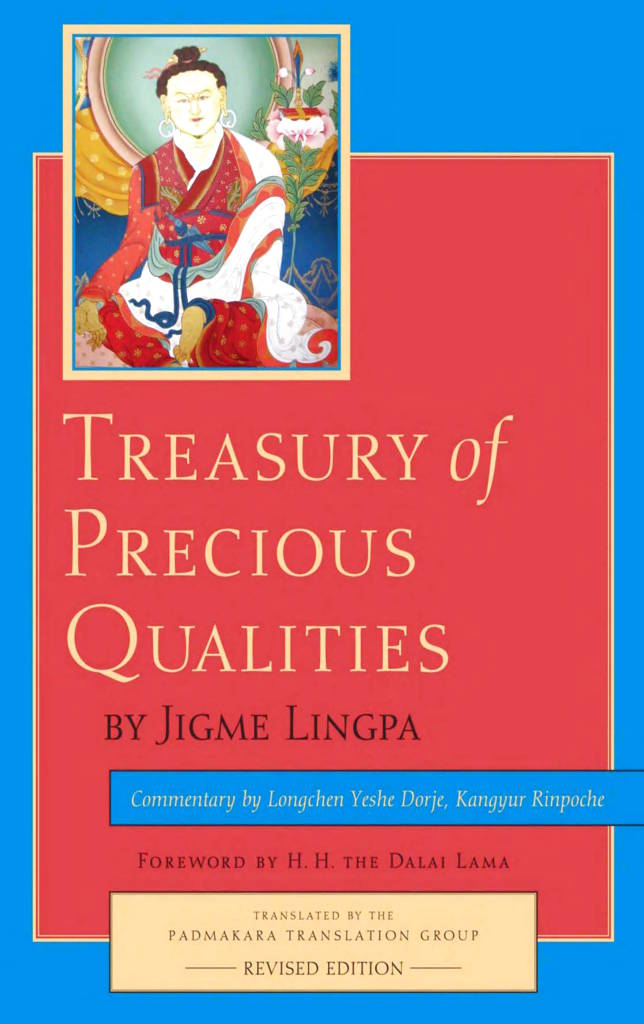
- Foreword by His Holiness the Dalai Lamaxvii
- Foreword by Jigme Khyentse Rinpochexix
- Introduction1
- Treasury of Precious Qualities15
- by Jigme Lingpa
- The Quintessence of the Three Paths105
- by Longchen Yeshe Dorje, Kangyur Rinpoche
- Prologue107
- The title107
- Homage to the Three Jewels108
- Commitment to Compose the Text110
- PART ONE: Turning the Mind to the Dharma115
- CHAPTER 1 The Value of Human Existence117
- Samsaric existence117
- Eight conditions in which there is no freedom to practice the Dharma117
- Five individual and five circumstantial advantages121
- The rarity of a precious human existence121
- PART TWO: An Incentive for the Practice123
- CHAPTER 2 Impermanence125
- The impermanence of the outer world125
- The impermanence of living beings126
- PART THREE: The Gradual Path of the Three Kinds of Beings131
- The Path of Beings of Lesser Scope
- Ethical Teachings in Relation to the Karmic Law of Cause and Effect
- CHAPTER 3 The Law of Karma133
- The karmic process in general133
- Actions never fail to produce an effect133
- The karmic process is irresistible134
- Karmic effects are not transferable from one mindstream to another135
- An explanation of the eight worldly concerns and thirteen influential factors135
- The proliferating tendency of karmic results136
- Assessing the gravity of positive and negative actions138
- The basis of the karmic phenomenon139
- Propelling and completing actions140
- The performed and stored aspects of actions141
- Negative actions142
- Negative actions regarding the Three Jewels142
- The crucial role of intention142
- The ten negative actions142
- The results of the ten negative actions146
- The fully ripened effect147
- The effect similar to the cause147
- The conditioning or environmental effect148
- The proliferating effect150
- Conclusion150
- Virtuous actions151
- A recapitulation of the path of beings of lesser scope151
- How beings of medium scope practice virtue152
- How beings of great scope practice virtue152
- The Path of Beings of Medium Scope155
- Correct Conduct in Relation to the Four Truths
- CHAPTER 4 The Sufferings of Samsara157
- The four truths157
- The truth of suffering158
- The all-pervasive nature of suffering158
- The conditions that perpetuate suffering159
- The sufferings of the lower realms161
- The eight hot hells161
- The sixteen neighboring hells163
- The eight cold hells164
- The ephemeral hells165
- The sufferings of the higher realms165
- The suffering of the gods165
- The suffering of the asuras167
- The suffering of human beings168
- Suffering of suffering168
- Suffering of change168
- All-pervading suffering in the making168
- The eight complementary sufferings169
- Birth169
- Old age171
- IlIness172
- Death172
- Meeting unwanted circumstances172
- Separation from what is loved173
- Not having what one wants173
- Having what one does not want173
- The truth of origin173
- The truth of path and truth of cessation174
- The twelve links of dependent arising175
- The need for this teaching175
- Definitions of the twelve links176
- Four way's of presenting the principle of dependent arising177
- The number of lifetimes required for an entire cycle179
- How to meditate on the principle of dependent arising180
- The unoriginated nature of dependent arising183
- The truth of suffering158
- The Extraordinary Path of Beings of Great Scope185
- Meditation on the Twofold Bodhichitta
- CHAPTER 5 The Preparation: The Four Wheels187
- Prerequisites for the practice187
- Solitude187
- Livelihood189
- Reliance on a spiritual master191
- Fully qualified masters191
- False teachers193
- Evoking the sublime qualities of an authentic teacher195
- Relying on the teacher with a twentyfold attitude197
- The characteristics of bad disciples198
- The characteristics of good disciples200
- How to serve and follow the teacher201
- How to behave in the presence of the teacher202
- Reasons for serving the teacher205
- Conclusion206
- Excellent aspiration208
- The supreme protection of merit210
- CHAPTER 6 The Foundation of the Path: Refuge213
- The reasons for taking refuge213
- Faith as the cause of taking refuge213
- The causes of faith215
- The qualities of the Buddha215
- The qualities oj elimination215
- The one hundred and twelve obscurations eliminated on the path of seeing215
- How the obscurations militate against the understanding of the four truths216
- The four hundred and fourteen obscurations eliminated on the path of meditation217
- The difference between the Hinayana and the Mahayana approaches to the removal of obscurations219
- The Hinayana and Mahayana ways of removing the obscurations by seeing219
- How the obscurations are eliminated on the path of meditation222
- The qualities of a Buddha's realization223
- The qualities oj elimination215
- The qualities of the Dharma225
- Dharma posited as the two truths of path and cessation225
- Dharma defined as the Dharma of transmission and realization225
- The Dharma of transmission225
- The Dharma of realization226
- The grounds or stages of realization227
- The qualities of the Sangha229
- The Hinayana and Mahayana Sangha230
- The qualities of the Buddha215
- What is refuge?231
- Causal and resultant refuge231
- The different motives for taking refuge232
- How to take refuge233
- The benefits of taking refuge234
- The benefits of causal refuge234
- The benefits of resultant refuge235
- The precepts of the refuge vow236
- The precepts of causal refuge236
- The precepts regarding things to be avoided236
- The precepts regarding things to be accomplished236
- The precepts of resultant refuge237
- When the refuge vow is broken237
- Attitudes incompatible with refuge238
- The benefits of observing the precepts of the refuge vow238
- The precepts of causal refuge236
- CHAPTER 7 Cleansing the Mind by Training in the Four Boundless Attitudes239
- The Mahayana path239
- The four boundless attitudes240
- How to meditate on the four boundless attitudes242
- The benefits of this meditation242
- CHAPTER 8 The Vow of Bodhichitta247
- What is bodhichitta?247
- Classifications of bodhichitta249
- Bodhichitta in aspiration and action249
- Other classifications of bodhichitta249
- Bodhichitta classified according to twenty-two similes250
- Bodhichitta classified according to its benefits251
- Bodhichitta classified according to the speed of progression253
- How to cultivate bodhichitta253
- The causes of bodhichitta254
- Who can generate bodhichitta?254
- The ritual for taking the vow of bodhichitta255
- Inculcating the correct attitude255
- Accumulating merit256
- Preparing the place256
- Inviting the field of merit256
- Offering cleansing waters and clothes257
- Requesting to be seated260
- Expressions of respect260
- The prayer of seven branches261
- Offering oneself in service264
- Conclusion265
- The ritual of the bodhisattva vow266
- The conclusion of the ritual: the uplifting of one's own and others' minds269