- THE SAMGHA17
- THE DHAMMA51
- THE BUDDHA AND TATHAGATA103
- BASIC NOTIONS119
- NEW WISDOM SCHOOL146
- THE BUDDHISM OF FAITH
- YOGACARINS207
- TEXTS ORIGINATING IN INDIA274
- TEXTS ORIGINATING IN CHINA AND JAPAN287
(Created page with "{{Book |BookParentPage=Secondary Sources |BookPerson={{Book-person}} |FullTextRead=No |BookToc=<center>''Introduction''</center> <center>''First Part''</center> |AddRelated...") |
No edit summary |
||
| Line 1: | Line 1: | ||
{{Book | {{Book | ||
|BookParentPage=Secondary Sources | |BookParentPage=Secondary Sources | ||
|FullTextRead=No | |FullTextRead=No | ||
|BookToc=<center>''Introduction''</center> | |BookToc=<center>''Introduction''</center> | ||
<center>''First Part''</center> | <center>''First Part''</center> | ||
<center>THE TEACHING OF THE ELDERS</center> | |||
<center>''By I. B. Horner''</center> | |||
* {{i|THE SAMGHA|17}} | |||
<center>THE ORDER OF MONKS AND NUNS</center> | |||
<center>''Conversion of Anathapindika'' 17</center> | |||
<center>''Conversion of General Siha'' 20</center> | |||
<center>''Ordination of Pajapati the Great'' 23</center> | |||
<center>''Visakha, the Laywoman Supporter'' 26</center> | |||
<center>''Schism'' 28</center> | |||
<center>SKILL IN MEANS 33</center> | |||
<center>ARAHANTS 42</center> | |||
<center>THE BUDDHIST APOCALYPSE 45</center> | |||
* {{i|THE DHAMMA|51}} | |||
<center>THE FIVE FACULTIES</center> | |||
<center>''The Five Faculties collectively'' 51</center> | |||
<center>''The Five Faculties separately'' 52</center> | |||
<center>''Faith'' 52</center> | |||
<center>''Vigour'' 54</center> | |||
<center>''Mindfulness'' 56</center> | |||
<center>''Concentration'' 60</center> | |||
<center>''Wisdom'' 64</center> | |||
<center>CONDITIONED GENESIS</center> | |||
<center>''Conditioned Genesis collectively'' 65</center> | |||
<center>''Cond:tioned Genesis separately'' 70</center> | |||
<center>''Ignorance'' 70</center> | |||
<center>''Consciousness'' 70</center> | |||
<center>''Feelng'' 72</center> | |||
<center>''Craving'' 73</center> | |||
<center>''Grasping'' 74</center> | |||
<center>''Birth, Ageing and Dying'' 76</center> | |||
<center>THE OBJECT OF WISDOM</center> | |||
<center>''Crossing Over'' 82</center> | |||
<center>''Emptiness'' 90</center> | |||
<center>''Nirvana'' 92</center> | |||
*{{i|THE BUDDHA AND TATHAGATA|103}} | |||
<center>''Second Part''</center> | |||
<center>THE MAHAYANA</center> | |||
<center>''By Edward Conze''</center> | |||
* {{i|BASIC NOTIONS|119}} | |||
<center>CRITICISM OF THE HINAYANA POSITION</center> | |||
<center>''Bodhisattvas and Disciples'' 119</center> | |||
<center>''The Conversion of Sariputra'' 120</center> | |||
<center>''The two Nirvanas'' 124</center> | |||
<center>THE BODHISATTVA</center> | |||
<center>''Descriptions'' 127</center> | |||
<center>''His Infinite Compassion'' 131</center> | |||
<center>''The Dedication of Merit'' 132</center> | |||
<center>THE SIX PERFECTIONS</center> | |||
<center>''Definition'' 135</center> | |||
<center>''The six Perfections and the Body'' 136</center> | |||
<center>''The Perfection of Giving'' 136</center> | |||
<center>''The Perfection of Patience'' 137</center> | |||
<center>''The Perfection of Meditation'' 138</center> | |||
<center>THE BUDDHA</center> | |||
<center>''The Tathagata as a Rain-cloud'' 139</center> | |||
<center>''The real Buddha'' 140</center> | |||
<center>''The Tathagatas' Coming and Going'' 143</center> | |||
<center>''The Dharma-body'' 143</center> | |||
<center>''Tathagata and Suchness'' 144</center> | |||
<center>''The 18 special dharmas of a Buddha'' 145</center> | |||
* {{i|NEW WISDOM SCHOOL|146}} | |||
<center>THE PERFECTION OF WISDOM 146</center> | |||
<center>THE ELUSIVENESS OF PERFECT WISDOM 149</center> | |||
<center>THE DOCTRINE OF PERFECT WISDOM 152</center> | |||
<center>EMPTINESS</center> | |||
<center>''Preliminary Meditations'' 158</center> | |||
<center>''Definitions and Synonyms of Emptiness'' 163</center> | |||
<center>''Negations'' 172</center> | |||
<center>''Contradictions'' 175</center> | |||
<center>''Unreality of the World'' 177</center> | |||
<center>''Emptiness and Salvation'' 179</center> | |||
<center>''The Germ of Buddhahood in all Beings'' 181</center> | |||
* {{i|THE BUDDHISM OF FAITH|}} | |||
<center>FAITH 185</center> | |||
<center>THE ACTS AND REWARDS OF DEVOTION 186</center> | |||
<center>THE OBJECTS OF DEVOTION</center> | |||
<center>''The Buddha'' 190</center> | |||
<center>''Avalokitesvara'' 194</center> | |||
<center>''Tara'' 196<center> | |||
<center>THE PURE LAND 202</center> | |||
* {{i|YOGACARINS|207}} | |||
<center>MIND ONLY 207</center> | |||
<center>TWOFOLD EGOLESSNESS 211</center> | |||
<center>IRREALITY OF THE WORLD 212</center> | |||
<center>THE BUDDHA AS THE BASIS OF ALL 216</center> | |||
<center>''Third Part''</center> | |||
<center>THE TANTRAS</center> | |||
<center>''By David Snellgrove''</center> | |||
<center>''The Cleansing of Thought'' 221</center> | |||
<center>''Supreme Enlightenment'' 221</center> | |||
<center>''Saraha's Treasury of Songs'' 224</center> | |||
<center>''Anangavajra, The Attainment of the Realization of Wisdom and Means'' 240</center> | |||
<center>''Note on the Mandala'' 246</center> | |||
<center>''Advayavajra, The fivefold Manifestation'' 249</center> | |||
<center>''An Evocation of Prajnaparamita'' 252</center> | |||
<center>''The Mandala conceived within'' 254</center> | |||
<center>''The Story of Tanti'' 255</center> | |||
<center>''Mila Repa and the Novices'' 257</center> | |||
<center>''Fourth Part''</center> | |||
<center>TEXTS FROM CHINA AND JAPAN</center> | |||
<center>By Arthur Waley</center> | |||
<center>Introduction</center> | |||
* {{i|TEXTS ORIGINATING IN INDIA|274}} | |||
<center>''The Parable of Me and Mine'' 274</center> | |||
<center>''On the Curing of Illness contracted during Dhyana Practice'' 274</center> | |||
<center>''Meditation upon the Element Water'' 275</center> | |||
<center>''Judging the Character of a Dhyana Pupil'' 276</center> | |||
<center>''The Bracelets'' 278</center> | |||
<center>''All Words are true'' 278</center> | |||
<center>''Buddha's Doctrine'' 279</center> | |||
<center>''The Negation of Dhyana'' 280</center> | |||
<center>''Po Chu-i. Poem On Reading the Dhyana Sutra'' 281</center> | |||
<center>''Nationality'' 282</center> | |||
<center>''The Intermediate State'' 283</center> | |||
<center>''Devas repeople the Earth'' 283</center> | |||
<center>''Buddha's Pity'' 285</center> | |||
* {{i|TEXTS ORIGINATING IN CHINA AND JAPAN|287}} | |||
<center>''A Hinayana Sect in early China'' 287</center> | |||
<center>''The Truly So'' 290</center> | |||
<center>''From the Lives of the Nuns'' 291</center> | |||
<center>''On Trust in the Heart'' 295</center> | |||
<center>From the Conversations of Shen-hui 299</center> | |||
<center>''A nice Mountain'' 302</center> | |||
<center>''Rain-making'' 302</center> | |||
<center>BIBLIOGRAPHY 307 SOURCES 311 GLOSSARY 313</center> | |||
<center>ABBREVIATIONS 323</center> | |||
|AddRelatedTab=No | |AddRelatedTab=No | ||
}} | }} | ||
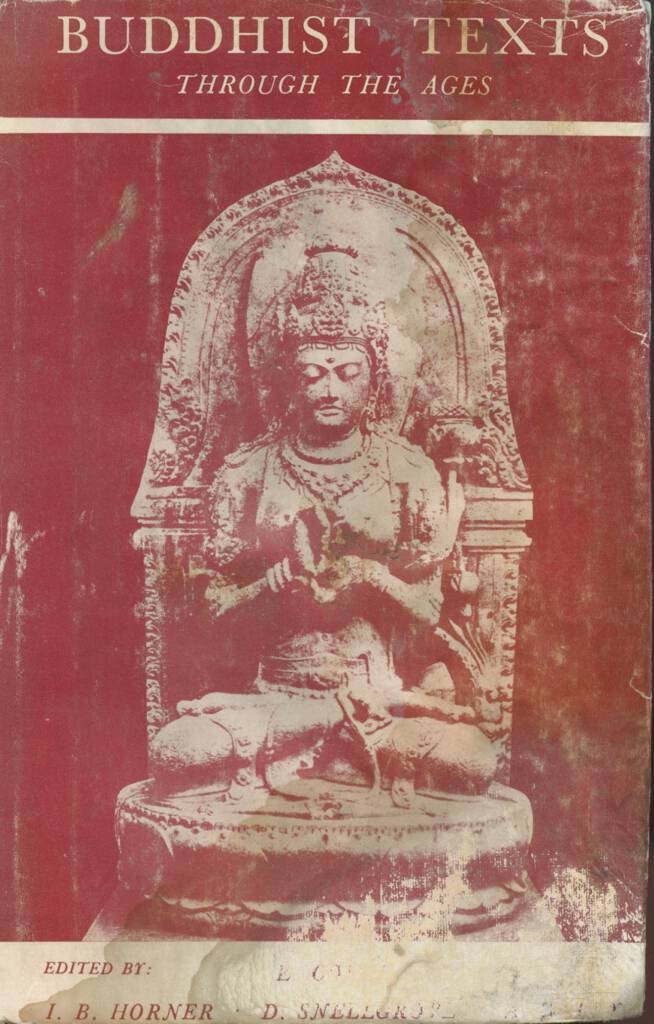
Edward Conze presents the premier anthology of Buddhist texts and scriptures in this stunningly ambitious collection. He traces the development of Buddhism through the ages, with translations from the original Pali, Sanskrit, Chinese, Tibetan and Japanese. For those looking for the perfect companion to Conze’s original text, Buddhism, or for those new to Buddhist theology, Buddhist Texts Through the Ages contains a thorough and comprehensive guide to the theology. This edition also includes a glossary of English and foreign terms. (Source: Philosophical Library)
| Citation | Conze, Edward, trans. and ed. Buddhist Texts Through the Ages: Newly Translated from the Original Pali, Sanskrit, Chinese, Tibetan, Japanese, and Apabhramsa. In collaboration with I. B. Horner, D. Snellgrove, and A. Waley. New York: Philosophical Library, 1954. |
|---|---|
See Bibliography pgs 307-311 for details on the translations.
Prajñāpāramitā - A class of Mahāyāna sūtras which represents some of the earliest known literature of this genre of Buddhism. There are around forty texts associated with this category, though the most widespread is the exceedingly brief Prajñāpāramitāhṛdayasūtra, popularly known as the Heart Sūtra. This class of literature is typically associated with the second turning of the dharma wheel and especially with the teachings on emptiness (śūnyatā). As such, these texts were the primary scriptural source for the philosophy of the Madhyamaka school. Skt. प्रज्ञापारमिता Tib. ཤེས་རབ་ཀྱི་ཕ་རོལ་ཏུ་ཕྱིན་པ་,ཤེར་ཕྱིན་ Ch. 般若波羅蜜多
The purpose of the buddha-nature website is to provide a resource hub for trustworthy information for learning about and teaching the concept of buddha-nature, its associated texts, teachings, lineages, and relevant Buddhist ideas. Unique content will be shared here, but the site will primarily act as a broker for other projects and authors that have already created quality materials, which we will curate for a wide range of audiences.
