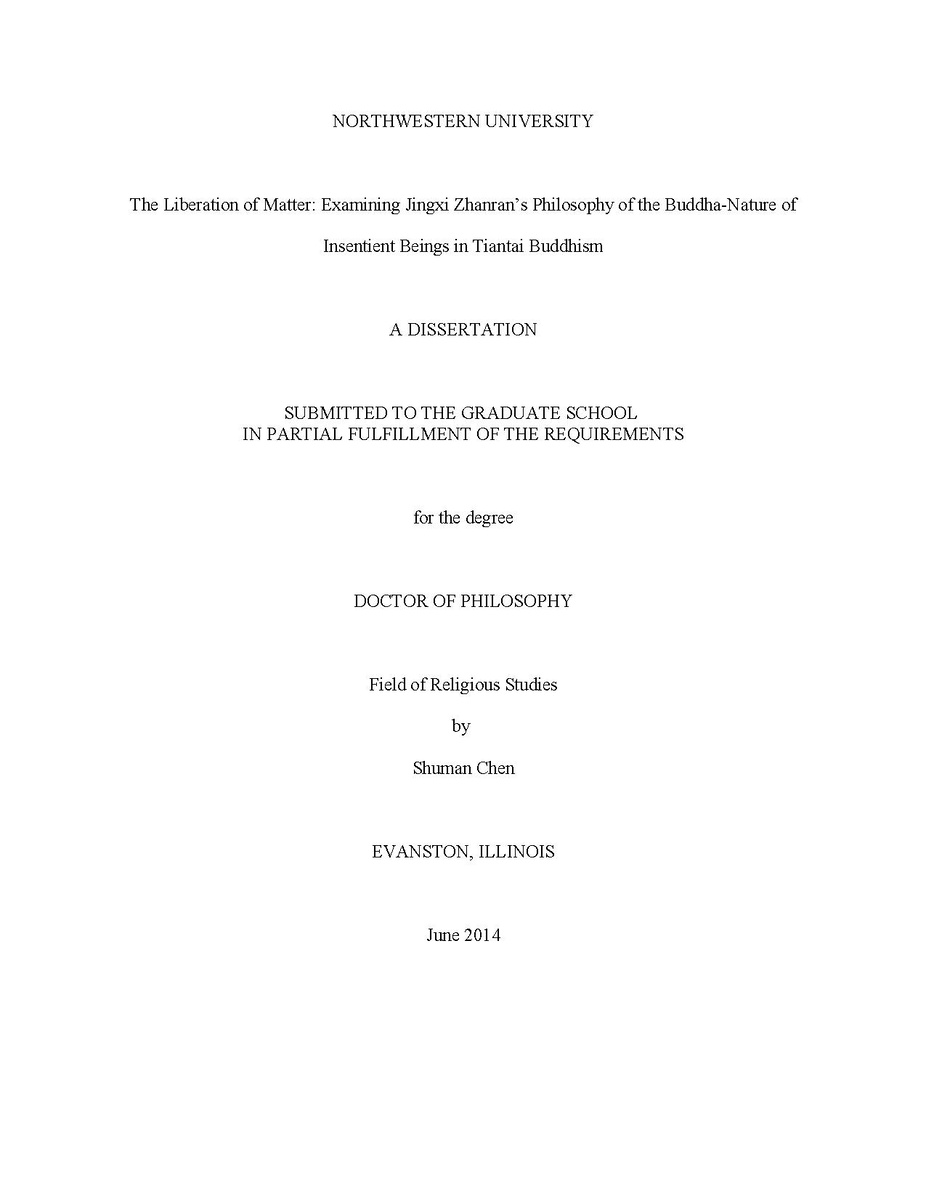
The Liberation of Matter: Examining Jingxi Zhanran’s Philosophy of the Buddha-Nature of Insentient Beings in Tiantai Buddhism

From Buddha-Nature
LibraryDissertationsThe Liberation of Matter: Examining Jingxi Zhanran’s Philosophy of the Buddha-Nature of Insentient Beings in Tiantai Buddhism
< Books
(Created page with "{{Book |BookPerson={{Book-person |PersonPage=Chen, S. |PersonName=Shuman Chen }} |FullTextRead=No |BookToc=Table of Contents Chapter 1. Introduction……………………...")
 
No edit summary
Line 5: Line 5:
}}
}}
|FullTextRead=No
|FullTextRead=No
|BookToc=Table of Contents
|BookToc=*{{i|'''Chapter 1. Introduction'''|12}}
Chapter 1. Introduction………………………………………………………….……….……12
**{{i|1.1. Literature Review and Method|16}}
1.1. Literature Review and Method…………………………………………….……..16
**{{i|1.2. Statement of Contribution|21}}
1.2. Statement of Contribution……………………………………………………..….21
**{{i|1.3. Overview of the Dissertation|24}}
1.3. Overview of the Dissertation…………………………………………….…..……24
*{{i|'''Chapter 2. The Tension between Sentience and Insentience?'''|27}}
Chapter 2. The Tension between Sentience and Insentience? ………………….………...…27
**{{i|2.1. The Obscure Definition of Sentience|28}}
2.1. The Obscure Definition of Sentience……………………………….……….……28
**{{i|2.2. Indian Thought of the Sentience/Insentience of Plants|37}}
2.2. Indian Thought of the Sentience/Insentience of Plants…………...………………37
**{{i|2.3. The Sentience and Power of Buddha Relics and Images|46}}
2.3. The Sentience and Power of Buddha Relics and Images ……………………...…46
**{{i|2.4. The Relic as the Full Embodiment of the Three Buddha Bodies and Buddhahood|69}}
2.4. The Relic as the Full Embodiment of the Three Buddha Bodies and
**{{i|2.5. Sentience, Insentience, and the Mutual Inclusion of Matter and Mind|82}}
Buddhahood…………………………………………………………………….…69
*{{i|'''Chapter 3. The Doctrine of Buddha-Nature'''|97}}
2.5. Sentience, Insentience, and the Mutual Inclusion of Matter and Mind………...…82
**{{i|3.1. ''Tathāgatagarbha'' as Great Self|101}}
Chapter 3. The Doctrine of Buddha-Nature………………………………………….……….97
**{{i|3.2. The Definitions of Buddha-Nature in the ''Nirvana Sutra''|117}}
3.1. Tathāgatagarbha as Great Self…………………………………………..………101
**{{i|3.3. Early Writings about the Buddha-Nature of Insentient Beings|130}}
3.2. The Definitions of Buddha-Nature in the Nirvana Sutra………………...………117
**{{i|3.4. Zhiyi's 智顗 (538-597) Teaching of Buddha-Nature|162}}
3.3. Early Writings about the Buddha-Nature of Insentient Beings…………..……...130
*{{i|'''Chapter 4. Jingxi Zhanran and His Theory of the Buddha-Nature of Insentient Beings''|204}}
3.4. Zhiyi’s 􃘢􆟿 (538-597) Teaching of Buddh-Nature………………………..……162
**{{i|4.1. Biography and Major Works of Jingxi Zhanran 荊溪湛然 (711-782)|208}}
Chapter 4. Jingxi Zhanran and His Theory of the Buddha-Nature of Insentient
**{{i|4.2. The Buddha-Nature of Insentient Beings|228}}
Beings………………………………………………………………………...……204
*{{i|'''Chapter 5. Responses to and Interpretations of Zhanran's Theory'''|298}}
4.1. Biography and Major Works of Jingxi Zhanran 􅋲􃹒􃸃􄃞 (711-782)………..…208
**{{i|5.1. Tang Tiantai-Tendai Dialogues on the Practice and Buddhahood of Insentient Beings|302}}
4.2. The Buddha-Nature of Insentient Beings…………………………………..……228
**{{i|5.2. Shanwai Thinker Gushan Zhiyuan 孤山智圓 (976-1022) on Mind-Inclusion|322}}
Chapter 5. Responses to and Interpretations of Zhanran’s Theory……………………….298
**{{i|5.3. Shanjia Thinker Siming Zhili 四明知禮 (960-1028) on Matter-Inclusion and the Deluded Mind|346}}
5.1. Tang Tiantai-Tendai Dialogues on the Practice and Buddhahood of Insentient
Beings……………………………………………………………………………302
11
5.2. Shanwai Thinker Gushan Zhiyuan 􂬌􂰙􃘢􂚻 (976-1022) on Mind-Inclusion.….322
5.3. Shanjia Thinker Siming Zhili 􂚃􃖶􄞍􄥖 (960-1028) on Matter-Inclusion and the
Deluded Mind………..……………………………………………………..……346
5.4. Contemporary Scholarly Viewpoints………………………………………….…383
5.5. The Modality of Insentient Beings’ Active and Passive Practice………….…….391

Revision as of 12:36, 29 May 2020


The Liberation of Matter: Examining Jingxi Zhanran’s Philosophy of the Buddha-Nature of Insentient Beings in Tiantai Buddhism
Dissertation
Dissertation

Abstract

This dissertation examines the notion that not only sentient beings but also insentient ones, e.g., flora, mountains, rivers, and manmade objects, have Buddha-nature. Employing an exegetical approach, I investigate Jingxi Zhanran’s (711-782) theory of the Buddha-nature of insentient beings. Emphasizing the all-pervasiveness of Buddha-nature and the nonduality of mind and material, he eliminates the absolute distinction between sentient and insentient beings and contends that Buddha-nature includes all beings. Additionally, insisting on the Tiantai notion of mutual inclusion, which reveals a two-way relationship between sentience and insentience, Zhanran reverses the positions of the subjective observer and the objective phenomenon, subjectifying insentient beings.
      In addition to examining the theoretical profundity of Zhanran’s theory, my study examines the issues of sentience versus insentience and Buddha-nature that took place before Zhanran and discusses the subsequent Tiantai concerns with the Buddha-nature of insentient beings. Through textual analysis, I reexamine the emergence of the Chinese thought that connects Buddha-nature to insentient things, initially presented by Jingying Huiyuan (523-592) and Jiaxiang Jizang (549-623). I also illustrate that the concept of the Buddha-nature of insentient beings is implied in Zhiyi’s (538-597) thought by interpreting Zhiyi’s teachings that inspired Zhanran’s advocacy. Furthermore, I analyze, on doctrinal grounds, Chinese Tiantai descendants’ endorsement of Zhanran’s theory, contrasting it with their Japanese counterparts’, the latter who found it difficult to conceptualize how insentient beings’ spiritual cultivation might occur.
      I ultimately argue that Zhanran, indeed, articulates the Buddhahood of insentient beings, and that the modality of their practice through the nonduality between passivity and activity, and between Buddhahood and “insentienthood” can be explained. By raising questions about the human relation to the insentient world and exploring possibilities for attaining harmony through transcending the duality between selfness and otherness, and subjectivity and objectivity, I hope to contribute to the reexamination of anthropocentric religious liberation.

Citation Chen, Shuman. "The Liberation of Matter: Examining Jingxi Zhanran’s Philosophy of the Buddha-Nature of Insentient Beings in Tiantai Buddhism." PhD diss., Northwestern University, 2014.


  • Chapter 1. Introduction12
    • 1.1. Literature Review and Method16
    • 1.2. Statement of Contribution21
    • 1.3. Overview of the Dissertation24
  • Chapter 2. The Tension between Sentience and Insentience?27
    • 2.1. The Obscure Definition of Sentience28
    • 2.2. Indian Thought of the Sentience/Insentience of Plants37
    • 2.3. The Sentience and Power of Buddha Relics and Images46
    • 2.4. The Relic as the Full Embodiment of the Three Buddha Bodies and Buddhahood69
    • 2.5. Sentience, Insentience, and the Mutual Inclusion of Matter and Mind82
  • Chapter 3. The Doctrine of Buddha-Nature97
    • 3.1. Tathāgatagarbha as Great Self101
    • 3.2. The Definitions of Buddha-Nature in the Nirvana Sutra117
    • 3.3. Early Writings about the Buddha-Nature of Insentient Beings130
    • 3.4. Zhiyi's 智顗 (538-597) Teaching of Buddha-Nature162
  • 'Chapter 4. Jingxi Zhanran and His Theory of the Buddha-Nature of Insentient Beings204
    • 4.1. Biography and Major Works of Jingxi Zhanran 荊溪湛然 (711-782)208
    • 4.2. The Buddha-Nature of Insentient Beings228
  • Chapter 5. Responses to and Interpretations of Zhanran's Theory298
    • 5.1. Tang Tiantai-Tendai Dialogues on the Practice and Buddhahood of Insentient Beings302
    • 5.2. Shanwai Thinker Gushan Zhiyuan 孤山智圓 (976-1022) on Mind-Inclusion322
    • 5.3. Shanjia Thinker Siming Zhili 四明知禮 (960-1028) on Matter-Inclusion and the Deluded Mind346

5.4. Contemporary Scholarly Viewpoints………………………………………….…383 5.5. The Modality of Insentient Beings’ Active and Passive Practice………….…….391 Chapter 6. Conclusion and the Recontextualization of Zhanran’s Theory…………..……402 6.1. Application of Zhanran’s Theory………………………...………………………404 6.2. Exploring the Buddha-Nature of Insentient Beings in Non-Tiantai Contexts…...422 Bibliography……………………………………………………………………………...……443 Appendix. The Diamond Scalpel………………………………………………………………457