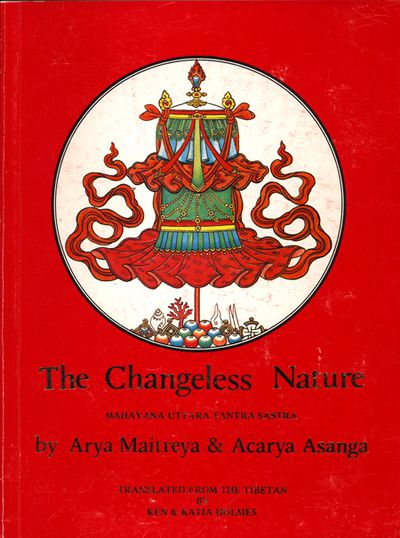
The Changeless Nature

From Buddha-Nature
LibraryBooksThe Changeless Nature
< Books
Revision as of 11:12, 25 March 2020 by AlexC (talk | contribs)


Book
Book

Lord Buddha taught the dharma in three main phases of teaching called the three dharmachakras or the three 'turnings of the wheel of dharma'. The first dharmachakra expounded the 'Four Truths of the Realised', the 'Eightfold Path of the Realised' and other fundamental principles, thereby making clear what suffering is, what causes such suffering, what really constitutes a definitive end (cessation) to suffering and what the means are for achieving this definitive end. The teachings given in this first phase are the easiest to understand.
      The second dharmachakra, also referred to as the 'middle turning' or the 'dharmachakra of no-characteristics', demonstrated the illusory nature of everything and placed the teachings of the first dharmachakra in a much less concrete perspective; suffering was no longer something to be doted with existential reality and the fundamental statements of voidness (śūnyatā) - 'form not existing', 'sound not existing' etc. - were postulated to show the void nature of everything. In the third dharmachakra the 'true nature' of everything was explained - not just voidness, in the sense of complete absence or negation, but a void nature, resplendent with all qualities, naturally present, which is the essence of all beings; their buddha-nature. Since this is the very nature of all beings then by working on it anyone of them can reveal the enlightened wisdom that is inherent to that nature.
      The subject matter of these three dharmachakras was commented upon and cross-referenced in the many treatises (śāstra) composed by buddhist scholars after the Buddha's parinirvāṇa. Maitreya composed five encyclopaedic śāstra of which this Mahāyāna Uttara Tantra Śāstra is one. Its teachings are those of the third dharmachakra. Many commentaries have been written for Maitreya's text, transmitted into this world by Aćarya Asaṅga. and the one chosen for this translation's standpoint is that of Jamgön Kongtrül the Great, whose commentary is in two main parts: an introduction to Maitreya's work and a commentary on the actual text of the original. (Kenneth and Katia Holmes, translator's introduction, 3–4)

Citation Holmes, Ken, and Katia Holmes, trans. The Changeless Nature: The Mahāyānottaratantraśāstra. 2nd ed. By Arya Maitreya and Acarya Asanga. Eskdalemuir, Dumfriesshire, Scotland: Karma Kagyu Trust, 1985. https://archive.org/details/mahayanottaratantrasastrathechangelessnaturebykenandkatiaholmes_202003_994_R/page/n1/mode/2up.


  • Translators' Introductionp. 3
  • THE TEXT
  • Introduction: the seven vajra pointsp. 13
  • PART ONE: THE ACHIEVEMENT: THE THREE JEWELS
  • First Vajra Point: the buddhap. 17
  • Second Vajra Point: the dharmap. 19
  • Third Vajra Point: the sanghap. 21
  • PART TWO: THE BASIS FOR THIS ACHIEVEMENT
  • General Comment on these Last Four Vajra Pointsp. 29
  • 'Fourth Vajra Point: buddha-naturep. 31

I. Summary: A. 3 reasons why beings have it p.31 2. Detailed Presentation B. 10 aspects of buddha-potential nature p.33 cause p. 33 fruit p.35 function p.35 endowments p.37

approach p. 37 phases p. 39 all-pervasiveness p. 39 inalterability p. 39 inseparability from its qualities p. 49 C. 9 examples the examples p. 51 summary and meaning of examples p. 61 D. Purpose of teachings on buddha-nature p. 69 Fifth Vajra Point: enlightenment its nature p. 77 cause p. 77 fruit p. 79 function p. 81 endowments p. 85 actualisation p. 87 permanence p. 97 inconceivability p. 99

Sixth Vajra Point: the qualities of buddhahood 1. synopsis in terms of two sorts of kaya p. 103 2. detailed explanation of each

the qualities of freedom - ultimately-true kaya 10 powers of perfect knowledge p. 105 4 kinds of fearlessness p. 107 18 distinctive qualities p. 107 the qualities of maturity - relatively-true kayas the 32 marks of a perfect being p. 111

3. scriptural source p. 133 4. recapitulation of the examples p. 113

Seventh Vajra Point : buddha-activity 1. synopsis p. 119 2. detailed explanation spontaneity p. 121 unceasingness p. 121 3. expanded explanation through 9 examples p. 123 purpose and significance of examples p. 141 review of examples to show their sublimeness p. 145

PART THREE: CONCLUSION 1. the benefits of this text p. 151 2. how this Sastra was composed p. 155 3. dedication p. 159

NOTES Translators Introduction p. 163 Part One p. 163 Part Two : buddha-nature p. 167 enlightenment p. 171 qualities p. 174 activity p. 175 Part Three p. 176

