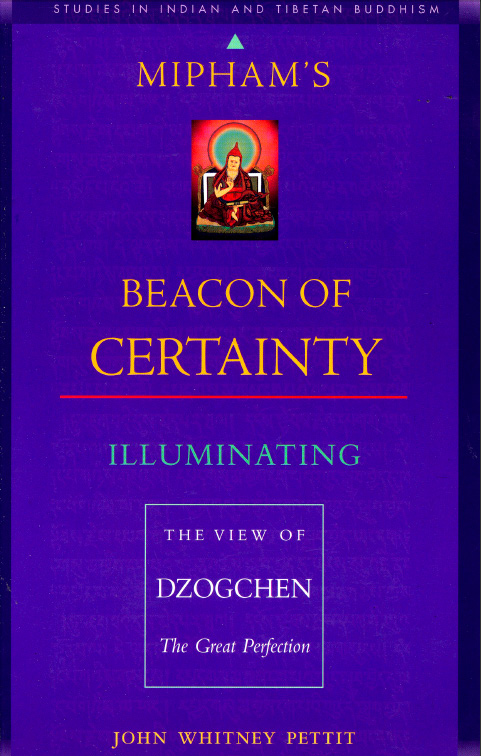
Mipham's Beacon of Certainty

From Buddha-Nature
LibraryBooksMipham's Beacon of Certainty
< Books
No edit summary
No edit summary
Line 8: Line 8:
}}
}}
|FullTextRead=No
|FullTextRead=No
|BookToc=* {{i|Foreword by His Holiness Penor Rinpoche|''ix''}}
* {{i|Acknowledgments|''xi''}}
* {{i|Source Abbreviations|''xv''}}
* {{i|Annotations, Diacritics, and Transcription|''xvii''}}
* {{i|1. INTRODUCTION|1}}
* {{i|1.1 Mipham Rinpoche and the Beacon ofCertainty|1}}
* {{i|1.2 Outline|2}}
* {{i|1.3 The Beacon ofCertainty: Context and Significance|2}}
* {{i|1.3.1 Dialectical Philosophy and the Great Perfection|2}}
* {{i|1.3.2 The Beacons Purpose|5}}
* {{i|1.3.3 The Beacons Comparative Method|6}}
* {{i|1.4 Methods and Sources|7}}
* {{i|1.4.1 Tibetan Language Sources|8}}
* {{i|1.4.1.1 Editions of the Beacon|8}}
* {{i|1.4.2 English Language Sources|11}}
* {{i|1.5 The Contributions of this Work|14}}
* {{i|2. THE LIFE AND WORKS OF MIPHAM RINPOCHE|19}}
* {{i|2.1 Accounts of Mipham’s Life|22}}
* {{i|2.2 The Essential Hagiography<br>
&nbsp;&nbsp;&nbsp;&nbsp;&nbsp;&nbsp;&nbsp;by mKhan chen Kun bzang dpal ldan|23}}
* {{i|3. Indo-Tibetan Buddhism: An Overview|41}}
* {{i|3.1 Historical and Philosophical Dimensions of Buddhism|41}}
* {{i|3.2 Hinayäna and Mahäyäna|42}}
* {{i|3.3 Important Teachings of Mahäyäna Scriptures|45}}
* {{i|3.3.1 Prajnäpäramitä|45}}
* {{i|3.3.2 The Samdhinirmocana and the “Essence Sütras”|47}}
* {{i|3.3.3 Sources for Buddhist Hermeneutics|49}}
* {{i|3.4 Traditions of Indian Madhyamaka|51}}
* {{i|3.4.1 Origins of Prasahgika and Svätantrika Madhyamaka|52}}
* {{i|3.4.2 Yogäcära and the Yogäcära Madhyamaka Synthesis|55}}
* {{i|3.4.3 Madhyamaka and Pramäna|57}}
* {{i|3.5 Vajrayäna: Buddhist Tantra|60}}
* {{i|3.5.1 Indian Origins|60}}
* {{i|3.5.2 Philosophical Dimensions of Tantra|62}}
* {{i|3.5.3 Styles ofTantric Practice|68}}
* {{i|4. Tibetan Buddhist Traditions and the Great Perfection|71}}
* {{i|4.1 The Yarlung Empire and the Introduction of Buddhism|72}}
* {{i|4.2 Early Nyingma Teachers and Texts|74}}
* {{i|4.2.1 The Treasure Tradition|76}}
* {{i|4.2.2 The Great Perfection|77}}
* {{i|4.2.2.1 Origins|77}}
* {{i|4.2.2.2 The View of the Great Perfection|77}}
* {{i|4.2.2.3 The Three Classes of Great Perfection|79}}
* {{i|4.2.24 Great Perfection in Practice|80}}
* {{i|4.2.3 The Great Perfection
in Comparative Philosophical Texts|81}}
* {{i|4.2.3.1 Ch’an and the Great Perfection
in the bSam gtan mig sgron|82}}
* {{i|4.2.3.2 Other Early Doxographies|84}}
* {{i|4.3 The New Translation Period
and the Nyingma Tradition|86}}
* {{i|4.3.1 Rong zom Pandita|88}}
* {{i|4.3.2 The Rise of Scholasticism|91}}
* {{i|4.3.3 Klong chen rab ’byams|92}}
* {{i|4.3.4 Nyingma Monasticism
and the Ecumenical Movement (ris med)|97}}
* {{i|4.3.5 A Nyingma Philosophy?|98}}
* {{i|5. Philosophical Distinctions of Mipham’s Thought|101}}
* {{i|5.1 The Gelug Philosophical Tradition|101}}
* {{i|5.2 Theory, Practice, and Ultimate Reality|104}}
* {{i|5.3 Valid Cognition and Philosophical Analysis|107}}
* {{i|5.4 The Philosophy of Extrinsic Emptiness|111}}
* {{i|5.5 Mipham’s Interpretation of Extrinsic Emptiness
and Tathägatagarbha|114}}
* {{i|5.6 Mipham’s Position on the Tathägatagarbha|117}}
* {{i|6. The Beacon ofCertainty|125}}
* {{i|6.1 Recapitulation of Earlier Discussions|125}}
* {{i|6.2 The Topics of the Beacon|126}}
* {{i|6.2.1 The Beacon and Tsongkhapa’s
Eight Great Difficult Points|128}}
* {{i|6.2.2 Some Observations on Topics 5, 6, and 7|130}}
* {{i|6.3 View, Meditative Practice,
and Ultimate Reality in the Beacon|133}}
* {{i|6.3.I Anupaksas and Pürvapaksas: An Overview|133}}
* {{i|6.3.1.1 Essential Issues and Arguments in Topics 1, 3, and 4|134}}
* {{i|6.3.1.2 Go ram pa’s Analysis ofView
and Meditation in the TSB|136}}
* {{i|6.3.1.2.1 Go ram pa on the Ultimate View|137}}
* {{i|6.3.1.2.2 Go ram pa on Meditative Practice |139}}
* {{i|6.3.2 Topic 1: Philosophical View and Rational Negation|141}}
* {{i|6.3.2.1 Tsongkhapa on the Negandum and Its Substratum|141}}
* {{i|6.3.2.2 Mipham’s Theory of Negation|144}}
* {{i|6.3.2.2.1 Negation and the Definition of the Ultimate|144}}
* {{i|6.3.2.2.2 Mipham’s Analysis of Negation in the MAZL|146}}
* {{i|6.3.2.2.3 Mipham’s Theory of the Ultimate:
Gnosis and Coalescence|151}}
* {{i|6.3.3 Topics 3 and 4: Tsongkhapa and Mipham
on Modal Apprehension and Analytical Reasoning|157}}
* {{i|6.3.3.1 Tsongkhapa on the Role
of Conceptuality in Meditation|157}}
* {{i|6.3.3.1.1 Yon tan rgya mtsho
on Modal Apprehension and Analysis|160}}
* {{i|7. Ascertainment (nges pa) and Certainty (nges shes):
Some Conclusions|169}}
* {{i|7.1 Mipham’s Place in Tibetan Philosophy|182}}
* {{i|7.2 Philosophical Texts and Human Relatedness|184}}
* {{i|8. The Translation of the Beacon of Certainty|187}}
* {{i|8.1 Terminology and Syntax|187}}
* {{i|8.2 Technical Terms|188}}
* {{i|8.3 Proper Names|192}}
* {{i|8.4 On the Use and Disuse of Sanskrit Terms|192}}
* {{i|8.5 Outline of the Beacon and Khro shul ’jam rdor’s Commentary|193}}
* {{i|Abbreviations and Bibliography|193}}
* {{i|Introduction|194}}
* {{i|Topic 1|196}}
* {{i|Topic 2|199}}
* {{i|Topic 3|203}}
* {{i|Topic 4|208}}
* {{i|Topic 5|214}}
* {{i|Topic 6|219}}
* {{i|Topic 7|227}}
* {{i|Conclusion|237}}
9. Stainless Light:
* {{i|A Commentary on the Beacon ofCertainty|241}}
* {{i|Topic 1|251}}
* {{i|Topic 2|271}}
* {{i|Topic 3|291}}
* {{i|Topic 4|306}}
* {{i|Topic 5|329}}
* {{i|Topic 6|345}}
* {{i|Topic 7|371}}
* {{i|Conclusion|404}}
* {{i|10. The Lion’s Roar Proclaiming Extrinsic Emptiness|415}}
Appendix: Explanatory Diagrams and Tables
* {{i|Diagram 1: Conceptuality and True Existence
According to Go ram pa and Mipham|429}}
* {{i|Diagram 2: Conceptuality and True Existence
According to Tsongkhapa|430}}
* {{i|Table 1: Mipham’s System of Four Pramânas|431}}
* {{i|Table 2: Traditions, Two-truth Paradigms, and Their Sources|432}}
* {{i|Table y Pramânas and Their Paradigms ofTruth and Negation|433}}
* {{i|Table 4: The Role ofAscertainment and Conceptuality
According to Mipham and Gelug Philosophers|434}}
* {{i|Notes to Tables|435}}
* {{i|Glossary of Technical Terms|439}}
* {{i|Notes|461}}
* {{i|Bibliography of Works Consulted|533}}
* {{i|Index|557}}
|AddRelatedTab=No
|AddRelatedTab=No
}}
}}

Revision as of 10:24, 7 April 2020


Mipham's Beacon of Certainty
Book
Book

For centuries, Dzogchen—a special meditative practice to achieve spontaneous enlightenment—has been misinterpreted by both critics and malinformed meditators as being purely mystical and anti-rational. In the grand spirit of Buddhist debate, 19th century Buddhist philosopher Mipham wrote Beacon of Certainty, a compelling defense of Dzogchen philosophy that employs the very logic it was criticized as lacking. Through lucid and accessible textural translation and penetrating analysis, Pettit presents Mipham as one of Tibet's greatest thinkers. (Source: Wisdom Publications)

Citation Pettit, John W. Mipham's Beacon of Certainty: Illuminating the View of Dzogchen, the Great Perfection. Studies in Indian and Tibetan Buddhism. Boston: Wisdom Publications, 1999.


  • Foreword by His Holiness Penor Rinpocheix
  • Acknowledgmentsxi
  • Source Abbreviationsxv
  • Annotations, Diacritics, and Transcriptionxvii
  • 1. INTRODUCTION1
  • 1.1 Mipham Rinpoche and the Beacon ofCertainty1
  • 1.2 Outline2
  • 1.3 The Beacon ofCertainty: Context and Significance2
  • 1.3.1 Dialectical Philosophy and the Great Perfection2
  • 1.3.2 The Beacons Purpose5
  • 1.3.3 The Beacons Comparative Method6
  • 1.4 Methods and Sources7
  • 1.4.1 Tibetan Language Sources8
  • 1.4.1.1 Editions of the Beacon8
  • 1.4.2 English Language Sources11
  • 1.5 The Contributions of this Work14
  • 2. THE LIFE AND WORKS OF MIPHAM RINPOCHE19
  • 2.1 Accounts of Mipham’s Life22
  • 2.2 The Essential Hagiography
       by mKhan chen Kun bzang dpal ldan23
  • 3. Indo-Tibetan Buddhism: An Overview41
  • 3.1 Historical and Philosophical Dimensions of Buddhism41
  • 3.2 Hinayäna and Mahäyäna42
  • 3.3 Important Teachings of Mahäyäna Scriptures45
  • 3.3.1 Prajnäpäramitä45
  • 3.3.2 The Samdhinirmocana and the “Essence Sütras”47
  • 3.3.3 Sources for Buddhist Hermeneutics49
  • 3.4 Traditions of Indian Madhyamaka51
  • 3.4.1 Origins of Prasahgika and Svätantrika Madhyamaka52
  • 3.4.2 Yogäcära and the Yogäcära Madhyamaka Synthesis55


in Comparative Philosophical Texts81

in the bSam gtan mig sgron82

  • 4.2.3.2 Other Early Doxographies84
  • 4.3 The New Translation Period

and the Nyingma Tradition86

  • 4.3.1 Rong zom Pandita88
  • 4.3.2 The Rise of Scholasticism91
  • 4.3.3 Klong chen rab ’byams92
  • 4.3.4 Nyingma Monasticism

and the Ecumenical Movement (ris med)97

  • 4.3.5 A Nyingma Philosophy?98
  • 5. Philosophical Distinctions of Mipham’s Thought101
  • 5.1 The Gelug Philosophical Tradition101
  • 5.2 Theory, Practice, and Ultimate Reality104
  • 5.3 Valid Cognition and Philosophical Analysis107
  • 5.4 The Philosophy of Extrinsic Emptiness111
  • 5.5 Mipham’s Interpretation of Extrinsic Emptiness

and Tathägatagarbha114

  • 5.6 Mipham’s Position on the Tathägatagarbha117
  • 6. The Beacon ofCertainty125
  • 6.1 Recapitulation of Earlier Discussions125
  • 6.2 The Topics of the Beacon126
  • 6.2.1 The Beacon and Tsongkhapa’s

Eight Great Difficult Points128

  • 6.2.2 Some Observations on Topics 5, 6, and 7130
  • 6.3 View, Meditative Practice,

and Ultimate Reality in the Beacon133

  • 6.3.I Anupaksas and Pürvapaksas: An Overview133
  • 6.3.1.1 Essential Issues and Arguments in Topics 1, 3, and 4134
  • 6.3.1.2 Go ram pa’s Analysis ofView

and Meditation in the TSB136

  • 6.3.1.2.1 Go ram pa on the Ultimate View137
  • 6.3.1.2.2 Go ram pa on Meditative Practice 139
  • 6.3.2 Topic 1: Philosophical View and Rational Negation141
  • 6.3.2.1 Tsongkhapa on the Negandum and Its Substratum141
  • 6.3.2.2 Mipham’s Theory of Negation144
  • 6.3.2.2.1 Negation and the Definition of the Ultimate144
  • 6.3.2.2.2 Mipham’s Analysis of Negation in the MAZL146
  • 6.3.2.2.3 Mipham’s Theory of the Ultimate:

Gnosis and Coalescence151

  • 6.3.3 Topics 3 and 4: Tsongkhapa and Mipham

on Modal Apprehension and Analytical Reasoning157

  • 6.3.3.1 Tsongkhapa on the Role

of Conceptuality in Meditation157

  • 6.3.3.1.1 Yon tan rgya mtsho

on Modal Apprehension and Analysis160

  • 7. Ascertainment (nges pa) and Certainty (nges shes):

Some Conclusions169

  • 7.1 Mipham’s Place in Tibetan Philosophy182
  • 7.2 Philosophical Texts and Human Relatedness184
  • 8. The Translation of the Beacon of Certainty187
  • 8.1 Terminology and Syntax187
  • 8.2 Technical Terms188
  • 8.3 Proper Names192
  • 8.4 On the Use and Disuse of Sanskrit Terms192
  • 8.5 Outline of the Beacon and Khro shul ’jam rdor’s Commentary193
  • Abbreviations and Bibliography193
  • Introduction194
  • Topic 1196
  • Topic 2199
  • Topic 3203
  • Topic 4208
  • Topic 5214
  • Topic 6219
  • Topic 7227
  • Conclusion237

9. Stainless Light:

  • A Commentary on the Beacon ofCertainty241
  • Topic 1251
  • Topic 2271
  • Topic 3291
  • Topic 4306
  • Topic 5329
  • Topic 6345
  • Topic 7371
  • Conclusion404
  • 10. The Lion’s Roar Proclaiming Extrinsic Emptiness415

Appendix: Explanatory Diagrams and Tables

  • Diagram 1: Conceptuality and True Existence

According to Go ram pa and Mipham429

  • Diagram 2: Conceptuality and True Existence

According to Tsongkhapa430

  • Table 1: Mipham’s System of Four Pramânas431
  • Table 2: Traditions, Two-truth Paradigms, and Their Sources432
  • Table y Pramânas and Their Paradigms ofTruth and Negation433
  • Table 4: The Role ofAscertainment and Conceptuality

According to Mipham and Gelug Philosophers434

  • Notes to Tables435
  • Glossary of Technical Terms439
  • Notes461
  • Bibliography of Works Consulted533
  • Index557