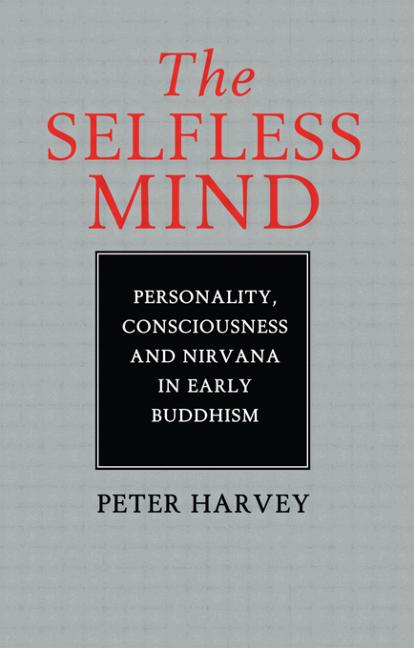
The Selfless Mind

From Buddha-Nature
LibraryBooksThe Selfless Mind
< Books
No edit summary
No edit summary
Line 70: Line 70:
*{{i|&nbsp;&nbsp;&nbsp;''The vortical interplay of discernment and the sentient body''|119}}
<br>
<br>
*{{i|8 DISCERNMENT AND CONDmONED ARISING|122}}
*{{i|8 DISCERNMENT AND CONDITIONED ARISING|122}}
*{{i|&nbsp;&nbsp;&nbsp;''The nature of the constructing activities''|122}}
*{{i|&nbsp;&nbsp;&nbsp;''The conditioning of discernment by the constructing activities''|124}}
Line 77: Line 77:
*{{i|&nbsp;&nbsp;&nbsp;''The conditioning of the sentient body by discernment''|130}}
*{{i|&nbsp;&nbsp;&nbsp;''Conditioned Arising as an analysis of the perceptual process''|134}}
 
<br>
9 DISCERNMENT AND THE PERCEPTUAL PROCESS 138
*{{i|9 DISCERNMENT AND THE PERCEPTUAL PROCESS|138}}
The perceptual process in the 'early Suttas' 138
*{{i|&nbsp;&nbsp;&nbsp;''The perceptual process in the 'early Suttas'''|138}}
The nature and functions of cognition (saiiiiii) 141
*{{i|&nbsp;&nbsp;&nbsp;''The nature and functions of cognition (saññā)''|141}}
The activity of discernment (viiiiiiii}Q) 143
*{{i|&nbsp;&nbsp;&nbsp;''The activity of discernment (viññāṇa)''|143}}
The functions of discernment in the Abhidhamma
*{{i|&nbsp;&nbsp;&nbsp;''The functions of discernment in the Abhidhamma 'process of cittas'''|145}}
'process of cittas' 145
*{{i|&nbsp;&nbsp;&nbsp;The nature of viññāṇa''|148}}
The nature of viiiiiiii'Ja 148
*{{i|&nbsp;&nbsp;&nbsp;''The effect of karma on discernment in the perceptual process''|151}}
The effect of karma on discernment in the
<br>
perceptual process 151
10 BHAVANOA AND. THE BRlGHTLY SHINING MIND 155
Is the bhavailga concept ruled out by the 'early
Sutta' world-view? 155
'Early Sutta' evidence for a bhavailga-type state 151
The meaning of 'bhavailga' 160
The roles of bhavahga 162
The brightly shining citta 166
Freedom from defilements 169
The shining citta and bhavailga 170
The Arahat's ever-shining citta 173
The shining citta and the Buddha-nature 114
The shining citta and the realms of rebirth 111

|AddRelatedTab=No
|AddRelatedTab=No
}}
}}

Revision as of 12:38, 28 April 2020


The Selfless Mind
Book
Book

This careful analysis of early Buddhist thought opens out a perspective in which no permanent Self is accepted, but a rich analysis of changing and potent mental processes is developed. It explores issues relating to the not-Self teaching: self-development, moral responsibility, the between-lives period, and the 'undetermined questions' on the world, on the 'life principle' and on the liberated one after death. It examines the 'person' as a flowing continuity centered on consciousness or discernment (vinnana) configured in changing minds-sets (cittas). The resting state of this is seen as 'brightly shining' - like the 'Buddha nature' of Mahayana thought - so as to represent the potential for Nirvana. Nirvana is then shown to be a state in which consciousness transcends all objects, and thus participates in a timeless, unconditioned realm. (Source: Routledge)

See especially chapter 10, Bhavaṅga and the Brightly Shining Mind.

Citation Harvey, Peter. The Selfless Mind: Personality, Consciousness and Nirvāṇa in Early Buddhism. London: RoutledgeCurzon, 2004. First published 1995 by Curzon Press. http://www.ahandfulofleaves.org/documents/The%20Selfless%20Mind_Personality_Consciousness%20and%20Nirvana%20in%20Early%20Buddhism_Harvey_1995-2004r.pdf.


  • INTRODUCTION1
  • Key non-Buddhist concepts1
  • Key Buddhist concepts2
  • 'Not-Self' and scholars7
  • Sources9
  • Methodology11


  • Part I Exploring the Notion of Selflessness


  • 1. THE QUESTION OF SELF17
  •    Scholars who see a metaphysical Self in the 'early Suttas'17
  •    Uses of the word 'self' (atta) in the 'early Suttas'19
  •    Passages which might indicate the acceptance of a Self21
  •    Nibbāna as not-Self and not related to a Self23
  •    Self as 'not being apprehended'24
  •    A Self beyond 'existence' and 'non-existence'?28
  •    Proof of the impossibility of a Self31
  •    Buddhism and the Upaniṣads on Self33
  •    The status of the 'person'34
  •    Why is Self not denied?: the Buddha and the
         Annihilationists
    38
  •    The 'I am' attitude: its cause, effect and its ending40


  • 2 THE MEANING OF 'NOT-SELF'43
  •    The role of viewing phenomena as not-Self 43
  •    The criteria for Self-hood46
  •    Nibbāna and the Self-ideal51


  • 3 DEVELOPING A SELF WITHOUT BOUNDARIES54
  •    Living with citta as an 'island'54
  •    Developing a 'great self'55
  •     'One of developed self' 57
  •    The Arahat as self-contained and 'dwelling alone'58
  •    The Arahat's boundaryless citta60
  •    The Arahat's boundaryless, self-contained self62


  • 4 PERSONAL CONTINUITY AND RESPONSIBILITY64
  •    The person as a continuity65
  •    Responsibility for actions66
  •    The stability of character traits over lives68
  •    What conserves character traits and the unity of the 'continuity'?72
  •    To what extent are 'continuities' isolated from each other and the world?74


  • 5 MY WORLD AND ITS END78
  •    The Self-world link and the meaning of 'world' (loka)78
  •    The Buddhist perspective on the world79
  •    The undetermined questions83
  •    The undetermined questions on the world 84


  • 6 THE LIFE-PRINCIPLE AND THE BETWEEN-LIVES STATE89
  •    The undetermined questions on the life-principle89
  •    The 'life-principle' accepted by early Buddhism91
  •    Discernment and rebirth95
  •    The question of the intermediary existence (antarā-bhava)98
  •    The nature of the intermediary existence102
  •    The gandhabba: spirit-being of the intermediary existence105


  •                         Part II: Saṃsāric and Nibbānic Discernment109


  • 7 THE CENTRALITY OF DISCERNMENT111
  •    The nature and centrality of citta111
  •    A person as discernment and the sentient body116
  •    The vortical interplay of discernment and the sentient body119


  • 8 DISCERNMENT AND CONDITIONED ARISING122
  •    The nature of the constructing activities122
  •    The conditioning of discernment by the constructing activities124
  •    The conditioning of discernment by nāma-rūpa127
  •    Discernment as conditioned by attention129
  •    The conditioning of the sentient body by discernment130
  •    Conditioned Arising as an analysis of the perceptual process134


  • 9 DISCERNMENT AND THE PERCEPTUAL PROCESS138
  •    The perceptual process in the 'early Suttas'138
  •    The nature and functions of cognition (saññā)141
  •    The activity of discernment (viññāṇa)143
  •    The functions of discernment in the Abhidhamma 'process of cittas'145
  •    The nature of viññāṇa148
  •    The effect of karma on discernment in the perceptual process151


10 BHAVANOA AND. THE BRlGHTLY SHINING MIND 155 Is the bhavailga concept ruled out by the 'early Sutta' world-view? 155 'Early Sutta' evidence for a bhavailga-type state 151 The meaning of 'bhavailga' 160 The roles of bhavahga 162 The brightly shining citta 166 Freedom from defilements 169 The shining citta and bhavailga 170 The Arahat's ever-shining citta 173 The shining citta and the Buddha-nature 114 The shining citta and the realms of rebirth 111