|
|
| Line 8: |
Line 8: |
| |FullTextRead=No | | |FullTextRead=No |
| |TextTranslated=Texts/Sdom gsum rab dbye | | |TextTranslated=Texts/Sdom gsum rab dbye |
| | |BookEssay=Tibetan Buddhists often describe their religion, and the path of practice it teaches, in terms of "three vows" {sdom gsum)-namely, the three codes of discipline associated with the monastic traditions of the Vinaya, the progressive path of the bodhisattva, and the esoteric precepts of the tantras. Mastery of the three codes implies broad and deep scriptural learning as well as scrupulous attention to every detail of one's personal conduct and deportment. For such mastery to be recognized means the achievement of an authoritative status within the religious community. Hence, in the Tibetan Buddhist tradition, the three codes were subject to intensive scrutiny and became a focal point of sustained commentary and debate. |
| | |
| | Among the many works of Tibetan masters devoted to the three codes, none |
| | has enjoyed more notoriety than A Clear Differentiation of the Three Codes {sDom pa gsum pi rab tu dbye ba) by the celebrated author Sakya Pandita Kunga Gyaltshen (or Sapan, n82-I251), presented here in a Western translation for the first time. Not so much a text on the content of the codes themselves as an examination of the many particular questions that relate to the codes-questions that Sapan saw as subject to misunderstanding on the part of his Tibetan contemporaries- The Three Codes has a strongly polemical character. Thus it is easy to see why some readers found the work objectionable in places, others praised it, and all became fascinated by it. Few indigenous Tibetan writings have inspired so abundant and diverse a body of later commentary, commentary that rivals even that on the great Indian Buddhist treatises in its extent. |
| | |
| | Whatever one may conclude about the correctness of Sakya Pandita's opinions |
| | on any given topic, there can be no doubt that by raising so many questions so |
| | trenchantly, Sapan roused Tibetan Buddhists from doctrinal complacency and |
| | contributed mightily to the formation of the remarkable intellectual culture that |
| | has long distinguished the Buddhist monastic colleges of Tibet. It is for this reason that Sakya Pandita is remembered as the first of the three great thinkers renowned in Central Tibet as emanations of Maiijusri, the Bodhisattva of Wisdom. The two who followed him-the great Dzokchen master Longchen Rabjampa (1308-1364) and the peerless scholar and adept Je Tsongkhapa (1357-I419)-were themselves indebted to Sakya Pandita in myriad ways. |
| | |
| | The translation offered here is the work of the American scholar Jared Rhoton |
| | (1941-1993), whose premature passing deprived us of one of our finest interpreters of Tibetan Buddhist learning. From his earliest contacts with Tibetan Buddhism and throughout his studies of Tibetan and Sanskrit in India, beginning in the mid-196os, Jared-or Sonam, as he was known to those of us who had the good fortune to meet him in India-was inspired by the Mafijusri tradition stemming from Sakya Pandita. Through his learning and discernment, his wit and humility, Sonam indeed came to exemplify that tradition in an American iteration. |
| | |
| | Dr. Rhoton was an excellent and prolific translator of Indian and Tibetan |
| | Buddhist texts; nevertheless, his humility and sense of perfection dictated that his published works were few. A Clear Differentiation of the Three.Codes is the most substantial of his writings to appear to date. Its publication is a result of the devoted efforts of his friends, who recognized the great value of his legacy. The vision of Mike Roche in creating the Sapan Fund, the editorial expertise of Victoria Scott, and the Tibetological contribution of Dr. David Jackson have been fundamental in bringing this manuscript into print. Their fine and thoughtful work is a fitting tribute to an admired scholar, and to the bodhisattva who graced him. |
| | |
| | MATTHEW T. KAPSTEIN |
| | Editor, SUNY Buddhist Studies Series |
| |BookToc=*{{i|Foreword|ix}} | | |BookToc=*{{i|Foreword|ix}} |
| *{{i|Acknowledgments|xi}} | | *{{i|Acknowledgments|xi}} |
Lua error in Module:GetBookValue at line 1: Module:BookData returned boolean, table expected.
| Citation
|
Lua error in Module:GetBookValue at line 1: Module:BookData returned boolean, table expected.
|
|
|
|
- Forewordix
- Acknowledgmentsxi
- Note on Transcriptionxii
- List of Abbreviationsxiii
- Part I: Sakya Pandita’s Life and Work
- Part II: A Clear Differentiation of the Three Codes
- Prologue39
- Vows of Individual Liberation41
- Vows of the Bodhisattva81
- Vows of the Vajra Vehicle95
- Epilogue199
- Part III: Six Letters by Sakya Pandita
- 1. Reply to the Questions of the Translator from Chak205
- 2. Reply to the Questions of the Translator of Lowo225
- 3. A Letter to the Noble-Minded229
- 4. A Letter to the Buddhas and Bodhisattvas of the Ten Directions241
- 5. Reply to the Questions of Dokorwa the Kadampa259
- 6. Reply to the Questions of Namkha Bum the Kadampa267
- Appendix A: Gorampa's Outline of A Clear Differentiation of the Three Codes273
- Appendix B: Transliteration of the Tibetan Text of A Clear Differentiation of the Three Codes277
- Glossary331
- Bibliography337
- Index349
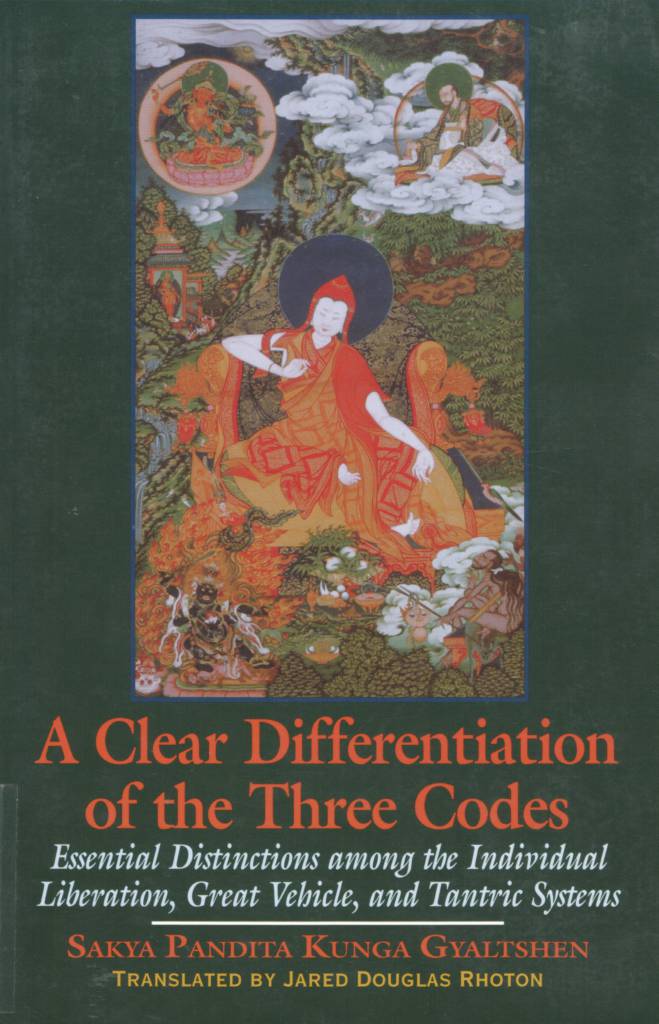
- About the Cover370
Tibetan Buddhists often describe their religion, and the path of practice it teaches, in terms of "three vows" {sdom gsum)-namely, the three codes of discipline associated with the monastic traditions of the Vinaya, the progressive path of the bodhisattva, and the esoteric precepts of the tantras. Mastery of the three codes implies broad and deep scriptural learning as well as scrupulous attention to every detail of one's personal conduct and deportment. For such mastery to be recognized means the achievement of an authoritative status within the religious community. Hence, in the Tibetan Buddhist tradition, the three codes were subject to intensive scrutiny and became a focal point of sustained commentary and debate.
Among the many works of Tibetan masters devoted to the three codes, none
has enjoyed more notoriety than A Clear Differentiation of the Three Codes {sDom pa gsum pi rab tu dbye ba) by the celebrated author Sakya Pandita Kunga Gyaltshen (or Sapan, n82-I251), presented here in a Western translation for the first time. Not so much a text on the content of the codes themselves as an examination of the many particular questions that relate to the codes-questions that Sapan saw as subject to misunderstanding on the part of his Tibetan contemporaries- The Three Codes has a strongly polemical character. Thus it is easy to see why some readers found the work objectionable in places, others praised it, and all became fascinated by it. Few indigenous Tibetan writings have inspired so abundant and diverse a body of later commentary, commentary that rivals even that on the great Indian Buddhist treatises in its extent.
Whatever one may conclude about the correctness of Sakya Pandita's opinions
on any given topic, there can be no doubt that by raising so many questions so
trenchantly, Sapan roused Tibetan Buddhists from doctrinal complacency and
contributed mightily to the formation of the remarkable intellectual culture that
has long distinguished the Buddhist monastic colleges of Tibet. It is for this reason that Sakya Pandita is remembered as the first of the three great thinkers renowned in Central Tibet as emanations of Maiijusri, the Bodhisattva of Wisdom. The two who followed him-the great Dzokchen master Longchen Rabjampa (1308-1364) and the peerless scholar and adept Je Tsongkhapa (1357-I419)-were themselves indebted to Sakya Pandita in myriad ways.
The translation offered here is the work of the American scholar Jared Rhoton
(1941-1993), whose premature passing deprived us of one of our finest interpreters of Tibetan Buddhist learning. From his earliest contacts with Tibetan Buddhism and throughout his studies of Tibetan and Sanskrit in India, beginning in the mid-196os, Jared-or Sonam, as he was known to those of us who had the good fortune to meet him in India-was inspired by the Mafijusri tradition stemming from Sakya Pandita. Through his learning and discernment, his wit and humility, Sonam indeed came to exemplify that tradition in an American iteration.
Dr. Rhoton was an excellent and prolific translator of Indian and Tibetan
Buddhist texts; nevertheless, his humility and sense of perfection dictated that his published works were few. A Clear Differentiation of the Three.Codes is the most substantial of his writings to appear to date. Its publication is a result of the devoted efforts of his friends, who recognized the great value of his legacy. The vision of Mike Roche in creating the Sapan Fund, the editorial expertise of Victoria Scott, and the Tibetological contribution of Dr. David Jackson have been fundamental in bringing this manuscript into print. Their fine and thoughtful work is a fitting tribute to an admired scholar, and to the bodhisattva who graced him.
MATTHEW T. KAPSTEIN
Editor, SUNY Buddhist Studies Series
Lua error in Module:GetBookValue at line 1: Module:BookData returned boolean, table expected.
[[Category:Lua error in Module:GetBookValue at line 1: Module:BookData returned boolean, table expected.]][[Category:Lua error in Module:GetBookValue at line 1: Module:BookData returned boolean, table expected.]][[Category:Lua error in Module:GetBookValue at line 1: Module:BookData returned boolean, table expected.]]<ul><li>"Lua error in Module:GetBookValue at line 1: Module:BookData returned boolean, table expected." is not recognized as a Boolean (true/false) value.</li> <!--br--><li>Property "Frontcoverimg" (as page type) with input value "Lua error in Module:GetBookValue at line 1: Module:BookData returned boolean, table expected." contains invalid characters or is incomplete and therefore can cause unexpected results during a query or annotation process.</li> <!--br--><li>Property "BuNayAuthor" (as page type) with input value "Lua error in Module:GetBookValue at line 1: Module:BookData returned boolean, table expected." contains invalid characters or is incomplete and therefore can cause unexpected results during a query or annotation process.</li> <!--br--><li>Property "Translator" (as page type) with input value "Lua error in Module:GetBookValue at line 1: Module:BookData returned boolean, table expected." contains invalid characters or is incomplete and therefore can cause unexpected results during a query or annotation process.</li> <!--br--><li> "Lua error in Module" has not been listed as valid URI scheme.</li> <!--br--><li>"Lua error in Module:GetBookValue at line 1: Module:BookData returned boolean, table expected." is not in the list (Definitive, Provisional) of allowed values for the "PosBuNayDefProv" property.</li> <!--br--><li>"Lua error in Module:GetBookValue at line 1: Module:BookData returned boolean, table expected." is not in the list (Yes, No, Qualified Yes, Qualified No) of allowed values for the "PosAllBuddha" property.</li> <!--br--><li>"Lua error in Module:GetBookValue at line 1: Module:BookData returned boolean, table expected." is not in the list (First Turning, Second Turning, Third Turning, (Fourth Turning)) of allowed values for the "PosWheelTurn" property.</li> <!--br--><li>"Lua error in Module:GetBookValue at line 1: Module:BookData returned boolean, table expected." is not in the list (Yogācāra, Madhyamaka) of allowed values for the "PosYogaMadhya" property.</li> <!--br--><li>"Lua error in Module:GetBookValue at line 1: Module:BookData returned boolean, table expected." is not in the list (Zhentong, Rangtong) of allowed values for the "PosZhenRang" property.</li> <!--br--><li>"Lua error in Module:GetBookValue at line 1: Module:BookData returned boolean, table expected." is not in the list (0, 1, 2, 3, 4, 5, 6, 7, 8, 9) of allowed values for the "PosVehicles" property.</li> <!--br--><li>"Lua error in Module:GetBookValue at line 1: Module:BookData returned boolean, table expected." is not in the list (Analytic Tradition, Meditative Tradition) of allowed values for the "PosAnalyticMedit" property.</li> <!--br--><li>"Lua error in Module:GetBookValue at line 1: Module:BookData returned boolean, table expected." is not in the list (Tathāgatagarbha as the Emptiness That is a Non-implicative Negation (without enlightened qualities), Tathāgatagarbha as the Emptiness That is an Implicative Negation (with enlightened qualities), Tathāgatagarbha as Mind's Luminous Nature, Tathāgatagarbha as the Unity of Emptiness and Luminosity, Tathāgatagarbha as a Causal Potential or Disposition (gotra), Tathāgatagarbha as the Resultant State of Buddhahood, Tathāgatagarbha as the Latent State of Buddhahood that is Obscured in Sentient Beings, There are several types of Tathāgatagarbha, Tathāgatagarbha was Taught Merely to Encourage Sentient Beings to Enter the Path) of allowed values for the "PosEmptyLumin" property.</li> <!--br--><li>"Lua error in Module:GetBookValue at line 1: Module:BookData returned boolean, table expected." is not in the list (Svātantrika (རང་རྒྱུད་), Prāsaṅgika (ཐལ་འགྱུར་)) of allowed values for the "PosSvataPrasa" property.</li> <!--br--><li>Property "BuNayPublisher" (as page type) with input value "Lua error in Module:GetBookValue at line 1: Module:BookData returned boolean, table expected." contains invalid characters or is incomplete and therefore can cause unexpected results during a query or annotation process.</li> <!--br--><li>Property "BuNayTopicTags" (as page type) with input value "Lua error in Module:GetBookValue at line 1: Module:BookData returned boolean, table expected." contains invalid characters or is incomplete and therefore can cause unexpected results during a query or annotation process.</li></ul>