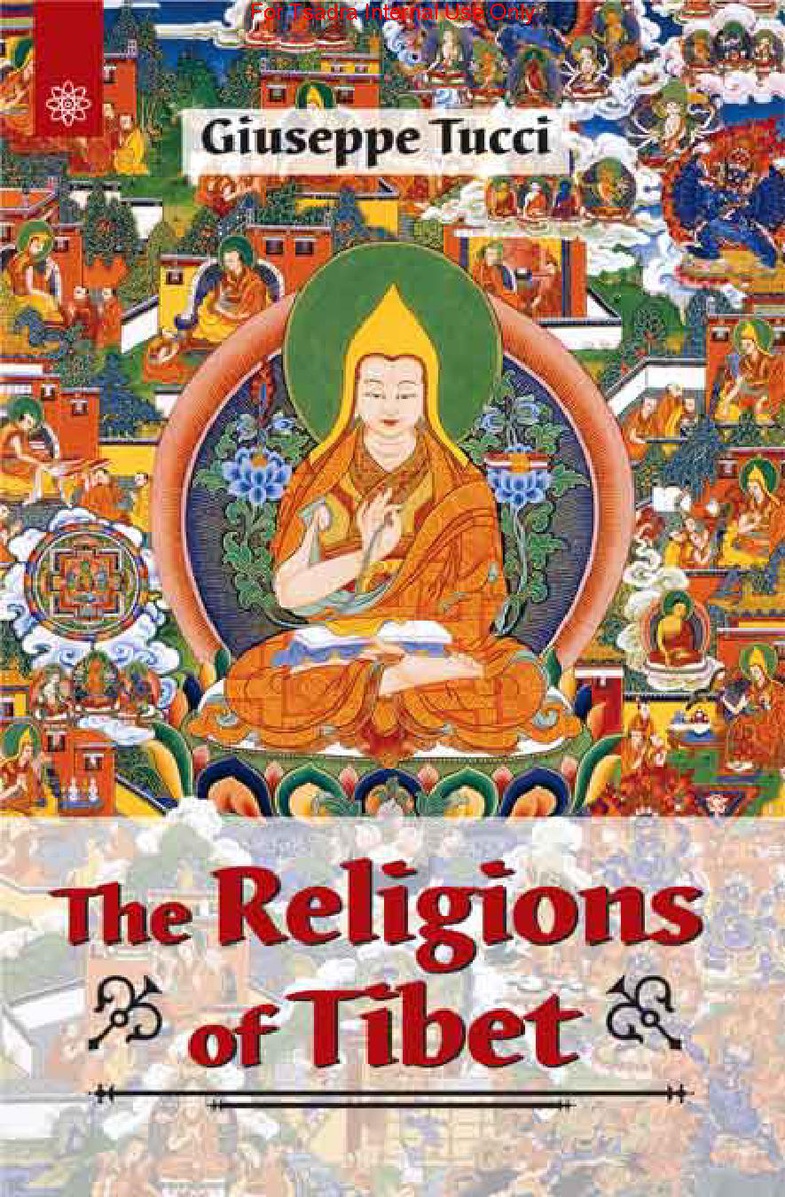
The Religions of Tibet (1980, Routledge)

From Buddha-Nature
LibraryBooksThe Religions of Tibet (1980, Routledge)
< Books
No edit summary
No edit summary
Line 31: Line 31:
**{{i|7 The ''bKa' brgyud pa'' school|70}}
**{{i|8 Tantric practice according to the tradition of the ''Bla na med rgyud''|71}}
**{{i|9 The rNying ma pa'' school|76}}
**{{i|9 The ''rNying ma pa'' school|76}}
**{{i|10 The ''gCod'' tradition|87}}
**{{i|11 Conclusion. The special nature of the Lamaist teaching of salvation|93}}
**{{i|Appendix: The process of transformation of ''Sems'' and ''rLungs''|106}}
**{{i|&nbp;&nbp;&nbp;Appendix: The process of transformation of ''Sems'' and ''rLungs''|106}}


5 Monkhood, monastery life, religious calendar and

Revision as of 12:27, 7 July 2020


The Religions of Tibet (1980, Routledge)
Book
Book

No description given. The following is an excerpt from Turrell Wylie's review published in The American Historical Review, Volume 88, Issue 5, December 1983, Page 1309:

This book by Giuseppe Tucci, the internationally renowned Tibetologist, is a scholarly study of the religions of Tibet: Buddhism, the nameless "folk religion," and the system called Bon. The history of the spread of Buddhism in Tibet is divided in the indigenous tradition into the "early" and "later" stages. The first chapter of the book surveys the significant events of the early spread, which ended with the persecution of Buddhism in the ninth century, and the second reviews those of the later spread, beginning with the revival of Buddhism and the founding of great monasteries in the eleventh century. Chapter 3 deals with the general character­istics of "Lamaism" and the emergence of the major schools of Tibetan Buddhism, particularly the rNying ma pa, Sa skya pa, bKa' brgyud pa, and dGe lugs pa. Chapter 4 examines the doctrines held, both in common and in particular, by these schools, as well as the substantialism of the Jo nang pa and the quietism of the Zhi byed pa. The fifth chapter deals with the organization of the monastic commu­nity, the administration of the monastery and its property, and the religious calendar with its various festivals. Chapter 6 is devoted to the "folk religion," replete with its beliefs in benevolent and malevolent numina. Various apotropaic rituals intended to protect the individual, the family, the house, and other property are discussed in detail. This chapter shows clearly the contradiction between the intellectual preoccupation with Buddhist epistemology and ontology on the monastic level and the emotional concern with the existence of demonic powers and the vulnerability of the "soul" (bla) on the lay level. The final chapter deals with the Bon religion that predated Buddhism in Tibet. This chapter explores the religious milieu of the ancient monarchy and then examines the way in which Bon evolved over the centuries in competition with, and later in imitation of, Buddhism. An eight-page chronologi­cal table listing significant dates and events in Tibet­an history is given at the end of the book.

Read more here . . .

Citation Tucci, Giuseppe. The Religions of Tibet. Translated from the German and Italian by Geoffrey Samuel. London: Routledge & Kegan Paul, 1980.


    • Prefacevii
    • Note on transcription and pronunciationxii
  • 1 The first diffusion of Buddhism in Tibet1
    • 1 The beginnings1
    • 2 Co-existence and conflict-among the various tendencies at the time of
         the first introduction of Buddhism into Tibet
      5
    • 3 Ordination of monks, foundation of monasteries, donations to
         monasteries
      8
    • 4 The Indian and Chinese currents12
  • 2 The second diffusion of Buddhism16
    • 1 The revival of Buddhism16
    • 2 Rin chen bzang po and Atisa20
    • 3 The foundation of the great monasteries26
  • 3 General characteristics of Lamaism29
    • 1 Fundamentals29
    • 2 The most important schools33
    • 3 The conflicts between the schools and their significance for the
         political history of Tibet. The office of Dalai Lama
      39
    • 4 The figure of the religious teacher (bla ma)44
  • 4 The doctrines of the most important schools47
    • 1 Assumptions common to all schools47
    • 2 The vehicle of the Mantra50
    • 3 Investiture and consecrations57
    • 4 The Tantric process of transcendence: mental-body,
         maya-body, body of transcendent consciousness
      58
    • 5 Sems and light63
    • 6 Substantialism of the Jo nang pa school67
    • 7 The bKa' brgyud pa school70
    • 8 Tantric practice according to the tradition of the Bla na med rgyud71
    • 9 The rNying ma pa school76
    • 10 The gCod tradition87
    • 11 Conclusion. The special nature of the Lamaist teaching of salvation93
    • &nbp;&nbp;&nbp;Appendix: The process of transformation of Sems and rLungs106

5 Monkhood, monastery life, religious calendar and festivals 110 1 Orgwüi ^ ion of monastic community: hierarchy and office-. 110 2 Religion • calendar and festivals 146 ?> Th e h c >. i fi t c. ' way of life • 156 ^ The piv : c rty of the monastery and its administration 158 6 The folk ye- -ion 163 î Gcneîrtf rharacteristics 163 ^. M^n -»< ; jo face with divine and demonic powers 171 3 l'ersoi)? ^'"oîcclion and protection of the house 187 4 The For1

' 190
> Death 193

h Thchvi.t v or suffirnen (offering of incense) 199 / Lcokii},^ *nlo the future: investigating the favourable ÖL unfav :u.' able omens for an action 202 il T he p i o • r c i io n of property and of flocks 204 9 Final CÛ: Triera lions . 205 7 The Bon religion 213 Chronological table 249 Notes 257 Bibliography 1 Tibetan sources 275 2 Books and articles 275 Index 280
