- Translator's Preface11
- The Root Text15
- The Commentary55
- The Authors Introduction57
- The explication of the treatise67
- I. The meaning of the title67
- II. The translators' homage67
- III. The main body of the text69
- A The verse introducing the author's intention69
- B The actual body of the treatise71
- 1 The brief presentation 71
- I) The points comprising the essential subject matter 71
- II) The defining traits of each of these75
- A) The definition of phenomena75
- B) The definition of pure being77
- III) The rationale underlying these traits79
- IV) Examining both for sameness and difference83
- 2 The expanded explanation85
- I) The expanded explanation of phenomena85
- A) A presentation of the headings85
- B) An explanation of each of these87
- (1) A passing reference to the first three points87
- (2) An explanation of the last three points89
- (I) The explanation of the two types of ground89
- (A) A brief presentation of both in common89
- (B) An expanded explanation of the meaning of each91
- 1) Experience comprising a common ground91
- 2) Experience not shared in common95
- (II) How to approach reality, which is free of perceived and perceiver97
- (A) The tenet stating that there is no outer referent, only image-awareness97
- 1) The lack of a perceived object discrete from the perceiver97
- 2) The elimination of any further uncertainty101
- (B) The resultant procedure for approaching reality, the freedom from perceived and perceiver107
- (A) The tenet stating that there is no outer referent, only image-awareness97
- (I) The explanation of the two types of ground89
- II) The expanded explanation of pure being113
- A) A brief presentation of the headings113
- B) The expanded explanation of these six115
- (1) The defining characteristics 115
- (2) The ground115
- (3) Definitive verification117
- (4) Encounter117
- (5) Recollection119
- (6) Complete immersion into its core121
- (I) The character of ultimate transformation 121
- (II) The expanded explanation of its distinctive features123
- (A) The brief presentation of the headings123
- (B) The expansion on these ten125
- 1) The essence125
- 2) The ingredients127
- 3) The individuals131
- 4) The special traits133
- 5) The requirements135
- 6) The ground137
- a) The brief presentation137
- b) The expansion on these six points141
- i) The focal requirement141
- ii) Surrendering attributes143
- iii) How to apply the mind correctly in practice 147
- iv) The defining characteristics of wisdom in terms of its effects—the sphere of experience it opens149
- v) The benefits159
- vi) The introduction to full understanding161
- (a) The brief presentation161
- (b) The expansion on that163
- (i) Fully understanding the remedy163
- (ii) Fully understanding the concrete characteristic165
- (iii) Fully understanding the distinctive marks171
- (iv) Fully understanding the five effects173
- 7) Mental cultivation175
- 8) Application185
- 9) The disadvantages189
- 10) The benefits199
- I) The expanded explanation of phenomena85
- 3 The concluding summary employing examples to illustrate the point201
- 1 The brief presentation 71
- B The actual body of the treatise71
- IV. The concluding statement203
- The Author's Colophon205
- Dedication207
- Bibliography209
- Notes211
No edit summary |
No edit summary |
||
| Line 11: | Line 11: | ||
|BookToc=*{{i|Translator's Preface|11}} | |BookToc=*{{i|Translator's Preface|11}} | ||
*{{i|The Root Text|15}} | *{{i|The Root Text|15}} | ||
*{{i|The Commentary |55}} | *{{i|The Commentary|55}} | ||
*{{i|The Authors Introduction|57}} | *{{i|The Authors Introduction|57}} | ||
*{{i|The explication of the treatise|67}} | *{{i|The explication of the treatise|67}} | ||
| Line 19: | Line 19: | ||
*{{i|A The verse introducing the author's intention|69}} | *{{i|A The verse introducing the author's intention|69}} | ||
**{{i|B The actual body of the treatise|71}} | **{{i|B The actual body of the treatise|71}} | ||
***{{i|1 The brief presentation |71}} | ***{{i|1 The brief presentation |71}} | ||
**** {{i|I) The points comprising the essential subject matter |71}} | ****{{i|I) The points comprising the essential subject matter |71}} | ||
**** {{i|II) The defining traits of each of these|75}} | ****{{i|II) The defining traits of each of these|75}} | ||
***** {{i|A) The definition of phenomena|75}} | *****{{i|A) The definition of phenomena|75}} | ||
***** {{i|B) The definition of pure being|77}} | *****{{i|B) The definition of pure being|77}} | ||
**** {{i|III) The rationale underlying these traits|79}} | ****{{i|III) The rationale underlying these traits|79}} | ||
**** {{i|IV) Examining both for sameness and difference|83}} | ****{{i|IV) Examining both for sameness and difference|83}} | ||
*** {{i|2 The expanded explanation|85}} | ***{{i|2 The expanded explanation|85}} | ||
**** {{i|I) The expanded explanation of phenomena|85}} | ****{{i|I) The expanded explanation of phenomena|85}} | ||
***** {{i|A) A presentation of the headings|85}} | *****{{i|A) A presentation of the headings|85}} | ||
***** {{i|B) An explanation of each of these|87}} | *****{{i|B) An explanation of each of these|87}} | ||
****** {{i|(1) A passing reference to the first three points|87}} | ******{{i|(1) A passing reference to the first three points|87}} | ||
****** {{i|(2) An explanation of the last three points|89}} | ******{{i|(2) An explanation of the last three points|89}} | ||
******* {{i|(I) The explanation of the two types of ground|89}} | *******{{i|(I) The explanation of the two types of ground|89}} | ||
******** {{i|(A) A brief presentation of both in common|89}} | ********{{i|(A) A brief presentation of both in common|89}} | ||
******** {{i|(B) An expanded explanation of the meaning of each|91}} | ********{{i|(B) An expanded explanation of the meaning of each|91}} | ||
********* {{i|1) Experience comprising a common ground|91}} | *********{{i|1) Experience comprising a common ground|91}} | ||
********* {{i|2) Experience not shared in common|95}} | *********{{i|2) Experience not shared in common|95}} | ||
******* {{i|(II) How to approach reality, which is free of perceived and perceiver|97}} | *******{{i|(II) How to approach reality, which is free of perceived and perceiver|97}} | ||
******** {{i|(A) The tenet stating that there is no outer referent, only image-awareness|97}} | ********{{i|(A) The tenet stating that there is no outer referent, only image-awareness|97}} | ||
********* {{i|1) The lack of a perceived object discrete from the perceiver|97}} | *********{{i|1) The lack of a perceived object discrete from the perceiver|97}} | ||
********* {{i|2) The elimination of any further uncertainty|101}} | *********{{i|2) The elimination of any further uncertainty|101}} | ||
******** {{i|(B) The resultant procedure for approaching reality, the freedom from perceived and perceiver|107}} | ********{{i|(B) The resultant procedure for approaching reality, the freedom from perceived and perceiver|107}} | ||
**** {{i|II) The expanded explanation of pure being|113}} | ****{{i|II) The expanded explanation of pure being|113}} | ||
***** {{i|A) A brief presentation of the headings|113}} | *****{{i|A) A brief presentation of the headings|113}} | ||
***** {{i|B) The expanded explanation of these six|115}} | *****{{i|B) The expanded explanation of these six|115}} | ||
****** {{i|(1) The defining characteristics |115}} | ******{{i|(1) The defining characteristics |115}} | ||
****** {{i|(2) The ground|115}} | ******{{i|(2) The ground|115}} | ||
****** {{i|(3) Definitive verification|117}} | ******{{i|(3) Definitive verification|117}} | ||
****** {{i|(4) Encounter|117}} | ******{{i|(4) Encounter|117}} | ||
****** {{i|(5) Recollection|119}} | ******{{i|(5) Recollection|119}} | ||
****** {{i|(6) Complete immersion into its core|121}} | ******{{i|(6) Complete immersion into its core|121}} | ||
******* {{i|(I) The character of ultimate transformation |121}} | *******{{i|(I) The character of ultimate transformation |121}} | ||
******* {{i|(II) The expanded explanation of its distinctive features|123}} | *******{{i|(II) The expanded explanation of its distinctive features|123}} | ||
******** {{i|(A) The brief presentation of the headings|123}} | ********{{i|(A) The brief presentation of the headings|123}} | ||
******** {{i|(B) The expansion on these ten|125}} | ********{{i|(B) The expansion on these ten|125}} | ||
********* {{i|1) The essence|125}} | *********{{i|1) The essence|125}} | ||
********* {{i|2) The ingredients|127}} | *********{{i|2) The ingredients|127}} | ||
********* {{i|3) The individuals|131}} | *********{{i|3) The individuals|131}} | ||
********* {{i|4) The special traits|133}} | *********{{i|4) The special traits|133}} | ||
********* {{i|5) The requirements |135}} | *********{{i|5) The requirements|135}} | ||
********* {{i|6) The ground|137}} | *********{{i|6) The ground|137}} | ||
********** {{i|a) The brief presentation|137}} | **********{{i|a) The brief presentation|137}} | ||
********** {{i|b) The expansion on these six points|141}} | **********{{i|b) The expansion on these six points|141}} | ||
*********** {{i|i) The focal requirement|141}} | ***********{{i|i) The focal requirement|141}} | ||
*********** {{i|ii) Surrendering attributes|143}} | ***********{{i|ii) Surrendering attributes|143}} | ||
*********** {{i|iii) How to apply the mind correctly in practice |147}} | ***********{{i|iii) How to apply the mind correctly in practice |147}} | ||
*********** {{i|iv) The defining characteristics of wisdom in terms of its effects—the sphere of experience it opens |149}} | ***********{{i|iv) The defining characteristics of wisdom in terms of its effects—the sphere of experience it opens|149}} | ||
*********** {{i|v) The benefits|159}} | ***********{{i|v) The benefits|159}} | ||
*********** {{i|vi) The introduction to full understanding|161}} | ***********{{i|vi) The introduction to full understanding|161}} | ||
************ {{i|(a) The brief presentation |161}} | ************{{i|(a) The brief presentation|161}} | ||
************ {{i|(b) The expansion on that |163}} | ************{{i|(b) The expansion on that|163}} | ||
************* {{i|(i) Fully understanding the remedy |163}} | *************{{i|(i) Fully understanding the remedy|163}} | ||
************* {{i|(ii) Fully understanding the concrete characteristic|165}} | *************{{i|(ii) Fully understanding the concrete characteristic|165}} | ||
************* {{i|(iii) Fully understanding the distinctive marks |171}} | *************{{i|(iii) Fully understanding the distinctive marks|171}} | ||
************* {{i|(iv) Fully understanding the five effects|173}} | *************{{i|(iv) Fully understanding the five effects|173}} | ||
********* {{i|7) Mental cultivation |175}} | *********{{i|7) Mental cultivation|175}} | ||
********* {{i|8) Application|185}} | *********{{i|8) Application|185}} | ||
********* {{i|9) The disadvantages|189}} | *********{{i|9) The disadvantages|189}} | ||
********* {{i|10) The benefits|199}} | *********{{i|10) The benefits|199}} | ||
*** {{i|3 The concluding summary employing examples to illustrate the point|201}} | ***{{i|3 The concluding summary employing examples to illustrate the point|201}} | ||
* {{i|IV. The concluding statement|203}} | *{{i|IV. The concluding statement|203}} | ||
** {{i|The Author's Colophon|205}} | **{{i|The Author's Colophon|205}} | ||
** {{i|Dedication|207}} | **{{i|Dedication|207}} | ||
* {{i|Bibliography|209}} | *{{i|Bibliography|209}} | ||
* {{i|Notes|211}} | *{{i|Notes|211}} | ||
|AddRelatedTab=No | |AddRelatedTab=No | ||
|StopPersonRedirects=No | |StopPersonRedirects=No | ||
}} | }} | ||
Revision as of 17:17, 17 September 2020
Maitreya's Distinguishing Phenomena and Pure Being
Translation of Distinguishing Phenomena and Their Nature (84000)
Book
Book
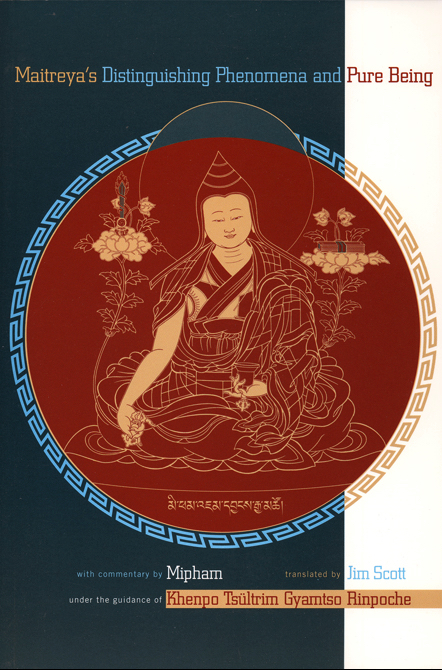
Distinguishing Phenomena and Pure Being was composed by Maitreya during the golden age of Indian Buddhism. Mipham's commentary supports Maitreya's text in a detailed analysis of how ordinary, confused consciousness can be transformed into wisdom. Easy-to-follow instructions guide the reader through the profound meditation that gradually brings about this transformation. This important and comprehensive work belongs on the bookshelf of any serious Buddhist practitioner—and indeed of anyone interested in realizing their full potential as a human being.
Ju Mipham Rinpoche (1846–1912) was a great master of the Nyingma lineage of Tibetan Buddhism and one of the leading figures in the Rime nonsectarian movement in Tibet. This text, along with Ju Mipham Rinpoche's commentary, is taught extensively throughout the world by Khenpo Tsultrim Gyamtso Rinpoche, who considers this text to be of pivotal importance. Jim Scott, a longtime student of Khenpo Tsultrim Gyamtso Rinpoche, translated this work at his request and under his guidance. (Source: Shambhala Publications)
| Citation | Scott, Jim, trans. Maitreya's Distinguishing Phenomena and Pure Being. With commentary by Mipham. Ithaca, NY: Snow Lion Publications, 2004. |
|---|---|
- Maitreya/Asaṅga (mgon po byams pa)/thogs med: chos dang chos nyid rnam par 'byed pa'i tshig le'ur byas pa (Dharmadharmatāvibhaṅgakārikā), Otani: (P5524), sems tsam, phi 51b6-54b7 (vol.108, p.22-24) (Tōh. 4023), sems tsam, phi 50b1-53a7. (N) phi 45b3-48b2. (Kinsha) 3523, phi 59b1 (p.31-2-1). In bstan 'gyur (sde dge), Vol. 123: 91-98. Delhi: delhi karmapae choedhey, gyalwae sungrab partun khang, 1982-1985.

- Mi pham rgya mtsho, (Chos dang chos nyid rnam par 'byed pa'i tshig le'ur byas pa'i 'grel pa ye shes snang ba rnam 'byed). In Sde-dge dgon-chen Prints of the Writings of 'Jam-mgon 'Ju Mi-pham-rgya-mtsho, ed. Dilgo Khyentse, vol. 4, 609-657. Kathmandu: Shechen Monastery,1990.