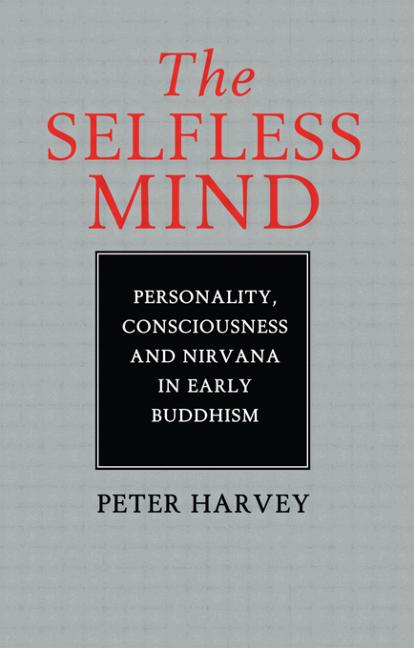
This careful analysis of early Buddhist thought opens out a perspective in which no permanent Self is accepted, but a rich analysis of changing and potent mental processes is developed. It explores issues relating to the not-Self teaching: self-development, moral responsibility, the between-lives period, and the 'undetermined questions' on the world, on the 'life principle' and on the liberated one after death. It examines the 'person' as a flowing continuity centered on consciousness or discernment (vinnana) configured in changing minds-sets (cittas). The resting state of this is seen as 'brightly shining' - like the 'Buddha nature' of Mahayana thought - so as to represent the potential for Nirvana. Nirvana is then shown to be a state in which consciousness transcends all objects, and thus participates in a timeless, unconditioned realm. (Source: Routledge)
See especially chapter 10, Bhavaṅga and the Brightly Shining Mind.
| Citation | Harvey, Peter. The Selfless Mind: Personality, Consciousness and Nirvāṇa in Early Buddhism. London: RoutledgeCurzon, 2004. First published 1995 by Curzon Press. http://www.ahandfulofleaves.org/documents/The%20Selfless%20Mind_Personality_Consciousness%20and%20Nirvana%20in%20Early%20Buddhism_Harvey_1995-2004r.pdf. |
|---|---|
- INTRODUCTION1
- Key non-Buddhist concepts1
- Key Buddhist concepts2
- 'Not-Self' and scholars7
- Sources9
- Methodology11
- 1. THE QUESTION OF SELF17
- Scholars who see a metaphysical Self in the 'early Suttas'17
- Uses of the word 'self' (atta) in the 'early Suttas'19
- Passages which might indicate the acceptance of a Self21
- Nibbāna as not-Self and not related to a Self23
- Self as 'not being apprehended'24
- A Self beyond 'existence' and 'non-existence'?28
- Proof of the impossibility of a Self31
- Buddhism and the Upaniṣads on Self33
- The status of the 'person'34
- Why is Self not denied?: the Buddha and the
Annihilationists38 - The 'I am' attitude: its cause, effect and its ending40
- 2 THE MEANING OF 'NOT-SELF'43
- The role of viewing phenomena as not-Self 43
- The criteria for Self-hood46
- Nibbāna and the Self-ideal51
- 3 DEVELOPING A SELF WITHOUT BOUNDARIES54
- Living with citta as an 'island'54
- Developing a 'great self'55
- 'One of developed self' 57
- The Arahat as self-contained and 'dwelling alone'58
- The Arahat's boundaryless citta60
- The Arahat's boundaryless, self-contained self62
