|
|
| (20 intermediate revisions by the same user not shown) |
| Line 1: |
Line 1: |
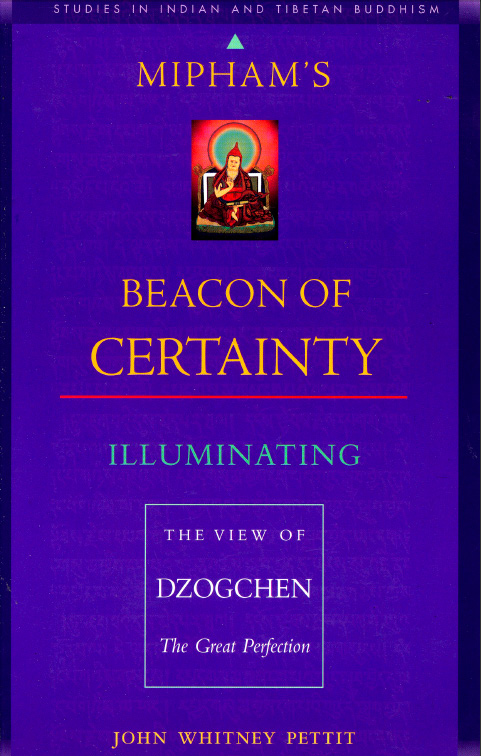
| {{Book | | {{Book |
| |BookPerson={{Book-person | | |BookPerson={{Book-person |
| |PersonPage=mi pham rgya mtsho | | |PersonPage=Pettit, J. |
| | |PersonName=John W. Pettit |
| | }}{{Book-person |
| | |PersonPage=Mi pham rgya mtsho |
| |PersonName=Mipam Gyatso | | |PersonName=Mipam Gyatso |
| }}{{Book-person
| |
| |PersonPage=Pettit, J.
| |
| |PersonName=John Pettit
| |
| }} | | }} |
| |FullTextRead=No | | |FullTextRead=No |
| Line 11: |
Line 11: |
| * {{i|Acknowledgments|''xi''}} | | * {{i|Acknowledgments|''xi''}} |
| * {{i|Source Abbreviations|''xv''}} | | * {{i|Source Abbreviations|''xv''}} |
| * {{i|Annotations, Diacritics, and Transcription|''xvii''}} | | * {{i|Annotations, Diacritics, and Transcription|''xvii''}}<br><br> |
|
| |
|
| * {{i|1. INTRODUCTION|1}} | | * {{i|1. INTRODUCTION|1}} |
| * {{i|1.1 Mipham Rinpoche and the Beacon ofCertainty|1}} | | * {{i|1.1 Mipham Rinpoche and the Beacon of Certainty|1}} |
| * {{i|1.2 Outline|2}} | | * {{i|1.2 Outline|2}} |
| * {{i|1.3 The Beacon ofCertainty: Context and Significance|2}} | | * {{i|1.3 The Beacon of Certainty: Context and Significance|2}} |
| * {{i|1.3.1 Dialectical Philosophy and the Great Perfection|2}} | | * {{i|1.3.1 Dialectical Philosophy and the Great Perfection|2}} |
| * {{i|1.3.2 The Beacons Purpose|5}} | | * {{i|1.3.2 The Beacons Purpose|5}} |
| * {{i|1.3.3 The Beacons Comparative Method|6}} | | * {{i|1.3.3 The Beacons Comparative Method|6}} |
| * {{i|1.4 Methods and Sources|7}} | | * {{i|1.4 Methods and Sources|7}} |
| * {{i|1.4.1 Tibetan Language Sources|8}} | | * {{i|1.4.1 Tibetan Language Sources|8}} |
| * {{i|1.4.1.1 Editions of the Beacon|8}} | | * {{i|1.4.1.1 Editions of the Beacon|8}} |
| * {{i|1.4.2 English Language Sources|11}} | | * {{i|1.4.2 English Language Sources|11}} |
| * {{i|1.5 The Contributions of this Work|14}} | | * {{i|1.5 The Contributions of this Work|14}}<br><br> |
|
| |
|
| * {{i|2. THE LIFE AND WORKS OF MIPHAM RINPOCHE|19}} | | * {{i|2. THE LIFE AND WORKS OF MIPHAM RINPOCHE|19}} |
| * {{i|2.1 Accounts of Mipham’s Life|22}} | | * {{i|2.1 Accounts of Mipham’s Life|22}} |
| * {{i|2.2 The Essential Hagiography<br> | | * {{i|2.2 The ''Essential Hagiography'' by mKhan chen Kun bzang dpal ldan|23}}<br><br> |
| by mKhan chen Kun bzang dpal ldan|23}}
| |
|
| |
|
| * {{i|3. Indo-Tibetan Buddhism: An Overview|41}} | | * {{i|3. INDO-TIBETAN BUDDHISM: AN OVERVIEW|41}} |
| * {{i|3.1 Historical and Philosophical Dimensions of Buddhism|41}} | | * {{i|3.1 Historical and Philosophical Dimensions of Buddhism|41}} |
| * {{i|3.2 Hinayäna and Mahäyäna|42}} | | * {{i|3.2 Hīnayāna and Mahāyāna|42}} |
| * {{i|3.3 Important Teachings of Mahäyäna Scriptures|45}} | | * {{i|3.3 Important Teachings of Mahāyāna Scriptures|45}} |
| * {{i|3.3.1 Prajnäpäramitä|45}} | | * {{i|3.3.1 Prajñāpāramitā|45}} |
| * {{i|3.3.2 The Samdhinirmocana and the “Essence Sütras”|47}} | | * {{i|3.3.2 The ''Saṃdhinirmocana'' and the "Essence Sūtras"|47}} |
| * {{i|3.3.3 Sources for Buddhist Hermeneutics|49}} | | * {{i|3.3.3 Sources for Buddhist Hermeneutics|49}} |
| * {{i|3.4 Traditions of Indian Madhyamaka|51}} | | * {{i|3.4 Traditions of Indian Madhyamaka|51}} |
| * {{i|3.4.1 Origins of Prasahgika and Svätantrika Madhyamaka|52}} | | * {{i|3.4.1 Origins of Prāsaṅgika and Svātantrika Madhyamaka|52}} |
| * {{i|3.4.2 Yogäcära and the Yogäcära Madhyamaka Synthesis|55}} | | * {{i|3.4.2 Yogācāra and the Yogācāra Madhyamaka Synthesis|55}} |
| | | * {{i|3.4.3 Madhyamaka and Pramāṇa|57}} |
| | | * {{i|3.5 Vajrayāna: Buddhist Tantra|60}} |
| * {{i|3.4.3 Madhyamaka and Pramäna|57}} | |
| * {{i|3.5 Vajrayäna: Buddhist Tantra|60}} | |
| * {{i|3.5.1 Indian Origins|60}} | | * {{i|3.5.1 Indian Origins|60}} |
| * {{i|3.5.2 Philosophical Dimensions of Tantra|62}} | | * {{i|3.5.2 Philosophical Dimensions of Tantra|62}} |
| * {{i|3.5.3 Styles ofTantric Practice|68}} | | * {{i|3.5.3 Styles of Tantric Practice|68}}<br><br> |
| * {{i|4. Tibetan Buddhist Traditions and the Great Perfection|71}} | | |
| | * {{i|4. TIBETAN BUDDHIST TRADITIONS AND THE GREAT PERFECTION|71}} |
| * {{i|4.1 The Yarlung Empire and the Introduction of Buddhism|72}} | | * {{i|4.1 The Yarlung Empire and the Introduction of Buddhism|72}} |
| * {{i|4.2 Early Nyingma Teachers and Texts|74}} | | * {{i|4.2 Early Nyingma Teachers and Texts|74}} |
| Line 57: |
Line 55: |
| * {{i|4.2.2.3 The Three Classes of Great Perfection|79}} | | * {{i|4.2.2.3 The Three Classes of Great Perfection|79}} |
| * {{i|4.2.24 Great Perfection in Practice|80}} | | * {{i|4.2.24 Great Perfection in Practice|80}} |
| * {{i|4.2.3 The Great Perfection | | * {{i|4.2.3 The Great Perfection in Comparative Philosophical Texts|81}} |
| in Comparative Philosophical Texts|81}} | | * {{i|4.2.3.1 Ch’an and the Great Perfection in the bSam gtan mig sgron|82}} |
| * {{i|4.2.3.1 Ch’an and the Great Perfection | |
| in the bSam gtan mig sgron|82}} | |
| * {{i|4.2.3.2 Other Early Doxographies|84}} | | * {{i|4.2.3.2 Other Early Doxographies|84}} |
| * {{i|4.3 The New Translation Period | | * {{i|4.3 The New Translation Period and the Nyingma Tradition|86}} |
| and the Nyingma Tradition|86}} | | * {{i|4.3.1 Rong zom Paṇḍita|88}} |
| * {{i|4.3.1 Rong zom Pandita|88}} | |
| * {{i|4.3.2 The Rise of Scholasticism|91}} | | * {{i|4.3.2 The Rise of Scholasticism|91}} |
| * {{i|4.3.3 Klong chen rab ’byams|92}} | | * {{i|4.3.3 Klong chen rab 'byams|92}} |
| * {{i|4.3.4 Nyingma Monasticism | | * {{i|4.3.4 Nyingma Monasticism and the Ecumenical Movement (''ris med'')|97}} |
| and the Ecumenical Movement (ris med)|97}} | | * {{i|4.3.5 A Nyingma Philosophy?|98}}<br><br> |
| * {{i|4.3.5 A Nyingma Philosophy?|98}} | | |
| * {{i|5. Philosophical Distinctions of Mipham’s Thought|101}} | | * {{i|5. PHILOSOPHICAL DISTINCTIONS OF MIPHAM'S THOUGHT|101}} |
| * {{i|5.1 The Gelug Philosophical Tradition|101}} | | * {{i|5.1 The Gelug Philosophical Tradition|101}} |
| * {{i|5.2 Theory, Practice, and Ultimate Reality|104}} | | * {{i|5.2 Theory, Practice, and Ultimate Reality|104}} |
| * {{i|5.3 Valid Cognition and Philosophical Analysis|107}} | | * {{i|5.3 Valid Cognition and Philosophical Analysis|107}} |
| * {{i|5.4 The Philosophy of Extrinsic Emptiness|111}} | | * {{i|5.4 The Philosophy of Extrinsic Emptiness|111}} |
| * {{i|5.5 Mipham’s Interpretation of Extrinsic Emptiness | | * {{i|5.5 Mipham’s Interpretation of Extrinsic Emptiness and Tathāgatagarbha|114}} |
| and Tathägatagarbha|114}} | | * {{i|5.6 Mipham’s Position on the Tathāgatagarbha|117}}<br><br> |
| * {{i|5.6 Mipham’s Position on the Tathägatagarbha|117}} | | |
| * {{i|6. The Beacon ofCertainty|125}} | | * {{i|6. The ''Beacon of Certainty''|125}} |
| * {{i|6.1 Recapitulation of Earlier Discussions|125}} | | * {{i|6.1 Recapitulation of Earlier Discussions|125}} |
| | | * {{i|6.2 The Topics of the ''Beacon''|126}} |
| * {{i|6.2 The Topics of the Beacon|126}} | | * {{i|6.2.1 The ''Beacon'' and Tsongkhapa’s ''Eight Great Difficult Points''|128}} |
| * {{i|6.2.1 The Beacon and Tsongkhapa’s | |
| Eight Great Difficult Points|128}} | |
| * {{i|6.2.2 Some Observations on Topics 5, 6, and 7|130}} | | * {{i|6.2.2 Some Observations on Topics 5, 6, and 7|130}} |
| * {{i|6.3 View, Meditative Practice, | | * {{i|6.3 View, Meditative Practice, and Ultimate Reality in the ''Beacon''|133}} |
| and Ultimate Reality in the Beacon|133}} | | * {{i|6.3.I Anupakṣas and Pūrvapakṣas: An Overview|133}} |
| * {{i|6.3.I Anupaksas and Pürvapaksas: An Overview|133}} | |
| * {{i|6.3.1.1 Essential Issues and Arguments in Topics 1, 3, and 4|134}} | | * {{i|6.3.1.1 Essential Issues and Arguments in Topics 1, 3, and 4|134}} |
| * {{i|6.3.1.2 Go ram pa’s Analysis ofView | | * {{i|6.3.1.2 Go ram pa's Analysis of View and Meditation in the ''TSB''|136}} |
| and Meditation in the TSB|136}} | |
| * {{i|6.3.1.2.1 Go ram pa on the Ultimate View|137}} | | * {{i|6.3.1.2.1 Go ram pa on the Ultimate View|137}} |
| * {{i|6.3.1.2.2 Go ram pa on Meditative Practice |139}} | | * {{i|6.3.1.2.2 Go ram pa on Meditative Practice |139}} |
| * {{i|6.3.2 Topic 1: Philosophical View and Rational Negation|141}} | | * {{i|6.3.2 Topic 1: Philosophical View and Rational Negation|141}} |
| * {{i|6.3.2.1 Tsongkhapa on the Negandum and Its Substratum|141}} | | * {{i|6.3.2.1 Tsongkhapa on the Negandum and Its Substratum|141}} |
| * {{i|6.3.2.2 Mipham’s Theory of Negation|144}} | | * {{i|6.3.2.2 Mipham's Theory of Negation|144}} |
| * {{i|6.3.2.2.1 Negation and the Definition of the Ultimate|144}} | | * {{i|6.3.2.2.1 Negation and the Definition of the Ultimate|144}} |
| * {{i|6.3.2.2.2 Mipham’s Analysis of Negation in the MAZL|146}} | | * {{i|6.3.2.2.2 Mipham's Analysis of Negation in the ''MAZL''|146}} |
| * {{i|6.3.2.2.3 Mipham’s Theory of the Ultimate: | | * {{i|6.3.2.2.3 Mipham's Theory of the Ultimate: Gnosis and Coalescence|151}} |
| Gnosis and Coalescence|151}} | | * {{i|6.3.3 Topics 3 and 4: Tsongkhapa and Mipham on Modal Apprehension and<br>Analytical Reasoning|157}} |
| * {{i|6.3.3 Topics 3 and 4: Tsongkhapa and Mipham | | * {{i|6.3.3.1 Tsongkhapa on the Role of Conceptuality in Meditation|157}} |
| on Modal Apprehension and Analytical Reasoning|157}} | | * {{i|6.3.3.1.1 Yon tan rgya mtsho on Modal Apprehension and Analysis|160}}<br><br> |
| * {{i|6.3.3.1 Tsongkhapa on the Role | | |
| of Conceptuality in Meditation|157}} | | * {{i|7. ASCERTAINMENT (''nges pa'') AND CERTAINTY (''nges shes''):<br> SOME CONCLUSIONS|169}} |
| * {{i|6.3.3.1.1 Yon tan rgya mtsho | |
| on Modal Apprehension and Analysis|160}} | |
| * {{i|7. Ascertainment (nges pa) and Certainty (nges shes): | |
| Some Conclusions|169}}
| |
| * {{i|7.1 Mipham’s Place in Tibetan Philosophy|182}} | | * {{i|7.1 Mipham’s Place in Tibetan Philosophy|182}} |
| * {{i|7.2 Philosophical Texts and Human Relatedness|184}} | | * {{i|7.2 Philosophical Texts and Human Relatedness|184}}<br><br> |
| * {{i|8. The Translation of the Beacon of Certainty|187}} | | |
| | * {{i|8. THE TRANSLATION OF THE ''Beacon of Certainty''|187}} |
| * {{i|8.1 Terminology and Syntax|187}} | | * {{i|8.1 Terminology and Syntax|187}} |
| * {{i|8.2 Technical Terms|188}} | | * {{i|8.2 Technical Terms|188}} |
| * {{i|8.3 Proper Names|192}} | | * {{i|8.3 Proper Names|192}} |
| * {{i|8.4 On the Use and Disuse of Sanskrit Terms|192}} | | * {{i|8.4 On the Use and Disuse of Sanskrit Terms|192}} |
| * {{i|8.5 Outline of the Beacon and Khro shul ’jam rdor’s Commentary|193}} | | * {{i|8.5 Outline of the ''Beacon'' and Khro shul 'jam rdor's Commentary|193}} |
| * {{i|Abbreviations and Bibliography|193}} | | * {{i|Abbreviations and Bibliography|193}} |
| * {{i|Introduction|194}} | | * {{i|Introduction|194}} |
| * {{i|Topic 1|196}} | | * {{i|Topic 1|196}} |
|
| |
| * {{i|Topic 2|199}} | | * {{i|Topic 2|199}} |
| * {{i|Topic 3|203}} | | * {{i|Topic 3|203}} |
| Line 126: |
Line 113: |
| * {{i|Topic 6|219}} | | * {{i|Topic 6|219}} |
| * {{i|Topic 7|227}} | | * {{i|Topic 7|227}} |
| * {{i|Conclusion|237}} | | * {{i|Conclusion|237}}<br><br> |
|
| |
|
| 9. Stainless Light:
| | *{{i|9. STAINLESS LIGHT: A Commentary on the ''Beacon of Certainty''|241}} |
| * {{i|A Commentary on the Beacon ofCertainty|241}} | |
| * {{i|Topic 1|251}} | | * {{i|Topic 1|251}} |
| * {{i|Topic 2|271}} | | * {{i|Topic 2|271}} |
| Line 137: |
Line 123: |
| * {{i|Topic 6|345}} | | * {{i|Topic 6|345}} |
| * {{i|Topic 7|371}} | | * {{i|Topic 7|371}} |
| * {{i|Conclusion|404}} | | * {{i|Conclusion|404}}<br><br> |
| | |
| | * {{i|10. The LION'S ROAR PROCLAIMING EXTRINSIC EMPTINESS|415}}<br><br> |
|
| |
|
| * {{i|10. The Lion’s Roar Proclaiming Extrinsic Emptiness|415}} | | *Appendix: Explanatory Diagrams and Tables<br> |
| Appendix: Explanatory Diagrams and Tables | | *{{i|''Diagram 1'': Conceptuality and True Existence According to Go ram pa and<br>Mipham|429}} |
| * {{i|Diagram 1: Conceptuality and True Existence | | * {{i|''Diagram 2'': Conceptuality and True Existence According to Tsongkhapa|430}} |
| According to Go ram pa and Mipham|429}} | | * {{i|''Table 1'': Mipham's System of Four Pramāṇas|431}} |
| * {{i|Diagram 2: Conceptuality and True Existence | | * {{i|''Table 2'': Traditions, Two-truth Paradigms, and Their Sources|432}} |
| According to Tsongkhapa|430}} | | * {{i|''Table 3'' Pramāṇas and Their Paradigms of Truth and Negation|433}} |
| * {{i|Table 1: Mipham’s System of Four Pramânas|431}} | | * {{i|''Table 4'': The Role of Ascertainment and Conceptuality According to Mipham<br>and Gelug Philosophers|434}} |
| * {{i|Table 2: Traditions, Two-truth Paradigms, and Their Sources|432}} | | * {{i|''Notes to Tables''|435}} |
| * {{i|Table y Pramânas and Their Paradigms ofTruth and Negation|433}} | |
| * {{i|Table 4: The Role ofAscertainment and Conceptuality | |
| According to Mipham and Gelug Philosophers|434}} | |
| * {{i|Notes to Tables|435}} | |
| * {{i|Glossary of Technical Terms|439}} | | * {{i|Glossary of Technical Terms|439}} |
| * {{i|Notes|461}} | | * {{i|Notes|461}} |
| Line 156: |
Line 140: |
| * {{i|Index|557}} | | * {{i|Index|557}} |
| |AddRelatedTab=No | | |AddRelatedTab=No |
| | |StopPersonRedirects=No |
| }} | | }} |