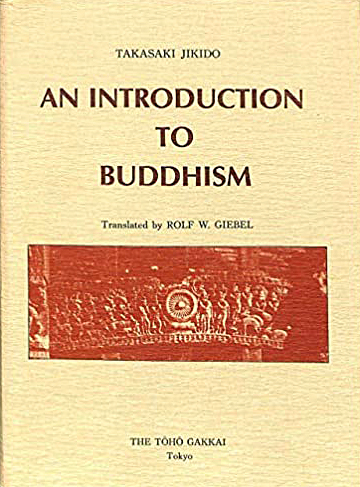
|
|
| Line 29: |
Line 29: |
| **{{i|The Theory of Three Bodies|68}} | | **{{i|The Theory of Three Bodies|68}} |
|
| |
|
| III. Dharma: The Buddhist Conception of Truth .......... 70 | | *{{i|III. Dharma: The Buddhist Conception of Truth|70}} |
| The Meanings of Dharma ... _:·:··:·····,··;····················· 70 | | **{{i|The Meanings of ''Dharma''|70}} |
| | **{{i|The Basis of the Teaching: Dependent Co-arising and the Four Noble Truths|76}} |
| | **{{i|Śākyamuni's: Philosophical Position: The Ten or Fourteen Unanswerables|85}} |
| | **{{i|"Dharma-seals": The Watchwords of Buddhism|89}} |
| | **{{i|''Saṃskāra'' and ''Dharma'': The Dependently Co-arisen|96}} |
| | **{{i|''Dharmatā'': The Principle of Dependent Co-arising|100}} |
| | **{{i|The Conception· of Truth in Mahāyāna Buddhism|104}} |
| | **{{i|Supreme Truth and Conventional Truth|105}} |
|
| |
|
| The Basis of the Teaching: Dependent Co-arising and the Four Noble Truths ................................. 76 | | *{{i|IV. ''Sarva-dharmāh'': The Constituent Elements of Existence|107}} |
| Sakyamunis: Philosophical Position:. The· Ten or Fourteen Unanswerables .. .' .................................... 85
| | **{{i|The Classification of the Constituent Elements of Existence in the Early Canon: The Five Aggregates, Twelve Sense-Fields, and Eighteen Realms|107}} |
| "Dharma-seals"·:· The Watchwords of Buddhism ...... 89
| | **{{i|The Sarvāstivādin Classification of the Constituent Elements of Existence: The Five Categories and Seventy-five Elements|114}} |
| Sarrz,skara and Dharma: The Dependently Co-arisen... 96
| | **{{i|The Sarvāstivādin Theory of the Elements: The Elements Exist Eternally|120}} |
| Dharmata: The Principle of Dependent· Co-arising ... 100
| | **{{i|The Mahāyānist Conception of the Elements: All is Empty|126}} |
| The Conception· of Truth in Mahayana Buddhism ...... 104 | |
| Supreme Truth and Conventional Truth .. ·······••p••·····l05
| |
|
| |
|
| IV. Sarva-dharmab,: The Constituent Elements of Existence . .· 107
| | *{{i|V. Transmigration, Karma, and Mental Defilements|128}} |
| The Classification of the Constituent Elements of Existence in the- Early Canon: The Five Aggregates, Twelve Sense-Fields, and Eighteen Realms 107 | | **{{i|Transmigratory Existence: The Three Realms and Six Paths|128}} |
| | **{{i|Karma|137}} |
| | **{{i|Mental Defilements|141}} |
| | **{{i|The Twelvefold Chain of Dependent Co-arising|149}} |
|
| |
|
| The Sarvastivadin Classification of the Constituent Elements of :Existence: The Five Categories and Seventy-five Elements·····.···· ......................... .114
| | *{{i|VI. The Path to Enlightenment|163}} |
| | | **{{i|Nirvāṇa and Enlightenment|163}} |
| The Sarvastivadin Theory of the Elements: The Elements Exist Eternally .................... -.................. 120
| | **{{i|The Mahāyānist Conception of Nirvāṇa|168}} |
| | | **{{i|The Path to Enlightenment|170}} |
| The Mahayanist Conception of the Elements: All is Empty ······:··········••.•······:·································126
| | **{{i|The Noble Eightfold Path|172}} |
| | | **{{i|The Three Disciplines: Morality, Meditation, and Wisdom|174}} |
| V. Transmigration, Karma, and Mental Defilements ...... 128
| | **{{i|Faith and Practice|188}} |
| Transmigrat6ry Existence: The Three Realms and Six Paths .. : .. . ................... .-.........................•...... 128
| | **{{i|Practices for· the Welfare of Others|191}} |
| | | **{{i|The Practices of the Bodhisattva: The Six Perfections|193}} |
| Karma ....... ;· ................................. ··'·,·•·;••·················137
| |
| Mental Defilements ................................................ 141
| |
| The Twelvefold Chain of _Dependent Co-aril:)ing ... -...... 1,49
| |
| | |
| VI. The Path to Enlightenment.. ................ · ..... ; ......... 163 | |
| Nirva.I}.a .and Enlightenment ..•... :\ ............................. 163
| |
| The Mahayanist Concepti9n of Nirva]).a .................... 168 | |
| The Path to Enlightenment ....... ... J.:.' ....................... 170 | |
| The Noble Eightfold Path ...... . :·.: • ............................ 172 | |
| The Three Disciplines: Mo;ality, Meditation, and Wisdom ... : .. : ......... : .. :.:: .. : ..... :.':.' ... ::. ................... 174 | |
| Faith and Practice ....... : . ........... : . . .'.'.' ..... :. ................... 188 | |
| Practices for· the Welfare of Others ... .. :.· .................... 191 | |
| The· Practices of the Bodhisattva: . The Six Perfections ............................... : . .-: ...................... 193
| |
|
| |
|
| VII. Mind: The Agency of Practice .. , .... :······ .. ···········198 | | VII. Mind: The Agency of Practice .. , .... :······ .. ···········198 |
Lua error in Module:GetBookValue at line 1: Module:BookData returned boolean, table expected.
| Citation
|
Lua error in Module:GetBookValue at line 1: Module:BookData returned boolean, table expected.
|
|
|
|
- Preface to the English Versioniii
- A Note on Foreign Wordsviii
- Introduction: What is Buddhism?1
- Buddha, Dharma, and Saṃgha: The Three Constituents of Buddhism3
- Taking Refuge in the Three Treasures5
- The Absolute Nature of the Dharma8
- Mahāyāna and Hīnayāna: The "Greater" and "Lesser" Vehicles11
- The Buddhist Canon (tri-piṭaka)16
- I. The Life of Śākyamuni23
- The Buddha Śākyamuni23
- Biographies of the Buddha25
- Birth and Renunciation28
- Austerities and Enlightenment31
- The Beginnings of Śākyamuni's Teaching Ministry: His First Sermon34
- Dissemination of the Teaching and the Growth of the Community38
- The Great Decease42
- Erection of Stūpas and the First Council45
- II. The True Nature of the Buddha49
- Designations of the Buddha50
- Buddha and Tathāgata53
- The Former Lives of the Buddha55
- The Buddhas of the Three Ages59
- The Buddhas of the Ten Directions61
- Material Body and Dharma-Body64
- The Theory of Three Bodies68
- III. Dharma: The Buddhist Conception of Truth70
- The Meanings of Dharma70
- The Basis of the Teaching: Dependent Co-arising and the Four Noble Truths76
- Śākyamuni's: Philosophical Position: The Ten or Fourteen Unanswerables85
- "Dharma-seals": The Watchwords of Buddhism89
- Saṃskāra and Dharma: The Dependently Co-arisen96
- Dharmatā: The Principle of Dependent Co-arising100
- The Conception· of Truth in Mahāyāna Buddhism104
- Supreme Truth and Conventional Truth105
- IV. Sarva-dharmāh: The Constituent Elements of Existence107
- The Classification of the Constituent Elements of Existence in the Early Canon: The Five Aggregates, Twelve Sense-Fields, and Eighteen Realms107
- The Sarvāstivādin Classification of the Constituent Elements of Existence: The Five Categories and Seventy-five Elements114
- The Sarvāstivādin Theory of the Elements: The Elements Exist Eternally120
- The Mahāyānist Conception of the Elements: All is Empty126
- V. Transmigration, Karma, and Mental Defilements128
- Transmigratory Existence: The Three Realms and Six Paths128
- Karma137
- Mental Defilements141
- The Twelvefold Chain of Dependent Co-arising149
- VI. The Path to Enlightenment163
- Nirvāṇa and Enlightenment163
- The Mahāyānist Conception of Nirvāṇa168
- The Path to Enlightenment170
- The Noble Eightfold Path172
- The Three Disciplines: Morality, Meditation, and Wisdom174
- Faith and Practice188
- Practices for· the Welfare of Others191
- The Practices of the Bodhisattva: The Six Perfections193
VII. Mind: The Agency of Practice .. , .... :······ .. ···········198
No-self and Subjective Agency ................................. 198
Mind (citta, manas, and vijfiana) ........ : ...... ;: .......... 200
Mind-only and Cognition-only ................................. -205
The 'Innately Pure Mind arid the · . .Embryo of the Tathagata ............................... : .. : .. ; .................... 215
Enlightenment a:nd-Salvation.:.: ....•..... ·J ••• •••••••••••••••••• 223
VIII. The Ideal Practitioner ..............•..... , .................. 227
The Concept "Man" ............ '.,. ............................... 227
Ordinary Man and Holy Mari' ................................. 228
The Stages ,of the Bodhisattv:a ...•.. ; ............ :: ................ 233
"One V ehide" and "Three V hicles" .: ..................... 240
IX. The Precepts and the Organization of th, Community .246
The Meaning of Sa'T[l,gha ............... ;.; ..................... 246
The Organization of the Community ........................ 250
Community Regulations .......................................... 255
X The History of Buddhism .................................... 263
1. Buddhism in India and the Surrounding Lands ...... 264
The Basic Schism ..................................... : .... 264
The Mauryan Dynasty and Dissemination to Sri Lanka ................................................... 266
The Kushan Dynasty and the Northern Tradition of Buddhism .......................... .,-: ..... 267
The Characteristics of Schismatic Buddhism ...... 268
The Birth of Mahayana Buddhism .................. 269
The Madhyamika and Y ogacara Schools ......... 270
The Age of Esoteric Buddhism ........................ 272
Tibetan Buddhism .......................................... 275
The Southern Tradition of Buddhism ............... 277
The Revival of Buddhism in India .................. 278
2. Chinese Buddhism ............................................. 279
The Introduction of Buddhism ........................ 279
Buddhism Takes Root: The Period of the Northern and Southern Dynasties .................. 280
The Establishment of Chinese Buddhism: The Sui and T'ang Dynasties ...................... 283
Subsequent Developments ................................ 290
3. Korean Buddhism .................... : ...................... .' .. 290
4.Japanese Buddhism .......................................... 293
The Introduction of Buddhism and Prince Shotoku ..................................................... 293
The Sects of the Nara Period ......................... 294
The Tendai and Shingon Sects ........................ 297
The Rise of the Pure Land Teachings ............. 300
The Introduction of the Zen Sects .................. 301
The Nichiren and Ji Sects .............................. 303
Buddhism since the Muromachi Period ............ 305
Sources .................................................................. 309
Select Bibliography ................................................... 315
General Index .............................................•... -........ 325
Character Index· ....................................................... 352
The Author; the Translator ....................................... 375

Lua error in Module:GetBookValue at line 1: Module:BookData returned boolean, table expected.
[[Category:Lua error in Module:GetBookValue at line 1: Module:BookData returned boolean, table expected.]][[Category:Lua error in Module:GetBookValue at line 1: Module:BookData returned boolean, table expected.]][[Category:Lua error in Module:GetBookValue at line 1: Module:BookData returned boolean, table expected.]]<ul><li>"Lua error in Module:GetBookValue at line 1: Module:BookData returned boolean, table expected." is not recognized as a Boolean (true/false) value.</li> <!--br--><li>Property "Frontcoverimg" (as page type) with input value "Lua error in Module:GetBookValue at line 1: Module:BookData returned boolean, table expected." contains invalid characters or is incomplete and therefore can cause unexpected results during a query or annotation process.</li> <!--br--><li>Property "BuNayAuthor" (as page type) with input value "Lua error in Module:GetBookValue at line 1: Module:BookData returned boolean, table expected." contains invalid characters or is incomplete and therefore can cause unexpected results during a query or annotation process.</li> <!--br--><li>Property "Translator" (as page type) with input value "Lua error in Module:GetBookValue at line 1: Module:BookData returned boolean, table expected." contains invalid characters or is incomplete and therefore can cause unexpected results during a query or annotation process.</li> <!--br--><li> "Lua error in Module" has not been listed as valid URI scheme.</li> <!--br--><li>"Lua error in Module:GetBookValue at line 1: Module:BookData returned boolean, table expected." is not in the list (Definitive, Provisional) of allowed values for the "PosBuNayDefProv" property.</li> <!--br--><li>"Lua error in Module:GetBookValue at line 1: Module:BookData returned boolean, table expected." is not in the list (Yes, No, Qualified Yes, Qualified No) of allowed values for the "PosAllBuddha" property.</li> <!--br--><li>"Lua error in Module:GetBookValue at line 1: Module:BookData returned boolean, table expected." is not in the list (First Turning, Second Turning, Third Turning, (Fourth Turning)) of allowed values for the "PosWheelTurn" property.</li> <!--br--><li>"Lua error in Module:GetBookValue at line 1: Module:BookData returned boolean, table expected." is not in the list (Yogācāra, Madhyamaka) of allowed values for the "PosYogaMadhya" property.</li> <!--br--><li>"Lua error in Module:GetBookValue at line 1: Module:BookData returned boolean, table expected." is not in the list (Zhentong, Rangtong) of allowed values for the "PosZhenRang" property.</li> <!--br--><li>"Lua error in Module:GetBookValue at line 1: Module:BookData returned boolean, table expected." is not in the list (0, 1, 2, 3, 4, 5, 6, 7, 8, 9) of allowed values for the "PosVehicles" property.</li> <!--br--><li>"Lua error in Module:GetBookValue at line 1: Module:BookData returned boolean, table expected." is not in the list (Analytic Tradition, Meditative Tradition) of allowed values for the "PosAnalyticMedit" property.</li> <!--br--><li>"Lua error in Module:GetBookValue at line 1: Module:BookData returned boolean, table expected." is not in the list (Tathāgatagarbha as the Emptiness That is a Non-implicative Negation (without enlightened qualities), Tathāgatagarbha as the Emptiness That is an Implicative Negation (with enlightened qualities), Tathāgatagarbha as Mind's Luminous Nature, Tathāgatagarbha as the Unity of Emptiness and Luminosity, Tathāgatagarbha as a Causal Potential or Disposition (gotra), Tathāgatagarbha as the Resultant State of Buddhahood, Tathāgatagarbha as the Latent State of Buddhahood that is Obscured in Sentient Beings, There are several types of Tathāgatagarbha, Tathāgatagarbha was Taught Merely to Encourage Sentient Beings to Enter the Path) of allowed values for the "PosEmptyLumin" property.</li> <!--br--><li>"Lua error in Module:GetBookValue at line 1: Module:BookData returned boolean, table expected." is not in the list (Svātantrika (རང་རྒྱུད་), Prāsaṅgika (ཐལ་འགྱུར་)) of allowed values for the "PosSvataPrasa" property.</li> <!--br--><li>Property "BuNayPublisher" (as page type) with input value "Lua error in Module:GetBookValue at line 1: Module:BookData returned boolean, table expected." contains invalid characters or is incomplete and therefore can cause unexpected results during a query or annotation process.</li> <!--br--><li>Property "BuNayTopicTags" (as page type) with input value "Lua error in Module:GetBookValue at line 1: Module:BookData returned boolean, table expected." contains invalid characters or is incomplete and therefore can cause unexpected results during a query or annotation process.</li></ul>