No edit summary |
No edit summary |
||
| Line 71: | Line 71: | ||
*'''Chapter Five: Mahāyāna, ''Bodhisattva'', and ''Bodhicitta'' ''' | *'''Chapter Five: Mahāyāna, ''Bodhisattva'', and ''Bodhicitta'' ''' | ||
*{{i|1. Introductory Remarks|107}} | *{{i|1. Introductory Remarks|107}} | ||
*{{i|2. The Concepts of ''Yāna'' in Buddhism|109}} | *{{i|2. The Concepts of ''Yāna'' in Buddhism|109}} | ||
| Line 88: | Line 89: | ||
***{{i|((iii) Is Mahāyāna Indispensable? Is Vajrayāna Indispensable?|125}} | ***{{i|((iii) Is Mahāyāna Indispensable? Is Vajrayāna Indispensable?|125}} | ||
*{{i|(3. The Concepts of ''Sattva'' and ''Bodhisattva''|126}} | *{{i|(3. The Concepts of ''Sattva'' and ''Bodhisattva''|126}} | ||
(a) No Bodhisattvas without Sattvas | **{{i|(a) No ''Bodhisattvas'' without ''Sattvas''|127}} | ||
(b) Faith-oriented and Reason-oriented Sentient Beings | **{{i|(b) Faith-oriented and Reason-oriented Sentient Beings|128}} | ||
(c) The Term Bodhisattva | **{{i|(c) The Term ''Bodhisattva''|129}} | ||
(d) Synonyms of Bodhisattva | **{{i|(d) Synonyms of ''Bodhisattva''|133}} | ||
(e) Types of Bodhisattvas | **{{i|(e) Types of ''Bodhisattvas''|134}} | ||
(i) Historical, Celestial, and Earthly Bodhisattvas.. | ***{{i|(i) Historical, Celestial, and Earthly ''Bodhisattvas''|135}} | ||
***{{i|(ii) Human and Non-human ''Bodhisattvas''|136}} | |||
***{{i|(iii) Male and Female ''Bodhisattvas''|137}} | |||
***{{i|(iv) Ordained and Lay ''Bodhisattvas''|139}} | |||
***{{i|(v) ''Bodhisattvas'' with Different Backgrounds|139}} | |||
**{{i|(f) The ''Śrāvaka-Bodhisattva'' Distinction|140}} | |||
**{{i|(g) The Concept of ''Vajrasattva''|142}} | |||
*{{i|4. The Term ''Bodhicitta'' and Its Definition|144}} | |||
**{{i|(a) The Term ''Bodhicitta'' in the ''Aṣṭasāhasrikā''|144}} | |||
**{{i|(b) The Term ''Bodhicitta'' in the ''Drumakinnararājaparipṛcchāsūtra''|145}} | |||
**{{i|(c) The Term ''Bodhicitta'' in the ''Bodhisattvabhūmi''|148}} | |||
**{{i|(d) The Relative Chronology of the ''Aṣṭasāhasrikā'' and the ''Bodhisattvabhūmi''|148}} | |||
**{{i|(e) The Terms ''Cittotpāda'', ''Bodhicitta'', and ''Bodhicittotpāda''|149}} | |||
**{{i|(f) Some Definitions of ''Bodhicitta'' or ''Cittotpāda''|151}} | |||
**{{i|(g) How Indispensable Is ''Bodhicitta'' for a ''Bodhisattva''?|154}} | |||
**{{i|(h) Benefits and Functions of ''Bodhicitta''|160}} | |||
*{{i|5. Concluding Remarks|166}} | |||
*'''Chapter Six: The Two ''Bodhicittotpāda'' Traditions''' | |||
*{{i|I. Introductory Remarks|169}} | |||
I. Introductory Remarks | |||
2. The Two Bodhicittotpada Traditions..................................................................... 170 | 2. The Two Bodhicittotpada Traditions..................................................................... 170 | ||
3. Tibetan Assessments of the Two Bodhicittotpada Traditions............................... 172 | 3. Tibetan Assessments of the Two Bodhicittotpada Traditions............................... 172 | ||
Revision as of 14:41, 10 August 2020
Becoming a buddha ('Awakened One') under the Bodhi tree (Ficus religiosa) was undoubtedly the most significant event in the career of the historical Buddha, and may be considered the starting point of Buddhism. According to both Mahāyāna ('Greater Vehicle') and Hīnayāna ('Lesser Vehicle') or non-Mahāyāna, the historical Buddha had sometime in the distant past resolved to become a buddha, thereby launching out on the career of a bodhisattva, that is, a sentient being who strives to attain the highest state of awakening. A major distinction between non-Mahāyāna and Mahāyāna, however, is that for the former the status of being a bodhisattva or buddha is confined to the historical Buddha (or a few others like him), while the ultimate soteriological goal of a disciple is Arhatship (that is, the final state of a saint who has attained release from the cycle of birth and death) primarily for oneself. For the latter, by contrast, even an ordinary sentient being is capable of undertaking the long and arduous career of a bodhisattva by generating bodhicitta and finally becoming a buddha (just like the historical Buddha himself), primarily for the sake of many other sentient beings. In sum, a person who possesses or has generated bodhicitta is considered to be a bodhisattva, and the form of Buddhism concerned with the theory and practice of a bodhisattva is known as Mahāyāna. The idea of bodhicitta in the sense of the resolve to become a buddha is hence the bedrock of Mahāyāna, and is what distinguishes a bodhisattva from a śrāvaka, Mahāyāna from non-Mahāyāna. It is presupposed by all forms of Mahāyāna Buddhism including Vajrayāna ('Diamond Vehicle'), or tantric Mahāyāna.
Multiple internal and external factors must have contributed to the formation and further development of the concept of bodhicitta. The psychological need of the Buddhists to make up in one way or another for the demise of the historical Buddha may have been one of the principal internal factors that contributed to the formation of the idea of the resolve to become a buddha. Such an idea would not have lacked the doctrinal justification or legitimisation that it needed, for the non-Mahāyāna sources seem to abound in doctrinal elements that could easily be used to underpin the concept of bodhicitta. In its early phase of development, the idea of generating bodhicitta probably meant only the initial resolve to become a buddha, a momentous decision made by an aspirant seeking Buddhahood (buddhatva). This was seen as an indispensable but not necessarily a sufficient condition for the attainment of Buddhahood. However, gradually the idea came to encompass the entire theory and practice of a bodhisattva and to be considered not only a necessary but in fact a sufficient condition for such an attainment. In the course of time, even the true reality that a bodhisattva or buddha experiences as a spiritual event, the meditative insight or gnosis by means of which the true reality is experienced, and all conceivable resources or means—be they psycho-physiological, visual, verbal, or visional impulses that could be employed for becoming a buddha—came to be regarded as bodhicitta. It is this idea as found explicated in Indian and Tibetan Mahāyāna Buddhism that the present study seeks to examine. (Wangchuk, introductory remarks, 21–22)
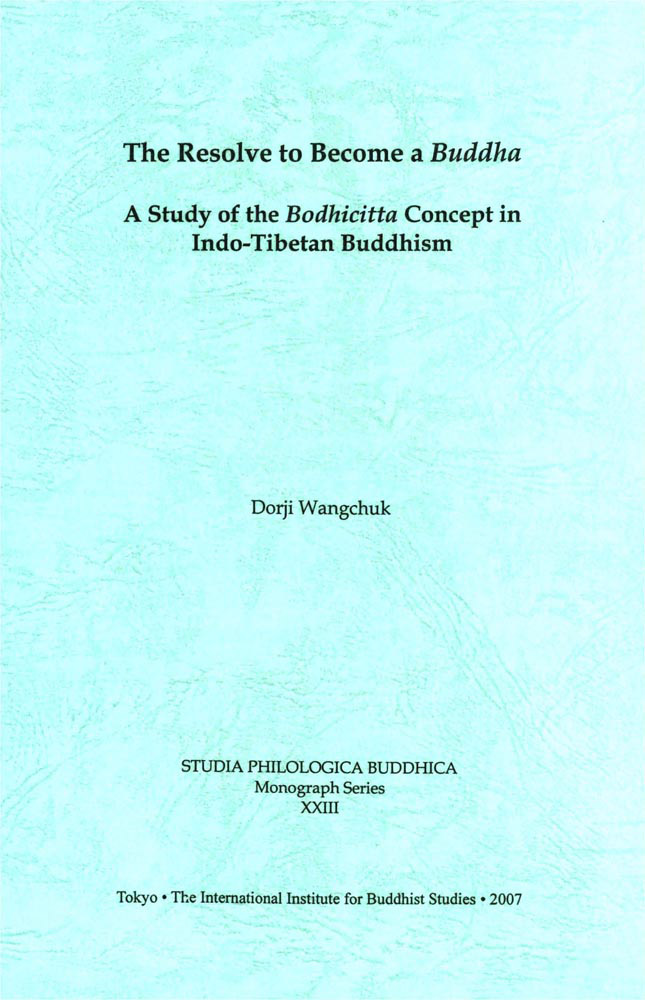
| Citation | Wangchuk, Dorji. The Resolve to Become a Buddha: A Study of the Bodhicitta Concept in Indo-Tibetan Buddhism. Studia Philologica Buddhica Monograph Series 23. Tokyo: International Institute for Buddhist Studies, 2007. https://dorjipenjore.files.wordpress.com/2014/08/the-resolve-to-become-a-buddha-a-study-of-the-bodhicitta-concept-in-indo-tibetan-buddhism.pdf. |
|---|---|
- Preface13
- Technical Note19
- Chapter One: A General Introduction: On Becoming a Buddha
- 1. Introductory Remarks21
- 2. Buddhology22
- 3. Buddhist Soteriology30
- 4. Ontology41
- 5. Buddhist Epistemology and Gnoseology43
- 6. Buddhist Axiology45
- (a) The Three-Vow Scheme45
- (b) Comparing and Contrasting the Three Vows47
- 7. Concluding Remarks56
- Chapter Two: Previous Studies on Bodhicitta
- 1. Introductory Remarks57
- 2. The Early Western Knowledge of Bodhicitta58
- 3. Monographs on the Study of Bodhicitta59
- (a) Taishū Tagami (1990)59
- (b) Francis Brassard (2000)60
- 4. Articles on Bodhicitta61
- (a) Kumataro Kawada (1965)61
- (b) Lal Mani Joshi (1971)62
- (c) S. K. Nanayakkara (1971)62
- (d) Lobsang Dargay (1981)63
- (e) Gareth Sparham (1987)63
- (f) Gareth Sparham (1992)64
- 5. Studies on Bodhicitta in Specific Canonical Works65
- 6. On Translating the Term Bodhicitta69
- 7. A Study of Bodhicitta: Still a Desideratum70
- 8. Concluding Remarks71
- Chapter Three: The Historical and Doctrinal Background of the Bodhicitta Concept
- 1. Introductory Remarks73
- 2. Bodhicitta as a Means of Compensating for the Loss of the Historical Buddha74
- 3. The Doctrinal Foundations of Bodhicitta in Early Buddhism77
- (a) A Buddha as a Discoverer and Proclaimer of the True Reality77
- (b) The Plurality of Buddhas and Bodhisattvas in Early Buddhism79
- (c) The Concept of the Resolve Made by Previous Buddhas80
- (d) The Altruism of the Historical Buddha82
- (e) Altruism in Early Buddhism84
- (f) Prerequisites for Becoming a Buddha in Early Buddhism86
- (g) The 'Golden Rule' in Early Buddhism87
- 4. Concluding Remarks89
- Chapter Four: The Buddha's First Resolve to Become a Buddha
- 1. Introductory Remarks91
- 2. The Historical Buddha as One of Many and Yet One of a Kind92
- 3. Three Events Marking the Career of the Buddha92
- (a) The First Event: The Initial Resolve to Become a Buddha94
- (i) Attempts to Resolve the Illogicality of Several 'First Times'98
- (ii) Was the Historical Bodhisattva 'King-Like' or 'Herdsman-Like'?99
- (b) The Second Event: Striving to Become a Buddha100
- (c) The Third Event: The Time and Place of the Buddha's Awakening102
- (a) The First Event: The Initial Resolve to Become a Buddha94
- 4. A Historical Sketch of the Buddha's Initial Resolve to Become a Buddha104
- 5. Concluding Remarks105
- Chapter Five: Mahāyāna, Bodhisattva, and Bodhicitta
- 1. Introductory Remarks107
- 2. The Concepts of Yāna in Buddhism109
- (a) The Various Models of Yāna110
- (i) The One-Vehicle Model111
- (ii) The Two-Vehicle Model112
- (iii) The Three-Vehicle Model113
- (iv) The Four-Vehicle Model115
- (v) The Five-Vehicle Model116
- (vi) The Nine-Vehicle Model117
- (vii) The n-Vehicle Model118
- (viii) The No-Vehicle Model119
- (b) Which Vehicles Are Buddhist?120
- (c) Mahāyāna121
- (a) The Various Models of Yāna110
- (3. The Concepts of Sattva and Bodhisattva126
- (a) No Bodhisattvas without Sattvas127
- (b) Faith-oriented and Reason-oriented Sentient Beings128
- (c) The Term Bodhisattva129
- (d) Synonyms of Bodhisattva133
- (e) Types of Bodhisattvas134
- (i) Historical, Celestial, and Earthly Bodhisattvas135
- (ii) Human and Non-human Bodhisattvas136
- (iii) Male and Female Bodhisattvas137
- (iv) Ordained and Lay Bodhisattvas139
- (v) Bodhisattvas with Different Backgrounds139
- (f) The Śrāvaka-Bodhisattva Distinction140
- (g) The Concept of Vajrasattva142
- 4. The Term Bodhicitta and Its Definition144
- (a) The Term Bodhicitta in the Aṣṭasāhasrikā144
- (b) The Term Bodhicitta in the Drumakinnararājaparipṛcchāsūtra145
- (c) The Term Bodhicitta in the Bodhisattvabhūmi148
- (d) The Relative Chronology of the Aṣṭasāhasrikā and the Bodhisattvabhūmi148
- (e) The Terms Cittotpāda, Bodhicitta, and Bodhicittotpāda149
- (f) Some Definitions of Bodhicitta or Cittotpāda151
- (g) How Indispensable Is Bodhicitta for a Bodhisattva?154
- (h) Benefits and Functions of Bodhicitta160
- 5. Concluding Remarks166
- Chapter Six: The Two Bodhicittotpāda Traditions
- I. Introductory Remarks169
2. The Two Bodhicittotpada Traditions..................................................................... 170 3. Tibetan Assessments of the Two Bodhicittotpada Traditions............................... 172 4. The Names of the Two Bodhicittotpada Traditions............................................... 173 5. The Two Bodhicittotpada Traditions: The Basis of the Distinctions .................... 175 6. The Two Bodhicittotpada Traditions: Personal Authorities ................................. 175 7. The Two Bodhicittotpada Traditions: Scriptural Authorities................................ 176 8. The Historical Background of the Bodhicittotpada RituaL.................................. 177 9. What Is Actually Generated by the Ritual?............................................................ 180 10. The Optionality of an Officiant in the Two Traditions.................................. ........ 181 11. Qualifications for Officiants in the Two Traditions............................................... 182 12. The Eligibility of Candidates in the Two Traditions.............................................. 183 13. The Preparatory Procedures of the Bodhicittotpada Ritual................................... 186 14. The Main Procedures of the Bodhicittotpada RituaL.......................................... 187 15. The Concluding Procedures of the Bodhicittotpada Ritual................................... 188 16. Observances and Offences in the Two Traditions................................................. 188 (a) The Cardinal Transgressions in the Mafijusn-Nagiirjuna Tradition............ 189 (b) The Cardinal Transgressions in the Maitreya-Asailga Tradition.................. 191 (c) The Minor Offences in the Two Traditions.................................................. 192 17. Reestablishing a Broken Vow in the Two Traditions............................................ 193 18. Concluding Remarks.............................................................................................. 194 Chapter Seven: A Typology of Bodhicitta 1. Introductory Remarks............................................................................................. 195 2. An Overview of the Five Types of Bodhicitta........................................................ 196 3. Ethico-Spiritual Bodhicitta..................................................................................... 197 4. Gnoseological Bodhicitta....................................................................................... 198 (a) What Gnoseologicai Bodhicitta Is................................................................. 198 (b) Some Synonyms of Gnoseological Bodhicitta.............................................. 198 (c) Some Salient Features of Gnoseological Bodhicitta..................................... 199 (d) Who Possesses Gnoseological Bodhicitta?.................................................. 201 (e) Gnosis as Abiding in the Body...... ..... ................. ........ ......... ...... ................... 202
(f) The Three Modes of Emergence Open to Gnosis......................................... 204 5. Ontological Bodhicitta........................................................................................... 205 (a) The Conception of Ontological Bodhicitta................................................... 206 (b) An Outcome of a Philosophical Quest? ...... ........ ..... ......... ..... ........... ........... 211 (c) Synonyms and Near Synonyms of Ontological Bodhicitta........................... 214 (d) Two Distinct Perceptions of Ontological Bodhicitta.;.................................. 216 (e) Some Salient Features of Ontological Bodhicitta......................................... 217 6. Psycho-Physiological Bodhicitta............................................................................ 217 (a) What is Psycho-Physiological Bodhicitta?.................................................. 218 (b) Some Salient Features of Psycho-Physiological Bodhicitta......................... 220 ( c) Probable Motives for the Conception of Psycho-Physiological Bodhicitta.. 220 (d) The Problems of Physicality and Sexuality in Buddhism............................. 221 (e) Psycho-Physiological Bodhicitta in Yogic Practices.................................... 223 7. SemeiologicalBodhicitta....................................................................................... 225 (a) General Features of Bodhicitta Symbolism.................................................. 225 (b) Putting Symbolism in a Buddhist Philosophical Context... ....... ........ ........... 226 (c) Three Kinds of Semeiological Bodhicitta: Visual, Verbal, and VisionaL.. 227 (d) Vajrayana Symbolism and Literalism..... ............ ... ... ....... ... ...... ... ....... .......... 231 8. A Concluding Assessment of the Five Types of Bodhicitta.................................. 232 Chapter Eight: Traditional Classifications of Bodhicitta 1. Introductory Remarks....... ..... .... ........... .... ...... .......... ........... .... ........... ........ ... ....... ... 235 2. Bodhicitta as a Fusion of SunyatiilPrajfzii and KarUlJiiIUpiiya............................... 235 (a) The Term SunyatiikarUlJiigarbha.................................................................. 236 (b) The Term SunyatiikarUlJiibhinna................................................................... 238 (c) The Importance of Upiiya and Prajfzii ...................................................... ,.... 239 (d) Tension between the Two Poles of Emptiness and Compassion.................. 243 (e) Union of Emptiness and Compassion: A Tibetan Controversy.................... 245 (f) Three Positions on the Fusion of SunyatiilPrajfzii and KarUlJiiIUpiiya........ 245 3. SubclassifYing Bodhicitta into Praflidhicitta and Prasthiinacitta........................... 246 (a) The Locus Classicus of the Classification..................................................... 246 (b) The Possible Historical Development of the Subclassification.... ... ..... ........ 248 (c) The Pervasiveness of the Classification........................................................ 248 (d) Distinctions, Interpretations, and Controversies........................................... 249 4. SubclassifYing Bodhicitta into Conventional and Absolute................................... 251 (a) Two Strands of the Conventional-Absolute Classification........................... 252 (b) Textual Sources of the Conventional-Absolute Classification..................... 253 (c) The Relative Chronology of the Conventional-Absolute Classification....... 255 (d) Two Different Perceptions of Conventional and Absolute Bodhicitta......... 256 (e) Can Absolute Bodhicitta be Generated Ritually? A Tibetan Controversy.... 258 5. Leading to the Goal and Not Leading to the Goa1................................................. 261 6. A Stable One and an Unstable One........................................................................ 262 7. Twofold Classifications of Cittotpiida in the ViniscayasarrzgrahalJf..................... 263 (a) Samiidiinasiirrzketika and Dharmatiipratilambhika....................................... 263 (b) The One That Is Uncertain and the One That Is Certain. .... .... .... ... ........... .... 264 (c) The One That Is Impure and the One That Is Pure...... .... .............. ........ ... .... 264 (d) The One That Is Weak and the One That Is Strong...................................... 265 (e) The One That Has Yielded the Ultimate Result and the One That Has Not yet........................................................................................... 265 8. Undistinguished and Distinguished Cittotpiida...................................................... 266 9. The One Characterised by Karuflii and the One Characterised by Prajfzii............ 266
10. Ongoing and Non-Ongoing Cittotpiida............................................... ................... 267 11. A Threefold Classification: King-like, Boatman-like, and Herdsman-like.......... 267 (a) Some Indian Precursors of the Classification... ..... .... .... ......... ...... ..... .... ....... 268 (b) Assessments by Some Tibetan Scholars ................................. ,..................... 269 12. A Fourfold Classification....................................................................................... 271 13. SubclassifYing Bodhicitta into Ten Types.............................................................. 273 14. Twenty-Two Kinds of Cittotpiida.......................................................................... 273 (a) Sources of the Twenty-Two Kinds of Cittotpada......................................... 273 (b) A Historical Sketch...... ........... ........ ......... ......... ....... ..... ............... ........ ......... 274 15. Concluding Remarks.............................................................................................. 275 Chapter Nine: Causes and Conditions pertaining to Bodhicitta 1. Introductory Remarks.............................................................................................. 277 2. Causes and Conditions pertaining to Bodhicitta in the Sutra Sources.................... 277 3. Causes and Conditions pertaining to Bodhicitta in the Bodhisattvabhumi............ 279 4. Causes and Conditions pertaining to Bodhicitta in the MahayanasutraZa7}'lki'ira... 283 5. Causes and Conditions pertaining to Bodhicitta as Discussed Elsewhere.. ........... 284 6. Compassion as the Root Cause of Bodhicitta........................................................ 285 7. Concluding Remarks.............................................................................................. 289 Chapter Ten: The Mahayana Observances and the Maintenance ofBodhicitta 1. Introductory Remarks.............................................................................................. 291 2. The Model of the Four Cardinal Transgressions (miiZapatti).................................. 292 3. Pledges and the Maintenance of Bodhicitta in the Kriyatantras............................. 295 (a) The Vairocanabhisa7}'lbodhitantra................................................................ 296 (b) The Guhyatantra........................................................................................... 298 (c) The Susiddhikaratantra................................................................................. 300 (d) The Subahupariprcchatantra........................................................................ 303 4. Pledges and Maintenance of Bodhicitta in the Yogatantras.................................. 305 (a) The Durgatiparisodhanatantra..................................................................... 305 (b) The Vajrasikharatantra................................................................................. 307 (c) The Srfparamiidyatantra.......... ........... .... ...... ............ ..... ............................... 310 (d) The Tattvasa7}'lgrahasutra.................................................................. ........... 312 5. Pledges and the Maintenance of Bodhicitta in the Mahayoga System.................. 313 (a) The Buddhasamayogatantra ......................... ,............................................... 319 (b) The Kr$/Jayamaritantra and Guhyasamajabhi$ekavidhi............................... 320 (c) The GuhyendutiZakatantra............................................................................ 328 (d) The *Guhyagarbhatantra.............................................................................. 329 (e) Padmasambhava's Categories of Pledges..................................................... 329 6. All Mahayana Precepts Relating to the Maintenance of Bodhicitta...................... 330 7. Concluding Remarks.............................................................................................. 331 Chapter Eleven: The Relapse and Restoration of Bodhicitta 1. Introductory Remarks............................................................................................. 333 2. Impairment to or Loss of Bodhicitta...................................................................... 334 3. Causes of the Partial or Total Breach of Vows...................................................... 337 4. Causes of Impairment to or Loss of Bodhicitta...................................................... 338 5. The Abandonment of Bodhicitta as the Severest Transgression............................ 346 6. The Types of Setbacks ...................... ;.................................................................... 348
7. The Restorability of Bodhicitta ...................................... : ....... ;............................... 351 8. Retaking and Restoring Bodhicitta........................................................................ 352 9. The Four Strengths................................................................................................. 355 10. Concluding Remarks.............................................................................................. 356 Appendix A: A Critical Edition of the Sanskrit Text of Bodliisattvabhumi 1.2 1. Introduction............................................................................................................ 357 (a) Extant Manuscripts, Critical Editions, and Other Related Studies on the Bodhisattvabhumi.......................................... 357 (b) A Brief Description of the Extant Manuscripts and Editions....................... 362 (c) Some Observations as to the Stemmatic Relation of the MSS..................... 365 (d) Method and Abbreviations Employed in the Critical Edition of the Sanskrit Text.......................................................................... 366 2. The Text. ............................................................................................................... " 368 Appendix B: A Critical Edition of the Tibetan Text of Bodhisattvabhumi 1.2 1. Introduction........................................ ................ ........................... ......................... 379 2. The Text................................................................................................................. 382 Abbreviations and Bibliography 1. Journals, Collections, Reference Books, Series, and Other Abbreviations............ 391 2. Indian Sources........................................................................................................ 393 3. Tibetan Sources...................................................................................................... 404 4. Secondary Sources................................................................................................. 411 Index............................................................................................................................... 431
