- Introduction1
- I Getting Started on the Path
- 1 The Ten Steps — Graglia 201212
- 2 The Dangers of Skipping Ngöndro — Bologna 201427
- II The Common Preliminary Practices
- 3 The Four Thoughts — Graglia 201246
- A Precious Human Reirth49
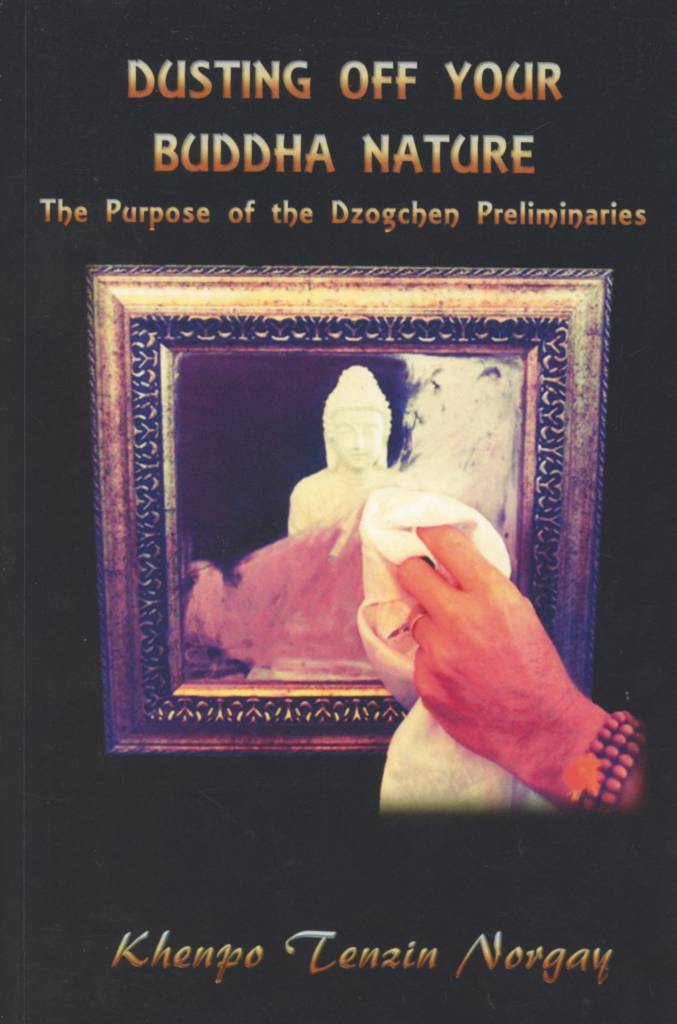
Dusting Off Your Buddha Nature derives principally from a series of Dharma teachings given in Italy on the Dzogchen Namchö Cycle of Ngöndro, known as "Buddha in the Palm of Your Hand." As taught in the Palyul lineage of the Nyingma sect of Tibetan Buddhism, these teachings include the Ten Steps to Buddhahood, the Four Thoughts that Turn the Mind Toward Dharma, the Four Uncommon Preliminary Practices of Refuge/Bodhicitta, Mandala, Vajrasattva, and Guru Yoga, as well as the supplemental practices of Phowa and Kusali Chod. The work culminates in a teaching on the dangers of skipping these preliminary practices, lest the Vajrayana practitioner misconstrue the higher teachings of Dzogchen and inadvertently "turn the medicine into poison." The key to understanding the higher teachings, explains Khenpo Norgay, is to "dust off" your Buddha Nature through these purification practices. As a bonus, a guided practice of the long Guru Yoga is appended for those new to Palyul practices. (Source: Back Cover)
| Citation | Norgay, Tenzin. Dusting Off Your Buddha Nature: The Purpose of the Dzogchen Preliminaries. Pensacola, FL: Reallusion Productions, 2014. |
|---|---|
Sprul sku mi 'gyur rdo rje; Rig 'dzin kun bzang shes rab. Gnam chos rdzogs chen sangs rgyas lag 'chang gi sngon 'gro'i khrid yig 'bring po. In Snga 'gyur rgyal ba dpal yul ba'i ri chos gsum gyi khrid yig, Vol. 1: 1-290. Khreng tu'u: Si khron mi rigs dpe skrun khang, 2007. 
Dzogchen - Dzogchen is an advanced system of meditation techniques to reveal the innate state of perfection primarily, but not exclusively, espoused by the Nyingma Buddhist tradition and the Tibetan Bön tradition. Skt. महासन्धि Tib. རྫོགས་ཆེན།
Nyingma - The Nyingma, which is often described as the oldest tradition of Tibetan Buddhism, traces its origin to Padmasambhava, who is said to have visited Tibet in the eighth century. Tib. རྙིང་མ་
bodhicitta - The altruistic thought to seek enlightenment for the sake of all sentient beings. It is said to have two aspects: compassion aimed at sentient beings and their problems and the wisdom of enlightenment as the solution. Skt. बोधिचित्त Tib. བྱང་ཆུབ་སེམས། Ch. 菩提心
gotra - Disposition, lineage, or class; an individual's gotra determines the type of enlightenment one is destined to attain. Skt. गोत्र Tib. རིགས་ Ch. 鍾姓,種性
The purpose of the buddha-nature website is to provide a resource hub for trustworthy information for learning about and teaching the concept of buddha-nature, its associated texts, teachings, lineages, and relevant Buddhist ideas. Unique content will be shared here, but the site will primarily act as a broker for other projects and authors that have already created quality materials, which we will curate for a wide range of audiences.

