- Preface and Acknowledgementiii
- List of Abbreviationsviii
- Introduction: The Nature and Purpose of the Present Study1
- Part One: The Indian Origins of the Buddha-Nature Doctrine15
- Chapter I: The Origins of the Buddha-Nature Concept16
- A. The Original Sanskrit Term for the Buddha-Nature17
- B. The Origins of the Buddhadhātu Concept in the Tathāgatagarbha
Literature22 - C. The Ekayāna Origins of the Tathāgatagarbha and Buddhadhātu
Concepts26
- Chapter II: The Twofold Meaning of the Buddhadhātu38
- A. The First Meaning: The Buddhadhātu as the "Store" of the
Buddhadharmas39 - B. The Second Meaning: The Buddhadhātu as the Basis (Āśraya) of the
Buddhadharmas48 - C. Tathatā and the Non-Origination of Discrimination51
- D. Cittaprakṛti and Non-Origination59
- E. The Buddhadhātu as the Realm of the Buddha's Wisdom61
- F. The Positive Character of the Buddhadhātu66
- A. The First Meaning: The Buddhadhātu as the "Store" of the
- Chapter III: The Amalgamation of the Tathāgatagarbha and Buddhadhātu
Concepts with Yogācārin Teachings76- A. Evidence of Yogācārin-Tathāgatagarbha Syncretism76
- B. Differences Within the Yogācārin School81
- C. The Positive Evaluation of the Absolute in Both Yogācārin and
Tathāgatagarbha Texts: Something "Left Over" in Emptiness85 - D. The Buddhadhātu and Subject-Object Non-Duality89
- E. The Tathāgatagarbha and the Three Svabhāvas100
- Conclusion: The Central Features of the Buddhadhātu Concept in India105
- Chapter I: The Origins of the Buddha-Nature Concept16
- Part II: The Buddha-Nature Concept in China112
- Chapter IV: The Introduction of the Buddha-Nature Concept to China113
- A. The Popularity of the Buddha-Nature Concept in China113
- B. Early Reactions to the Mahāparinirvāṇasūtra123
- C. Chih-yi132
- D. T'ien-t'ai and Hua-yen Disagreements over the Buddha-Nature135
- Chapter V: The Ekayāna-Triyāna Controversy over the Buddha-Nature144
- A. A Short History of the Controversy144
- B. A Critical Appraisal of the Issues Involved in the Controversy154
- Chapter VI: Ch'an Buddhist Understandings of the Buddha-Nature161
- A. T'ang Dynasty Ch'an: The Treatment of the Buddha-Nature in its
Scriptural Context162 - B. Confusion and Corruption in Sung Dynasty Ch'an172
- A. T'ang Dynasty Ch'an: The Treatment of the Buddha-Nature in its
- Conclusion: The Main Characteristics of the Buddha-Nature Theory
in China181
- Chapter IV: The Introduction of the Buddha-Nature Concept to China113
- Part III: Dōgen's Understanding of the Buddha-Nature187
- Chapter VII: The Formation of Dōgen's Understanding of the Buddha-
Nature188- A. The Tendai Concept of Original Enlightenment189
- B. Reactions Against the Idea of Original Enlightenment194
- C. Dōgen's Dilemma and Its Subsequent Resolution198
- Chapter VIII: Dōgen's Understanding of the Buddha-Nature208
- A. The Basic Premise of Dōgen's Idea of the Buddha-Nature:
What is it?209 - B. "All-Being" and the Buddha-Nature: the Phenomenal as the
Absolute210 - C. "All-Being" as a Realm of Subject-Object Non-Duality213
- D. Subject-Object Non-Duality and the Enlightenment of the
Insentient218 - E. Enlightenment as a Bodily Attainment220
- F. The Dynamic Quality of All-Being221
- G. The Buddha-Nature and Eternality223
- H. Time and the Buddha-Nature224
- A. The Basic Premise of Dōgen's Idea of the Buddha-Nature:
- Chapter IX: Dōgen's Understanding of Practice and the Buddha-Nature228
- A. The Need to Practice the Buddha-Nature228
- B. The Rejection of Stages in Practice and Striving for
Enlightenment233 - C. Practice as the Completed Activity of the Buddha236
- D. Everyday Life as the Stuff of Practice240
- E. Wrong Practice244
- F. Practice and the Conception of Original Enlightenment248
- Conclusion: The Significance of Dōgen's Thought Concerning the
Buddha-Nature257 - Appendix: An Annotated Translation of Dogen's Shōbōgenzō Busshō265
- Bibliography323
- Chapter VII: The Formation of Dōgen's Understanding of the Buddha-
The Zen Master Dōgen’s Understanding of the Buddha-Nature in Light of the Historical Development of the Buddha-Nature Concept in India, China, and Japan
From Buddha-Nature
< Books
(Created page with "{{Book |BookPerson={{Book-person |PersonPage=Grosnick, W. |PersonName=William Grosnick }} |FullTextRead=No |BookToc=Preface and Acknowledgement List of Abbreviations. Introd...") |
No edit summary |
||
| (20 intermediate revisions by the same user not shown) | |||
| Line 3: | Line 3: | ||
|PersonPage=Grosnick, W. | |PersonPage=Grosnick, W. | ||
|PersonName=William Grosnick | |PersonName=William Grosnick | ||
}}{{Book-person | |||
|PersonPage=Dōgen | |||
|PersonName=Dōgen | |||
}} | }} | ||
|FullTextRead=No | |FullTextRead=No | ||
|BookToc=Preface and Acknowledgement | |BookToc=***{{i|Preface and Acknowledgement|iii}} | ||
List of Abbreviations | ***{{i|List of Abbreviations|viii}} | ||
Introduction: The Nature and Purpose of the | **{{i|Introduction: The Nature and Purpose of the Present Study|1}} | ||
Present Study | *{{i|Part One: The Indian Origins of the Buddha-Nature Doctrine|15}} | ||
Part One: The Indian Origins of the Buddha-Nature Doctrine | **{{i|Chapter I: The Origins of the Buddha-Nature Concept|16}} | ||
Chapter I: The Origins of the Buddha-Nature Concept | ***{{i|A. The Original Sanskrit Term for the Buddha-Nature|17}} | ||
A. The Original Sanskrit Term for the Buddha-Nature | ***{{i|B. The Origins of the ''Buddhadhātu'' Concept in the ''Tathāgatagarbha''<br> Literature|22}} | ||
B. The Origins of the | ***{{i|C. The ''Ekayāna'' Origins of the ''Tathāgatagarbha'' and ''Buddhadhātu''<br> Concepts|26}} | ||
**{{i|Chapter II: The Twofold Meaning of the ''Buddhadhātu''|38}} | |||
C. The | ***{{i|A. The First Meaning: The ''Buddhadhātu'' as the "Store" of the<br> ''Buddhadharmas''|39}} | ||
and | ***{{i|B. The Second Meaning: The ''Buddhadhātu'' as the Basis (''Āśraya'') of the<br> ''Buddhadharmas''|48}} | ||
Chapter II: The Twofold Meaning of the | ***{{i|C. ''Tathatā'' and the Non-Origination of Discrimination|51}} | ||
A. The First Meaning: The | ***{{i|D. ''Cittaprakṛti'' and Non-Origination|59}} | ||
of the | ***{{i|E. The ''Buddhadhātu'' as the Realm of the Buddha's Wisdom|61}} | ||
B. The Second Meaning: The | ***{{i|F. The Positive Character of the ''Buddhadhātu''|66}} | ||
( | **{{i|Chapter III: The Amalgamation of the ''Tathāgatagarbha'' and ''Buddhadhātu''<br>Concepts with Yogācārin Teachings|76}} | ||
C. | ***{{i|A. Evidence of Yogācārin-''Tathāgatagarbha'' Syncretism|76}} | ||
D. | ***{{i|B. Differences Within the Yogācārin School|81}} | ||
E. The | ***{{i|C. The Positive Evaluation of the Absolute in Both Yogācārin and<br> ''Tathāgatagarbha'' Texts: Something "Left Over" in Emptiness|85}} | ||
F. The Positive Character of the | ***{{i|D. The ''Buddhadhātu'' and Subject-Object Non-Duality|89}} | ||
Chapter III: The Amalgamation of the | ***{{i|E. The ''Tathāgatagarbha'' and the Three ''Svabhāvas''|100}} | ||
**{{i|Conclusion: The Central Features of the ''Buddhadhātu'' Concept in India|105}} | |||
A. Evidence of | *{{i|Part II: The Buddha-Nature Concept in China|112}} | ||
B. Differences Within the | **{{i|Chapter IV: The Introduction of the Buddha-Nature Concept to China|113}} | ||
C. The Positive Evaluation of the Absolute in Both | ***{{i|A. The Popularity of the Buddha-Nature Concept in China|113}} | ||
***{{i|B. Early Reactions to the ''Mahāparinirvāṇasūtra''|123}} | |||
"Left Over" in Emptiness | ***{{i|C. Chih-yi|132}} | ||
***{{i|D. T'ien-t'ai and Hua-yen Disagreements over the Buddha-Nature|135}} | |||
**{{i|Chapter V: The ''Ekayāna-Triyāna'' Controversy over the Buddha-Nature|144}} | |||
***{{i|A. A Short History of the Controversy|144}} | |||
***{{i|B. A Critical Appraisal of the Issues Involved in the Controversy|154}} | |||
**{{i|Chapter VI: Ch'an Buddhist Understandings of the Buddha-Nature|161}} | |||
***{{i|A. T'ang Dynasty Ch'an: The Treatment of the Buddha-Nature in its<br> Scriptural Context|162}} | |||
***{{i|B. Confusion and Corruption in Sung Dynasty Ch'an|172}} | |||
**{{i|Conclusion: The Main Characteristics of the Buddha-Nature Theory<br>in China|181}} | |||
*{{i|Part III: Dōgen's Understanding of the Buddha-Nature|187}} | |||
**{{i|Chapter VII: The Formation of Dōgen's Understanding of the Buddha-<br>Nature|188}} | |||
***{{i|A. The Tendai Concept of Original Enlightenment|189}} | |||
***{{i|B. Reactions Against the Idea of Original Enlightenment|194}} | |||
***{{i|C. Dōgen's Dilemma and Its Subsequent Resolution|198}} | |||
**{{i|Chapter VIII: Dōgen's Understanding of the Buddha-Nature|208}} | |||
***{{i|A. The Basic Premise of Dōgen's Idea of the Buddha-Nature:<br> What is it?|209}} | |||
***{{i|B. "All-Being" and the Buddha-Nature: the Phenomenal as the<br> Absolute|210}} | |||
***{{i|C. "All-Being" as a Realm of Subject-Object Non-Duality|213}} | |||
***{{i|D. Subject-Object Non-Duality and the Enlightenment of the<br> Insentient|218}} | |||
***{{i|E. Enlightenment as a Bodily Attainment|220}} | |||
85 | ***{{i|F. The Dynamic Quality of All-Being|221}} | ||
***{{i|G. The Buddha-Nature and Eternality|223}} | |||
D. The | ***{{i|H. Time and the Buddha-Nature|224}} | ||
E. The | **{{i|Chapter IX: Dōgen's Understanding of Practice and the Buddha-Nature|228}} | ||
Conclusion: The Central Features of the | ***{{i|A. The Need to Practice the Buddha-Nature|228}} | ||
Concept in India | ***{{i|B. The Rejection of Stages in Practice and Striving for<br> Enlightenment|233}} | ||
Part II: The Buddha-Nature Concept in China 112 | ***{{i|C. Practice as the Completed Activity of the Buddha|236}} | ||
Chapter IV: The Introduction of the Buddha-Nature | ***{{i|D. Everyday Life as the Stuff of Practice|240}} | ||
Concept to China | ***{{i|E. Wrong Practice|244}} | ||
A. The Popularity of the Buddha-Nature Concept in China 113 | ***{{i|F. Practice and the Conception of Original Enlightenment|248}} | ||
B. Early Reactions to the | **{{i|Conclusion: The Significance of Dōgen's Thought Concerning the<br>Buddha-Nature|257}} | ||
C. Chih-yi | **{{i|Appendix: An Annotated Translation of Dogen's ''Shōbōgenzō Busshō''|265}} | ||
D. T'ien-t'ai and Hua-yen Disagreements over the | **{{i|Bibliography|323}} | ||
Buddha-Nature | |||
Chapter V: The | |||
A. A Short History of the Controversy 144 | |||
B. A Critical Appraisal of the Issues Involved | |||
in the Controversy | |||
Chapter VI: Ch'an Buddhist Understandings of | |||
the Buddha-Nature | |||
A. T'ang Dynasty Ch'an: The Treatment of the Buddha- | |||
Nature in its Scriptural Context | |||
B | |||
Conclusion: The Main Characteristics of the Buddha- | |||
Nature Theory in China | |||
Part III: | |||
Chapter VII: The Formation of | |||
of the Buddha-Nature | |||
A. The Tendai Concept of Original Enlightenment | |||
B. Reactions Against the Idea of Original Enlightenment | |||
C. | |||
Chapter VIII: | |||
A. The Basic Premise of | |||
What is it? | |||
B. "All-Being" and the Buddha-Nature: the Phenomenal | |||
as the Absolute | |||
C. "All-Being" as a Realm of Subject-Object Non-Duality | |||
D. Subject-Object Non-Duality and the Enlightenment | |||
of the Insentient | |||
E. Enlightenment as a Bodily Attainment | |||
F. The Dynamic Quality of All-Being | |||
G. The Buddha-Nature and Eternality | |||
H. Time and the Buddha-Nature | |||
Chapter IX: | |||
the Buddha-Nature | |||
A. The Need to Practice the Buddha-Nature | |||
B. The Rejection of Stages in Practice and Striving | |||
for Enlightenment | |||
C. Practice as the Completed Activity of the Buddha | |||
D. Everyday Life as the Stuff of Practice | |||
E. Wrong Practice | |||
F. Practice and the Conception of Original Enlightenment | |||
Conclusion: The Significance of | |||
the Buddha-Nature | |||
Appendix: An Annotated Translation of Dogen's | |||
Bibliography | |||
323 | |||
|AddRelatedTab=No | |AddRelatedTab=No | ||
|StopPersonRedirects=No | |||
}} | }} | ||
Latest revision as of 14:58, 31 July 2020
The Zen Master Dōgen’s Understanding of the Buddha-Nature in Light of the Historical Development of the Buddha-Nature Concept in India, China, and Japan
Dissertation
Dissertation
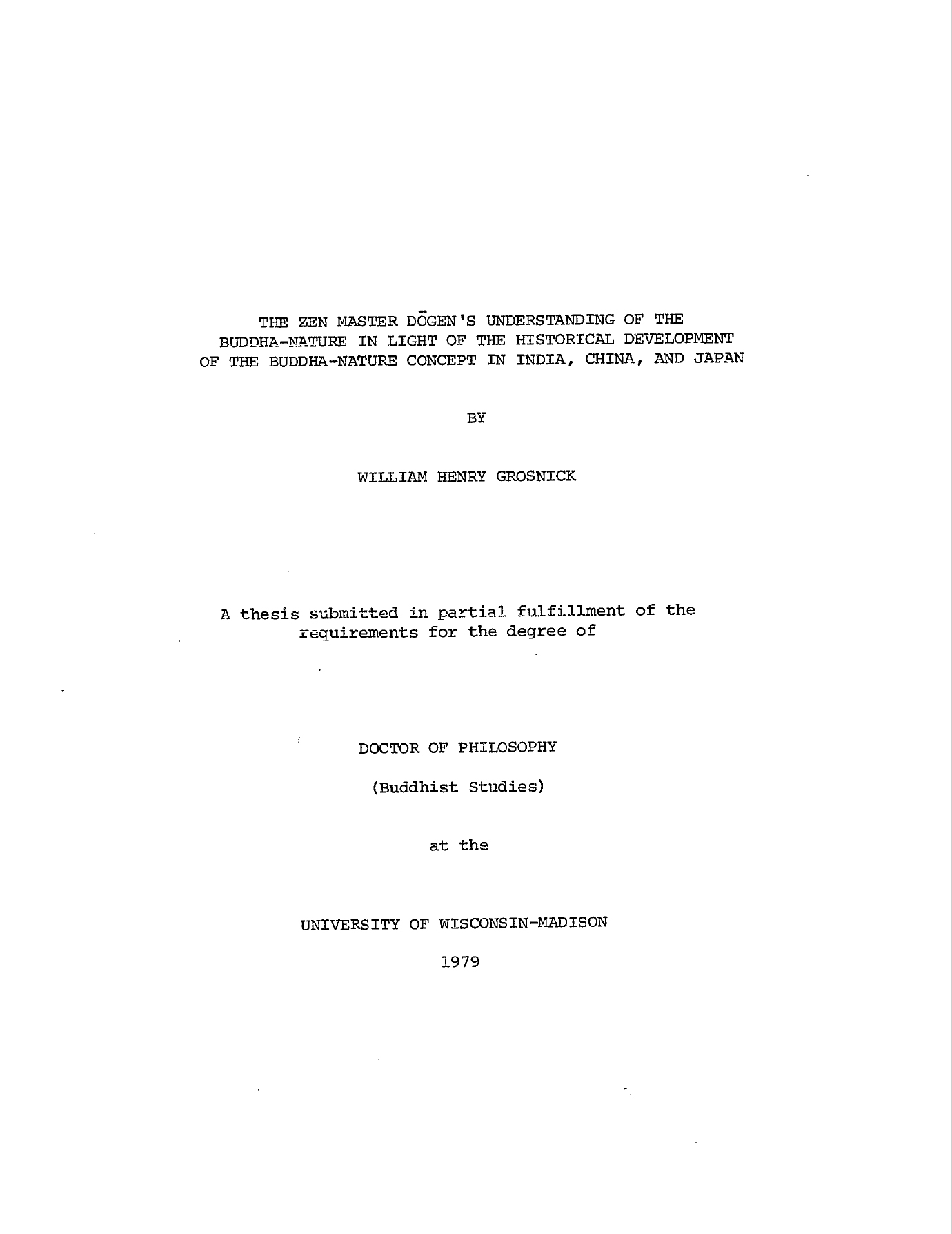
. . . The present study will have a twofold purpose: 1) to examine the history of the Buddha-nature concept in an attempt to discover a central core of meaning inherent in the concept, and 2) to evaluate Dōgen's view of the Buddha-nature in the light of that central core of meaning. Parts I and II of this work, which examine the doctrinal history of the Buddha-nature concept in India and China, are devoted to the former task, and Part III, which examines Dōgen's thought concerning the Buddha-nature, is devoted to the latter. It is hoped that through the examination of Dōgen's conception of the Buddha-nature in the light of the previous articulation of the concept, it will be possible to form conclusions concerning the significance of Dōgen's thought in Buddhist doctrinal history. (Grosnick, introduction, 7–8)
| Citation | Grosnick, William. "The Zen Master Dōgen’s Understanding of the Buddha-Nature in Light of the Historical Development of the Buddha-Nature Concept in India, China, and Japan." PhD diss., University of Wisconsin-Madison, 1979. |
|---|---|
Dōgen. 正法眼蔵 (Shōbōgenzō), T2582, 82: https://21dzk.l.u-tokyo.ac.jp/SAT/ddb-bdk-sat2.php
- Manuscript Editions:
- 75 fascicles, "original" edition, edited by Dōgen.
- 12 fascicles Yōkōji edition.
- 60 fascicles Eiheiji edition, edited by Giun (1253-1333).
- 84 fascicles edition, edited by Bonsei (d. 1427) in 1419.
- 89 fascicles edition, edited by Manzan Dōhaku (1636-1715) in 1684 at Daishōji.
- 95 fascicles edition, edited by Kōzen (1627-1693) in 1690 at Eiheiji.
