|
|
| Line 12: |
Line 12: |
|
| |
|
| Whatever one may conclude about the correctness of Sakya Pandita's opinions on any given topic, there can be no doubt that by raising so many questions so trenchantly, Sapan roused Tibetan Buddhists from doctrinal complacency and contributed mightily to the formation of the remarkable intellectual culture that has long distinguished the Buddhist monastic colleges of Tibet. It is for this reason that Sakya Pandita is remembered as the first of the three great thinkers renowned in Central Tibet as emanations of Mañjuśrī, the Bodhisattva of Wisdom. The two who followed him-the great Dzokchen master Longchen Rabjampa (1308-1364) and the peerless scholar and adept Je Tsongkhapa (1357-I419)-were themselves indebted to Sakya Pandita in myriad ways. | | Whatever one may conclude about the correctness of Sakya Pandita's opinions on any given topic, there can be no doubt that by raising so many questions so trenchantly, Sapan roused Tibetan Buddhists from doctrinal complacency and contributed mightily to the formation of the remarkable intellectual culture that has long distinguished the Buddhist monastic colleges of Tibet. It is for this reason that Sakya Pandita is remembered as the first of the three great thinkers renowned in Central Tibet as emanations of Mañjuśrī, the Bodhisattva of Wisdom. The two who followed him-the great Dzokchen master Longchen Rabjampa (1308-1364) and the peerless scholar and adept Je Tsongkhapa (1357-I419)-were themselves indebted to Sakya Pandita in myriad ways. |
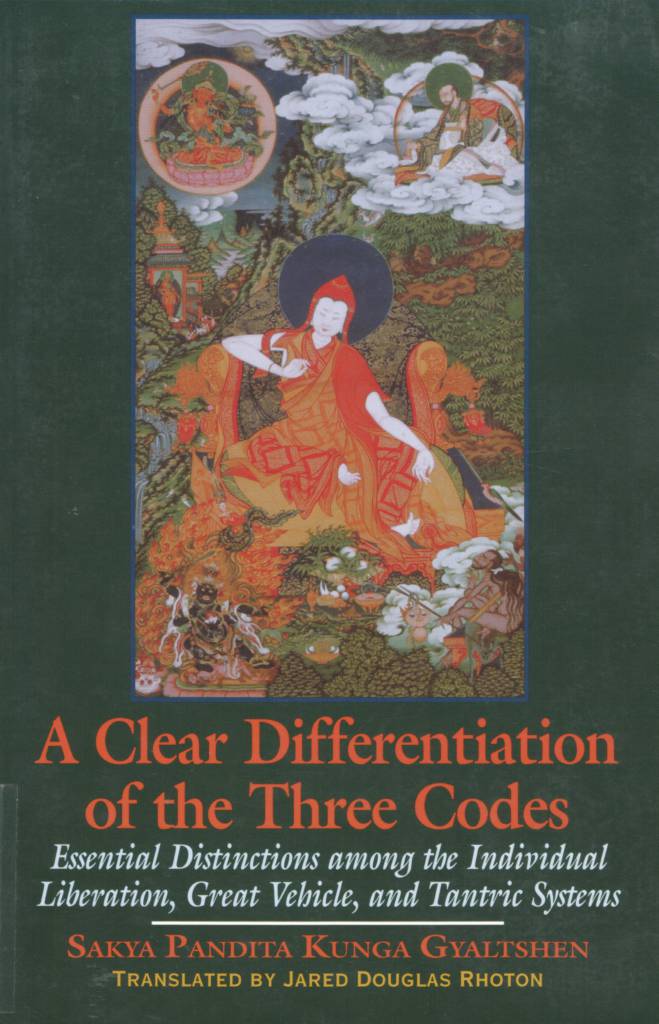
| [[Media:A Clear Differentiation of the Three Codes-front.jpg]] | | [http://commons.tsadra.org/images-commons/d/d3/A_Clear_Differentiation_of_the_Three_Codes-front.jpg] |
| MATTHEW T. KAPSTEIN | | MATTHEW T. KAPSTEIN |
| Editor, SUNY Buddhist Studies Series | | Editor, SUNY Buddhist Studies Series |