... read more at

About this person
The Third Karmapa’s commentary on the Dharmadharmatāvibhāga ’s concluding examples for the nature of the fundamental change explains the following.
- Examples for the fundamental change are space, gold, water, and so on.
For example, space is nothing but pure by nature. Therefore, by virtue of certain conditions (such as fog or mist), in the world, one can observe the statements "The sky is not pure" and "It is pure," [when] it is clear and free [from these conditions]. However, it is not suitable to claim such because of a change of the nature of space. With its own nature’s being pure, empty, and unconditioned, it is indeed not in order for it to either become pure by virtue of itself or become pure by virtue of something else. Nevertheless, mistaken minds that connect mere conventional terms to it cling to space as being pure and impure, [but] this is nothing but an error. Likewise, though it may appear as if the naturally pure nature of phenomena—the perfect [nature]—has become free from the fog and mist of conceptions, it is not asserted that this perfect [nature] changes [in any way]—it is absolutely without any arising or ceasing in terms of itself, others, both, or neither.
In the same way, the fact of gold’s remaining in its state of being immaculate is not changed by any stains, and the fact of water’s remaining clear and moist is not changed in its nature, even if it becomes associated with sullying factors, [such as] silt. Likewise, all that happens to the unmistaken path and the pure dharmas is that they just become associated with stains and sullying factors through the conceptions of ignorance, but it is not asserted that these uncontaminated dharmas [the path and the pure dharmas entailed by cessation] change. Consequently, naturally luminous stainlessness is unconditioned and changeless. Therefore, though the nature of phenomena is referred to by the conventional term "fundamental change," it is also called "permanent."
The words "and so on" refer to its being like a buddha [statue’s] existing in the shroud of a [decaying] lotus, honey’s existing amid bees, a grain in its husks, gold in filth, a treasure in the earth, a tree’s [sprouting] from a fruit, a precious statue in tattered rags, a cakravartin in the belly of a destitute woman, and a golden statue in clay.
[In due order, the respective obscuring factors in these nine examples correspond to the following mental obscurations.] The four that consist of the three latencies of desire, hatred, and ignorance, as well as the intense rising of all [three] are the factors to be relinquished through cultivating the mundane paths. The ground of the latent tendencies of ignorance is the factor to be relinquished through the cognition of realizing the foundation of knowable objects. The [afflictive] factors to be relinquished through seeing are relinquished through the path of seeing. The [afflictive] factors to be relinquished through familiarization are relinquished through [the path of] familiarization. The cognitive obscurations of the impure bhūmis are relinquished through the two wisdoms of meditative equipoise and subsequent attainment. The cognitive obscurations of the pure [bhūmis] are relinquished through the vajra-like [samādhi].
Thus, [the corresponding obscured factors in the nine examples correspond to] the buddha heart, the [single] taste of the [profound] dharma, the essence of its meaning, natural luminosity, changelessness, the unfolding of wisdom, the dharmakāya, the sāmbhogikakāya, and the nairmāṇikakāya, [all of which] represent the pure unchanging and spontaneously present nature. These [examples and their meanings] are found in the Uttaratantra and the Tathāgatagarbhasūtra. [The Uttaratantra also says]:
- There is nothing to be removed from it
- And not the slightest to be added.
- Actual reality is to be seen as it really is—
- Whoever sees actual reality is liberated.
- The basic element is empty of what is adventitious,
- Which has the characteristic of being separable.
- It is not empty of the unsurpassable dharmas,
- Which have the characteristic of being inseparable.
This teaches the defining characteristics of the emptiness endowed with all supreme aspects, free from the extremes of superimposition and denial.[1]
The same author’s commentary on verse 17 of Nāgārjuna’s Dharmadhātustava also quotes our verse in question, but interestingly uses Nāgārjuna’s Pratītysamutpādahṛdaya as its source.
Therefore, in order to teach the conventional terms of cause and result with regard to this dharmadhātu, [lines 17ab] say:
- This basic element, which is the seed,
- Is held to be the basis of all dharmas.
The basis of all uncontaminated qualities is the naturally pure dharmadhātu. This is also the seed and the basic element [for awakening]. As [Asaṅga’s] commentary on the Uttaratantra says:
The Uttaratantra ’s chapter on awakening states:
- Just as space, which is not a cause,
- Is the cause for forms, sounds, smells,
- Tastes, tangible objects, and phenomena
- To be seen, heard, and so on,
- Likewise, on account of being unobscured,
- The two kāyas are the cause
- For the arising of uncontaminated qualities
- Within the objects of the faculties of the wise.[3]
For this reason, due to the obscurations of mind, mentation, and consciousness gradually becoming pure, [the dharmadhātu’s] own stainless qualities appear. Hence, this is taught as "attaining great awakening." In order to demonstrate that, [lines 17cd say]:
- Through its purification step by step,
- The state of buddhahood we will attain.
However, there is nothing to be newly attained from something extrinsic [to the dharmadhātu], nor are there any obscurations other than being caught up in our own discriminating notions to be relinquished.
Therefore, these discriminating notions’ own essence is that they, just like a mirage, lack any nature of their own. To directly realize this lack for what it is and to realize and reveal the basic nature of the naturally luminous dharmakāya—the perfect [nature]—as just this perfect [nature] means to have gone to the other shore, since it cannot be gauged by the mind of any naive being. This is stated in master [Nāgārjuna]’s text on dependent origination:
- There is nothing to be removed from it
- And not the slightest to be added.
- Actual reality is to be seen as it really is—
- Who sees actual reality is liberated.[4]
- (Karl Brunnhölzl. When the Clouds Part, pp. 917-920)
Notes
- Rang byung rdo rje 2006b, 610–13. The last sentence here corresponds to the almost identical passage in RGVV on the above two verses from the Uttaratantra (J76; D4025, fol. 114ba.4).
- J72.
- II.27–28.
- Rang byung rdo rje 2006c, 31–32.
Philosophical positions of this person
"Rangjung Dorjé says in accordance with RGV I.27-28 that only the dharmakāya of all buddhas truly abides in sentient beings. The form kāyas are then explained as the outflow of the Dharma teachings on the level of the fruit, which corresponds to the pertinent passages in the first and third chapters of the Ratnagotravibhāga."
Mathes, K., A Direct Path to the Buddha Within, p. 72.
"Furthermore, the Third Karmapa composed a summary of the Uttaratantra in accordance with the meditative tradition, which establishes the Uttaratantra as a definitive text included in the last wheel of the Buddha's teachings." Wangchuk, Tsering. Uttaratantra in the Land of Snows, pp. 30-31.
- "To sum up, in his explanation of buddha nature, Rangjung Dorjé combines three different strands of interpretations:
1. The mahāmudrā interpretation stemming from Saraha. 2.The interpretation according to Asaṅga's Mahāyānasaṁgraha. 3.The dzogchen interpretation. In other words, for Rangjung Dorjé, well-founded mahāmudrā and dzogchen explanations need be combined with Asaṅgas Yogācāra distinction." Mathes, K., A Direct Path to the Buddha Within, p. 65.
- See also Wangchuk, Tsering. Uttaratantra in the Land of Snows, p. 30.
- He never actually uses this term, so this is a later attribution imputed on to his exegesis of the RGV and other works by his commentators such as Karma Trinlepa and eventually Kongtrul, which is labeled the Zhentong Tradition of the Karma Kagyu, which differs considerably from Dölpopa's tradition. See Mathes, K., A Direct Path to the Buddha Within, pp. 54-57.
- For more on the difference between the Third Karmapa and Dölpopa see Mathes, K., A Direct Path to the Buddha Within, p. 69-70.
- See also Brunnhölzl, K., Luminous Heart, pp. 95-109.
"Furthermore, the Third Karmapa composed a summary of the Uttaratantra in accordance with the meditative tradition, which establishes the Uttaratantra as a definitive text included in the last wheel of the Buddha's teachings." Wangchuk, Tsering. Uttaratantra in the Land of Snows, pp. 30-31.
- "The tathāgata heart is mind’s luminous ultimate nature or nondual wisdom, which is the basis of everything in saṃsāra and nirvāṇa. Its essence is empty, its nature is lucid, and its display is unimpeded (this is also how the nature of the mind is presented in the Mahāmudrā tradition, and the Karmapa’s commentary on the Dharmadhātustava indeed equates the tathāgata heart with Mahāmudrā)." Brunnhölzl, K., When the Clouds Part, p. 72.
- Another take on this is found in Mathes, K., A Direct Path to the Buddha Within, pp. 51-54, in which he seems to suggest that his views are more inclined to view it as the dharmadhātu, which is equivalent to dharmakāya.
- "This becomes clear from an answer to a rhetorical question in the autocommentary of the Zab mo nang gi don:
Question: How are the properties of purification produced? They are supported by buddha nature, [in as much as] it is the dharmakāya of the above-mentioned purity of mind." Mathes, K., A Direct Path to the Buddha Within, p. 58.
Other names
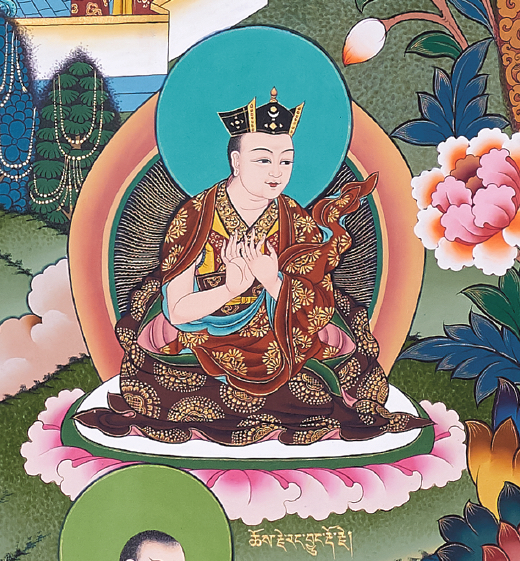
- ཀརྨ་པ་གསུམ་པ་ · other names (Tibetan)
- karma pa gsum pa · other names (Wylie)
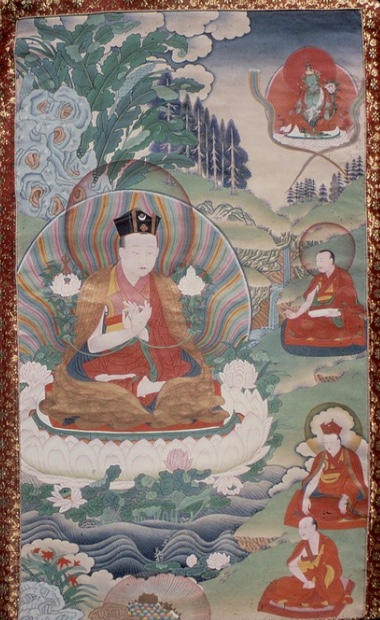
- Karmapa, 3rd · other names
Affiliations & relations
- Karma Kagyu · religious affiliation
- Karmapa, 2nd · emanation of
- Karmapa, 4th · incarnation
- o rgyan pa rin chen dpal · teacher
- rig 'dzin ku mA ra rA dza · teacher
- Pad+ma las 'brel rtsal · teacher
- Rgyal sras legs pa · teacher
- klong chen rab 'byams · student
- Rgyal sras legs pa · student
- G.yung ston rdo rje dpal bzang po · student
- g.yag sde paN chen · student
- Shamarpa, 1st · student