Books/Thought of Buddha Nature as Depicted in the Laṅkāvatārasūtra
From Buddha-Nature
< Books
(Redirected from Thought of Buddha Nature as Depicted in the Laṅkāvatārasūtra)
Thought of Buddha Nature as Depicted in the Laṅkāvatārasūtra
Dissertation
Dissertation
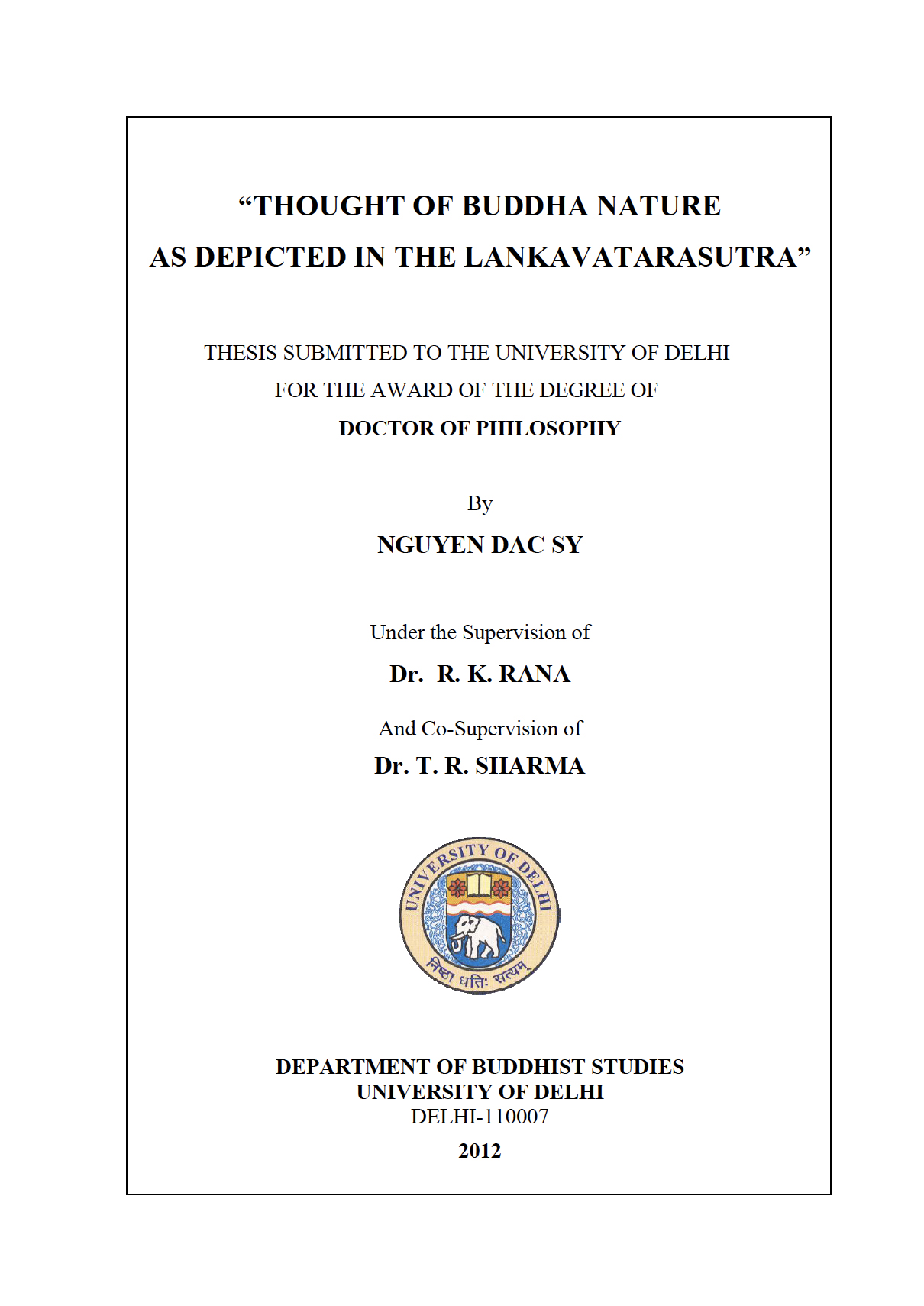
| Citation | Sy, Nguyen Dac. "Thought of Buddha Nature as Depicted in the Laṅkāvatārasūtra." PhD diss., University of Delhi, 2012. https://shodhganga.inflibnet.ac.in/handle/10603/28355. |
|---|---|
- ACKNOWLEDGEMENTS
- ABBREVIATIONS
- INTRODUCTION
- General Introduction1
- The Concept of the Buddha-nature4
- The Individuality of the Buddha-nature5
- The Tathāgatagarbha6
- The Dharmakāya8
- The Universality of the Buddha-nature10
- Introduction to the Tathāgatagarbha literature15
- Introduction to the Laṅkāvatārasūtra16
- Clarification of the Topic24
- Object of the present Study24
- The Extent of Existing Studies on the Topic26
- Scope and Method of The Research on the Topic Concerned28
- Scope of the Research28
- Research Methodology29
- Plan of the Study29–33
- General Introduction1
- CHAPTER I: EVOLUTION OF THE BUDDHA-NATURE CONCEPT
- CHAPTER II: THE BUDDHA-NATURE IN THE TATHĀGATAGARBHA LITERATURE60
- II.1. The Early Period62
- II.1.1. The Tathāgatagarbhasūtra63
- II.1.2. The Srīmālāsūtra66
- II.1.3. The Mahāparinirvānasūtra70
- II.1.4. The Ratnagotravibhāgaśāstra75
- II.1.5. The Anuttarāśrayasūtra78
- II.1.6. The Other Texts79
- II.2. The Middle Period81
- II.2.1. Mahāyānasūtrālaṃkāra81
- II.2.2.The Buddha-nature Treatise82
- II.2.3. Mahāyānasaṃparigrāhaśāstra86
- II.3. The Later Period89
- II.3.1. The Laṅkāvatārasūtra89
- II.3.2. The Awakening of Mahāyāna Faith89
- II.3.3. The Gaṇḍavyūhasūtra92-94
- CHAPTER III: THE LAṄKĀVATĀRASŪTRA AND HINDU PHILOSOPHY95
- III.1. Āryadeva and the Laṅkāvatārasūtra96
- III.1.1. Āryadeva and His Works96
- III.1.2. Āryadeva and the Laṅkāvatārasūtra99
- III.2. Six Hindu Philosophical Systems109
- III.2.1. Sāṃkhya110
- III.2.2. Yoga112
- III.2.3. Nyāya113
- III.2.4. Vaiśeṣika115
- III.2.5. Mīmāṃsā116
- III.2.6. Vedānta117
- III.2.6.1. Vedānta philosophers117
- III.2.6.2. Date of Vedānta121
- III.3. The Buddha-nature and Brahman128-133
- CHAPTER IV: THE THOUGHT OF BUDDHA-NATURE IN THE LAṄKĀVATĀRASŪTRA134
- IV.1. Tathāgatagarbha and Ālayavijñāna: the Essence of Beings
- IV.1.1. System of Consciousnesses135
- IV.1.2. The Ālayavijñāna140
- IV.1.3. Ālayavijñāna and Tathāgatagarbha144
- IV.2. TATHĀGATAGARBHA AND ĀTMAN149
- IV.3. BUDDHATĀ: THE ESSENCE OF THE BUDDHA154
- IV.3.1. Beyond the Twofold Hindrance and Ego157
- IV.3.2. Overcoming the Twofold Death159
- IV.3.3. Cleansing the Twofold Group of Passions160
- IV.4. THE BUDDHA-NATURE AS DHARMAKĀYA162
- IV.4.1. Origin and Development of the Dharmakāya162
- IV.4.2. Dharmakāya in the Laṅkāvatārasūtra167–173
- CHAPTER V: THE PRACTICE OF BUDDHA-NATURE IN THE LAṄKĀVATĀRASŪTRA174
- V.1. Sudden Enlightenment, Gradual Cultivation and the Revulsion175
- V.1.1. Gradual Cultivation and Habit-energy175
- V.1.1.1. Gradual Cultivation175
- V.1.1.2. Habit-energy178
- V.1.2. Sudden Enlightenment and Revulsion180
- V.1.2.1. Sudden Enlightenment180
- V.1.2.2. The Revulsion185
- V.2. Self-Power and Other-Power189
- V.2.1. Self-Power189
- V.2.2. Other-Power197–205
- CHAPTER VI – FURTHER DEVELOPMENT OF THE THOUGHT OF
BUDDHA-NATURE IN CHINA206- VI.1. The Daosheng’s Thought of Buddha-Nature209
- VI.1.1. Daosheng and the Nirvāṇa School209
- VI.1.2. The Daosheng’s Doctrine of Buddha-nature212
- VI.1.3. The Daosheng’s Doctrine of Sudden Enlightenment213
- VI.1.4. Daosheng: The Theoretical Forerunner of Chan215
- VI.2. The Buddha-Nature And Chan Buddhism216
- VI.2.1. The Thought of Buddha-nature in Chan216
- VI.2.2. Chan and the Laṅkāvatārasūtra244
- VI.2.3. The Buddha-nature in Gongan and Mozhao Chan228
- VI.3. The Buddha-Nature Thought in the Tiantai School235
- VI.4. The Buddha-Nature Thought in the Huayan School239–245
- CONCLUSION246
- Summation246
- The Buddha-nature: Solution to Individual and Social Problems253
- The Buddha-nature Today: A New Approach257–260
- BIBLIOGRAPHY261–284
- A GLOSSARY OF CHINESE CHARACTERS285–290
