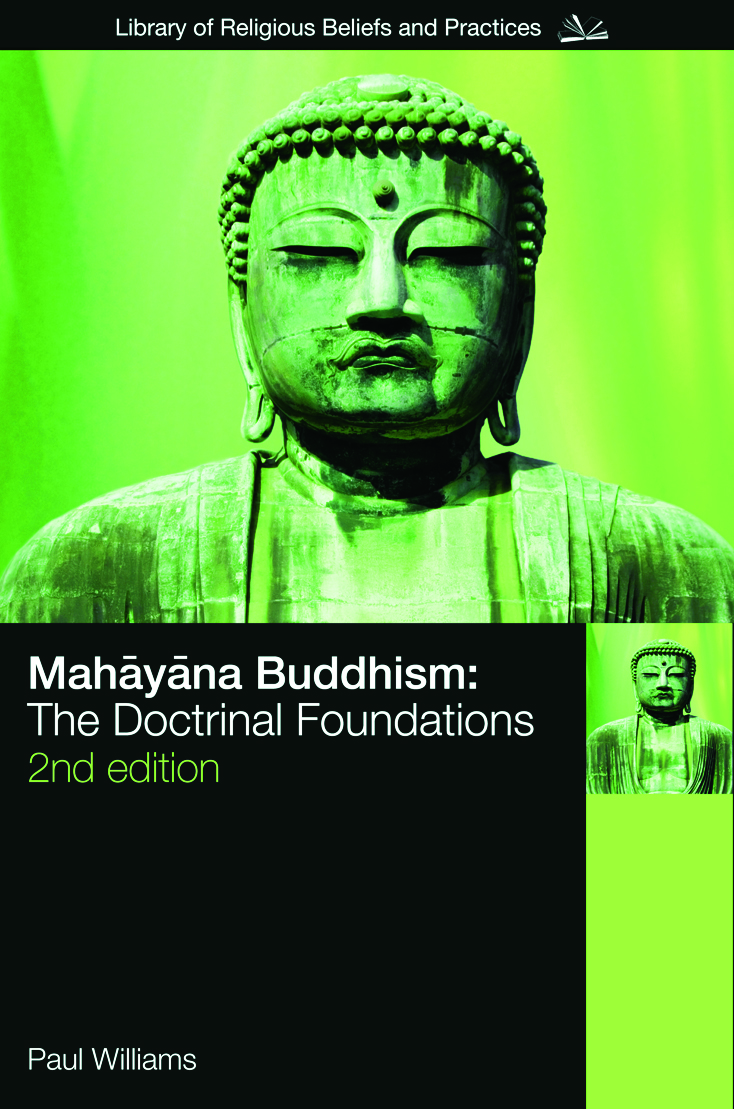
Mahāyāna Buddhism: The Doctrinal Foundations

From Buddha-Nature
LibraryBooksMahāyāna Buddhism: The Doctrinal Foundations
< Books
No edit summary
No edit summary
Line 57: Line 57:
**{{i|''Nichiren Shōnin and his tradition''|165}}
*{{i|'''8 On the bodies of the Buddha'''|'''172'''}}
Prolegomenon to the MahAyAna 172
**{{i|''Prolegomenon to the Mahāyāna''|172}}
The bodies of the Buddha and the philosophy of emptiness 176
**{{i|''The bodies of the Buddha and the philosophy of emptiness''|176}}
YogAcAra – the system develops 179
**{{i|''Yogācāra – the system develops''|179}}
A note on the dGe lugs schema of the Buddha’s bodies 182
**{{i|''A note on the dGe lugs schema of the Buddha's bodies''|182}}
A final note: the ‘nonabiding nirvAUa’ and the lifespan of the Buddha 185
**{{i|''A final note: the 'nonabiding nirvāṇa' and the lifespan of the Buddha''|185}}
 
*{{i|'''9 The path of the Bodhisattva'''|187}}
9 The path of the Bodhisattva 187
**{{i|''Buddhism reaches Tibet''|187}}
Buddhism reaches Tibet 187
**{{i|''The eighth-century debates''|191}}
The eighth-century debates 191
**{{i|''Compassion and the Bodhicitta''|194}}
Compassion and the Bodhicitta 194
**{{i|''Bodhisattva stages, paths and perfections''|200}}
Bodhisattva stages, paths and perfections 200
*{{i|'''10 Trust, self-abandonment and devotion: the cults of Buddhas and Bodhisattvas'''|'''209'''}}
10 Trust, self-abandonment and devotion: the cults of Buddhas and Bodhisattvas 209
**{{i|Buddhānusmṛti ''recollection of the Buddha''|209}}
Buddhanusmvti – recollection of the Buddha 209
**{{i|''The'' pratyutpanna samādhi ''and Huiyuan''|212}}
The pratyutpanna samadhi and Huiyuan 212
**{{i|''The notion of a Buddha Field'' (buddhakṣetra)|214}}
The notion of a Buddha Field (buddhakwetra) 214
**{{i|''Some Bodhisattvas''|218}}
Some Bodhisattvas 218
***{{i|''Maitreya''|218}}
Maitreya 218
***{{i|''Avalokiteśvara''|221}}
AvalokiteZvara 221
***{{i|''Tārā''|225}}
TArA 225
***{{i|''Mañjuśrī''|226}}
MañjuZrC 226
***{{i|''Kṣitigarbha''|229}}
KWitigarbha 229
**{{i|Some Buddhas|231}}
Some Buddhas 231
AkWobhya 231
AkWobhya 231
BhaiWajyaguru 234
BhaiWajyaguru 234

Revision as of 13:21, 26 June 2020


Mahāyāna Buddhism: The Doctrinal Foundations
Book
Book

Originating in India, Mahayana Buddhism spread across Asia, becoming the prevalent form of Buddhism in Tibet and East Asia. Over the last twenty-five years Western interest in Mahayana has increased considerably, reflected both in the quantity of scholarly material produced and in the attraction of Westerners towards Tibetan Buddhism and Zen.

Paul Williams’ Mahayana Buddhism is widely regarded as the standard introduction to the field, used internationally for teaching and research and has been translated into several European and Asian languages. This new edition has been fully revised throughout in the light of the wealth of new studies and focuses on the religion’s diversity and richness. It includes much more material on China and Japan, with appropriate reference to Nepal, and for students who wish to carry their study further there is a much-expanded bibliography and extensive footnotes and cross-referencing. Everyone studying this important tradition will find Williams’ book the ideal companion to their studies. (Source: Routledge)

Citation Williams, Paul. Mahayana Buddhism: The Doctrinal Foundations. 2nd ed. Library of Religious Beliefs and Practices. New York: Routledge, 2009. https://archive.org/details/mahayanabuddhismthedoctrinalfoundationspaulwilliamsroutledgeseealtruismandreality_202003_445_W/mode/2up.


    • Preface and acknowledgementsx
  • 1 Introduction1
    • Buddhism: doctrinal diversity and (relative) moral unity1
    • The Indian background7
    • Factors that may have contributed to change12
    • Abhidharma15
    • Mahāsāṃghikas and the Lokottaravāda18
    • The origins of the Mahāyāna, and the laity21
    • Mahāyāna before 'Mahāyāna' – the Ajitasenavyākaraṇanirdeśa Sūtra27
    • On the origins of the Mahāyāna – some more sūtras30
    • The justification of the Mahāyāna sutras38
  • 2 The Perfection of Wisdom (Prajñāpāramitā) Sūtras 45
    • On the Mahāyāna sūtras45
    • The origins and development of the Prajñāpāramitā literature47
    • Wisdom (prajña) and its perfection49
    • Absence of Self – the extensive perspective51
    • The Bodhisattva55
  • 3 Mādhyamika63
    • Nāgārjuna and Āryadeva63
    • The development of the Mādhyamika tradition in India65
    • Emptiness and intrinsic existence – the incompatible rivals68
    • A brief note on Mādhyamika method71
    • Three Mādhyamika critiques72
      • On causation73
      • On the Self74
      • On nirvāṇa75
    • The two truths76
    • Meditation and emptiness – an impressionistic outline79
    • A final note – Mādhyamika in China and East Asia81
  • 4 Yogācāra84
    • Background84
    • The Yogācāra tradition – scholars and texts86
    • The three natures (trisvabhava)88
    • Mind92
    • Substratum consciousness, consciousness and immaculate consciousness97
    • Yet more disputes within the Yogācāra tradition100
  • 5 The Tathāgatagarbha103
    • Some Tathāgatagarbha Sūtras104
    • The Tathāgatagarbha in the Ratnagotravibhāga109
    • Tibet – the gzhan stong and rang stong dispute112
    • The Dasheng qixinlun (Ta-sheng ch’i-hsin lun) and the
         Tathagatagarbha in East Asia
      115
    • Dōgen on the Buddha-nature119
    • A note on some contemporary issues: Critical Buddhism and a debate on
         not-Self in Thai Buddhism
      122
    • Critical Buddhism122
    • Not-Self in contemporary Thai Buddhism125
  • 6 Huayan – the Flower Garland tradition129
    • Buddhism in China129
    • The Avataṃsaka Sūtra132
    • The Huayan tradition in China138
    • Huayan thought – Fazang’s 'Treatise on the Golden Lion' 141
    • A note on some aspects of Huayan practice144
    • The Avataṃsaka Sūtra and Vairocana in Buddhist art146
  • 7 The Saddharmapuṇḍarīka (Lotus) Sūtra and its influences149
    • A note on Tiantai (Tendai)161
    • Nichiren Shōnin and his tradition165
  • 8 On the bodies of the Buddha172
    • Prolegomenon to the Mahāyāna172
    • The bodies of the Buddha and the philosophy of emptiness176
    • Yogācāra – the system develops179
    • A note on the dGe lugs schema of the Buddha's bodies182
    • A final note: the 'nonabiding nirvāṇa' and the lifespan of the Buddha185
  • 9 The path of the Bodhisattva187
    • Buddhism reaches Tibet187
    • The eighth-century debates191
    • Compassion and the Bodhicitta194
    • Bodhisattva stages, paths and perfections200
  • 10 Trust, self-abandonment and devotion: the cults of Buddhas and Bodhisattvas209
    • Buddhānusmṛti – recollection of the Buddha209
    • The pratyutpanna samādhi and Huiyuan212
    • The notion of a Buddha Field (buddhakṣetra)214
    • Some Bodhisattvas218
      • Maitreya218
      • Avalokiteśvara221
      • Tārā225
      • Mañjuśrī226
      • Kṣitigarbha229
    • Some Buddhas231

AkWobhya 231 BhaiWajyaguru 234 AmitAbha/AmitAyus 238 The AmitAbha sEtras 238 AmitAbha’s Pure Land in China 243 HDnen ShDnin (1133–1212) 254 Shinran ShDnin (1173–1262) 259 Notes 267 References 389 Index of names 422 Index of subjects 430
