- An Aspiration by H.H. the Seventeenth Karmapa, Ogyen Trinley Dorje8
- Foreword by H.H. the Seventeenth Karmapa, Ogyen Trinley Dorje10
- Preface12
- Introduction15
- The Indian Yogācāra Background15
- The Tibetan Tradition on the Five Maitreya Texts119
- The Third Karmapa's View126
- Translations180
- The Autocommmentary on The Profound Inner Reality181
- The Ornament That Explains the Dharmadharmatāvibhāga241
- Four Poems by the Third Karmapa271
- Jamgön Kongtrul Lodrö Tayé's Commentary on The Treatise on Pointing Out the Tathāgata Heart288
- Jamgön Kongtrul Lodrö Tayé's Commentary on The Treatise on the Distinction between Consciousness and Wisdom366
- Karma Trinlépa's Explanation of the Sugata Heart447
- Appendix I: Pawo Tsugla Trengwa's Presentation of Kāyas, Wisdoms, and Enlightened Activity463
- Appendix II: The Treatise on Pointing Out the Tathāgata Heart505
- Appendix III: The Treatise on the Distinction between Consciousness and Wisdom517
- Appendix_IV:_Outline_of_NTC527
- Appendix_V:_Outline_of_NYC531
- Appendix VI: The Change of State of the Eight Consciousnesses into the Four (Five) Wisdoms and the Three (Four) Kāyas534
- Glossary: English–Sanskrit–Tibetan536
- Glossary: Tibetan–Sanskrit–English542
- Bibliography548
- Endnotes589
Luminous Heart
Book
Book
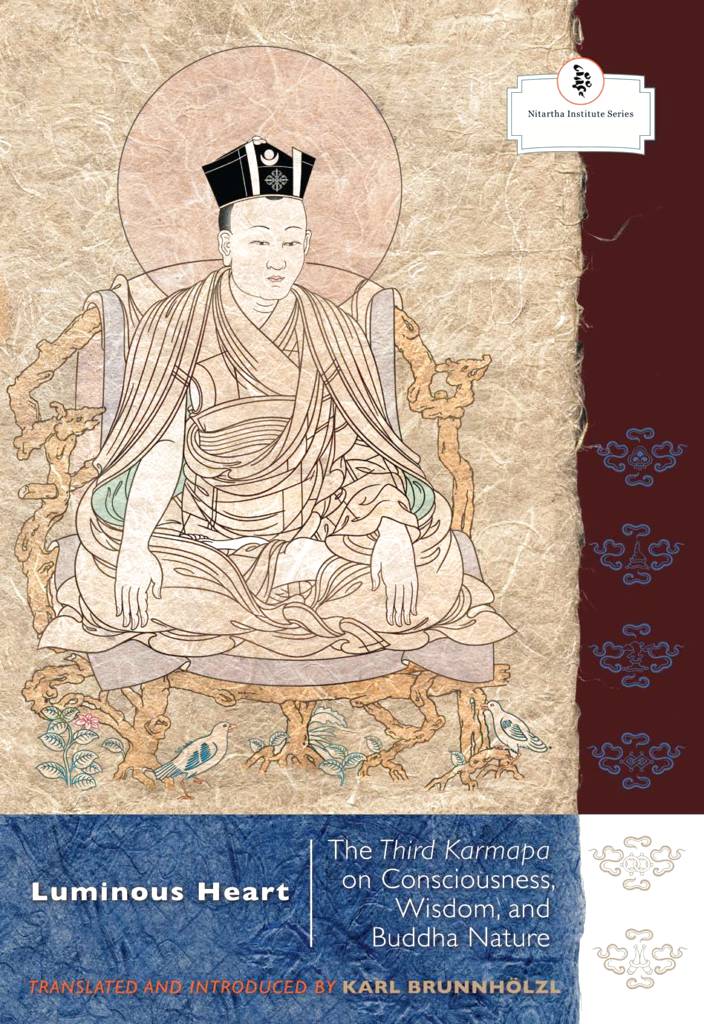
This superb collection of writings on buddha nature by the Third Karmapa Rangjung Dorje (1284–1339) focuses on the transition from ordinary deluded consciousness to enlightened wisdom, the characteristics of buddhahood, and a buddha’s enlightened activity. Most of these materials have never been translated comprehensively. The Third Karmapa’s unique and well-balanced view synthesizes Yogācāra, Madhyamaka, and the classical teachings on buddha nature. Rangjung Dorje not only shows that these teachings do not contradict each other but also that they supplement each other and share the same essential points in terms of the ultimate nature of mind and all phenomena. His fusion is remarkable because it clearly builds on Indian predecessors and precedes the later often highly charged debates in Tibet about the views of Rangtong ("self-empty") and Shentong ("other-empty"). Although Rangjung Dorje is widely regarded as one of the major proponents of the Tibetan Shentong tradition (some even consider him its founder), this book shows how his views differ from the Shentong tradition as understood by Dölpopa, Tāranātha, and the First Jamgön Kongtrul. The Third Karmapa’s view is more accurately described as one in which the two categories of rangtong and shentong are not regarded as mutually exclusive but are combined in a creative synthesis. For those practicing the sūtrayāna and the vajrayāna in the Kagyü tradition, what these texts describe can be transformed into living experience. (Source: Shambhala Publications)
| Citation | Brunnhölzl, Karl, trans. Luminous Heart: The Third Karmapa on Consciousness, Wisdom, and Buddha Nature. Nitartha Institute Series. Ithaca, NY: Snow Lion Publications, 2009. |
|---|---|
- Rang byung rdo rje (Karmapa, 3rd). Rang byung rdo rje'i mgur rnam. Bidung, Tashigang, Bhutan: Kunchhap, 1983.
- 1990a. Rnam par shes pa dang ye shes 'byed pa'i bstan bcos. In Dbu ma gzhan stong skor bstan bcos phyogs bsdus deb dang po, 49–54. Also as Rumtek blockprint, n.d.
- 1990b. De bzhin gshegs pa'i snying po bstan pa'i bstan bcos. In Dbu ma gzhan stong skor bstan bcos phyogs bsdus deb dang po, 55–62. Also as Rumtek blockprint, n.d.
- 2006a. Collected Works (Dpal rgyal dbang ka rma pa sku phreng gsum pa rang byung rdo rje'i gsung 'bum). 11 vols. Lhasa: Dpal brtsegs bod yig dpe rnying zhib 'jug khang.
- 2006b. Chos dang chos nyid rnam par 'byed pa'i bstan bcos kyi rnam par bshad pa'i rgyan. In Collected Works, vol. cha: 488–613.
- 2006c. De bzhin gshegs pa'i snying po bstan pa'i sa bcad. In Collected Works, vol. ja: 277–81.
- 2006d. Sems kyi khrul tshul brjod pa. In Collected Works, vol. ca: 101–6.
- 2006e. Rtogs pa brjod pa'i tshig bcad. In Collected Works, vol. ca: 89–92.
- 2006f. Gnas lugs gsal byed ye shes sgron me. In Collected Works, vol. A: 21–44.
- n.d.[a] Zab mo nang gi don gsal bar byed pa'i 'grel pa. Rumtek (Sikkim), India.
- n.d.[b] Zab mo nang gi don zhes bya ba'i gzhung. Rumtek (Sikkim), India.