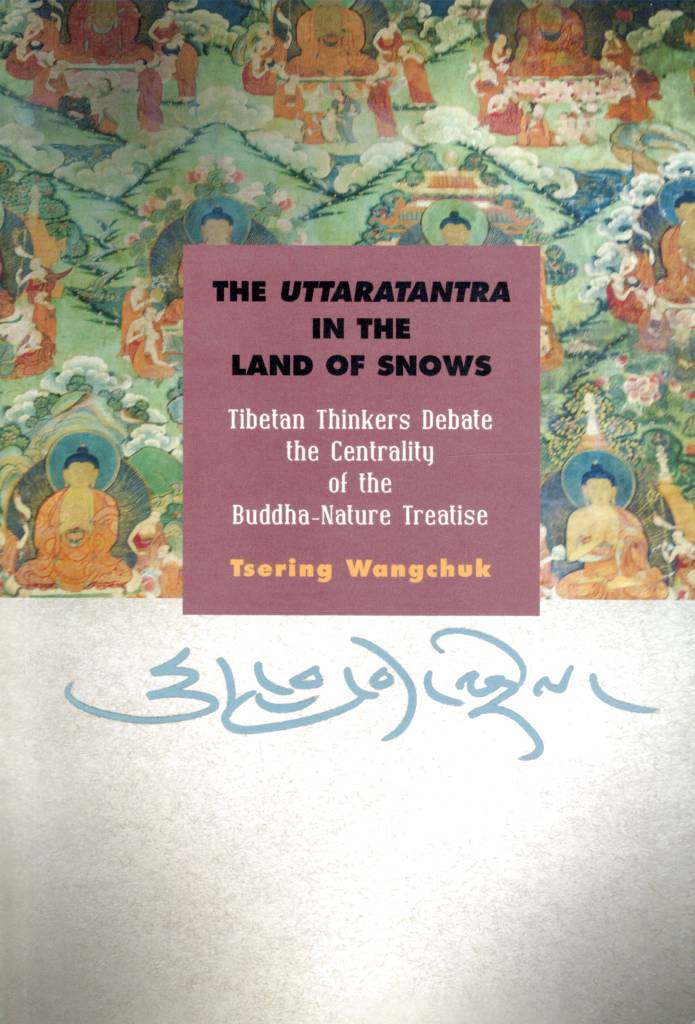
The Uttaratantra in the Land of Snows

From Buddha-Nature
LibraryBooksThe Uttaratantra in the Land of Snows
< Books
Revision as of 17:23, 19 July 2018 by Marcus (talk | contribs)


The Uttaratantra in the Land of Snows
Book
Book

With its emphasis on the concept of buddha-nature, or the ultimate nature of mind, the Uttaratantra is a classical Buddhist treatise that lays out an early map of the Mahāyāna path to enlightenment. Tsering Wangchuk unravels the history of this important Indic text in Tibet by examining numerous Tibetan commentaries and other exegetical texts on the treatise that emerged between the eleventh and fifteenth centuries. These commentaries explored such questions as: Is the buddha-nature teaching found in the Uttaratantra literally true, or does it have to be interpreted differently to understand its ultimate meaning? Does it explicate ultimate truth that is inherently enlightened or ultimate truth that is empty only of independent existence? Does the treatise teach ultimate nature of mind according to the Cittamātra or the Madhyamaka School of Mahāyāna? By focusing on the diverse interpretations that different textual communities employed to make sense of the Uttaratantra, Wangchuk provides a necessary historical context for the development of the text in Tibet. (Source: SUNY Press)

Citation Wangchuk, Tsering. The Uttaratantra in the Land of Snows: Tibetan Thinkers Debate the Centrality of the Buddha-Nature Treatise. Albany: State University of New York Press, 2017.


  • Acknowledgments
  • Introduction
  • General Remarks
  • Textual Historical Background
  • Part I. Early Period: Kadam Thinkers Rescue the Treatise
    • 1. Rise of the Uttaratantra in Tibet: Early Kadam Scholars Revitalize the Newly Discovered Indian Exegesis
      • Introduction
      • Ngok and Chapa on the Pervasive Nature of the Buddha-Body
      • Ngok and Chapa on Definitive or Provisional Nature in the Uttaratantra
      • Ngok and Chapa on the Uttaratantra as a Last Wheel Treatise
      • Buddha-Element as a Conceived Object
      • Ngok and Chapa Differ on Emphasis
      • Conclusion
    • 2. Sowing Seeds for Future Debate: Dissenters and Adherents
      • Introduction
      • Sapen, the Dissenter
      • Rikrel, the Third Karmapa, and Sangpu Lodrö Defend the Uttaratantra
      • Rinchen Yeshé’s Proto Other-Emptiness Presentation of the Uttaratantra, and Butön’s Reply
      • Conclusion
  • Part II. The Pinnacle Period: the Other-Emptiness Interpretation Spreads
  • Part III. The Argumentation Period: Self-Emptiness Proponents criticize Other-Emptiness Approach
    • 5. Challenges to the Purely Definitive Nature of the Uttaratantra: Zhalu Thinkers Criticize Dölpopa
      • Introduction
      • Butön’s Ornament
      • Dratsépa’s Commentary
      • Conclusion
    • 6. Challenges to the Supremacy of the Uttaratantra: Rendawa and Tsongkhapa on Tathāgata-essence Literature
      • Introduction
      • Rendawa on the Uttaratantra and the Tathāgata-Essence Literature
      • Tsongkhapa on the Uttaratantra and the Tathāgata-Essence Literature
      • Conclusion
    • 7. Gyeltsap’s Commentary on the Uttaratantra: A Critique of Dölpopa’s Interpretation of Tathāgata-essence Literature
      • Introduction
      • Middle Wheel and Last Wheel Teachings
      • Definitive Meaning and Provisional Meaning
      • Self-Emptiness and Other-Emptiness
      • Conclusion
  • Conclusion
  • General Remarks
  • Completing the Cycle
  • Notes
  • Bibliography
  • Tibetan Language Works Cited
  • English Language Works Cited
  • Index

Tsering Wangchuk's The Uttaratantra in the Land of Snows is a clear and concise introduction to the history of the Uttaratantra and buddha-nature theory in pre-modern Tibet. It is an ideal introduction for anyone not yet familiar with the buddha-nature debate in Tibet. Wangchuk summarizes the writings and views of several of the most important Tibetan philosophers who weighed in on buddha-nature between the eleventh and fifteenth centuries from Ngok Lotsāwa through Sakya Paṇḍita to Dolpopa and Gyeltsabje. The book is divided into three main sections: early Kadam thinkers who attempted to fold the Uttaratantra's positive-language teaching on buddha-nature into mainstream Madhyamaka doctrine of non-affirming negation. They did so by asserting that buddha-nature was in fact a synonym of emptiness, and was therefore a definitive teaching. The second stage was reactions during the thirteenth century. Sakya Paṇḍita, for example, rejected the conflation of buddha-nature and emptiness and declared the teaching to be provisional; early Kagyu thinkers revived the positive-language teachings and asserted that such statements were definitive; and Dolpopa taught "other-emptiness," the strongest expression of positive-language doctrine ever advocated in Tibet. Finally, in the fourteenth century a number of mainly Geluk thinkers such as Gyeltsabje reacted against Dolpopa and all synthesis of Yogacāra and Madhyamaka thought, relegating the Uttaratantra again to provisional status. The advantage of Wangchuk's historical frame is that all assertions are placed in easy context of an opponent or supporter's writing, thus reminding the reader that buddha-nature theory in Tibet is an ongoing conversation, a debate between the two fundamental doctrinal poles of positive and negative descriptions of the ultimate.

Brief selections from a number of texts including:

  1. Rngog blo ldan shes rab. theg chen rgyud bla'i don bsdus pa (Condensed Meaning of the Uttaratantra). Dharamsala: Library of Tibetan Works and Archives, 1993.
  2. phywa pa chos kyi seng+ge. theg pa chen po rgyud bla ma'i bstan bcos kyi tshig dang don gyi cha rgya cher bsnyad pa phra ba'i don gsal ba (Illumination of the Meaning of the Uttaratantra). Collected Works of Kadam Masters, vol. 7. Chengdu: si khron mi rigs dpe skrun khang, 2006. Buda by BDRC Logo.jpg
  3. blo gros mtshungs med. theg pa chen po rgyud bla ma'i bstan bcos kyi nges don gsal bar byed pa'i rin po che'i sgron me (The Precious Lamp That Illuminates Definitive Meaning). Arunachal Pradesh: Tibetan Nyingma Monastery, 1974. Buda by BDRC Logo.jpg
  4. sgra tshad pa rin chen rnam rgyal. de bzhin gshegs pa'i snying po mdzes rgyan gyi rgyan mkhas pa'i yid 'phrong (Ornament to the Ornament). Collected Works of Bu-Ston, part 28 (SA). Lhasa: Zhol par khang, 2000. Buda by BDRC Logo.jpg
  5. Red mda' ba gzhon nu blo gros. dbu ma la 'jug pa'i rnam bshad de kho na nyid gsal ba'i sgron ma (The Lamp That Illuminates Suchness). dpal ldan sa skya pa'i gsung rab, vol. 13. Beijing: mi rigs dpe skrun khang, 2003. Buda by BDRC Logo.jpg
  6. tsong kha pa. legs bshad gser phreng (Golden Rosary of Excellent Exposition). Taipei: The Corporate Body of the Buddha Educational Foundation, 2000. See Buda by BDRC Logo.jpg
  7. Rgyal tshab rje dar ma rin chen. theg pa chen po rgyud bla ma'i ti ka (Uttaratantra Commentary). Collected Works of Gyeltsep, vol. 3. Kubum Monastery: sku 'bum byas pa gling par khang, n.d. Buda by BDRC Logo.jpg

Does it explicate other-emptiness (གཞན་སྟོང་) or self-emptiness (རང་སྟོང་)? Generally speaking, the former refers to the idea that ultimate truth is empty of defilements that are naturally other than ultimate truth, whereas self-emptiness implies that everything including ultimate truth is empty of its own inherent nature.  

~ in The Uttaratantra in the Land of Snows, page(s) 4

All sentient beings have the buddha-essence because 1) the buddha-body radiates [to all sentient beings], 2) the suchness [of a buddha and sentient beings] is indivisible, and 3) the buddha-nature exists [in all sentient beings]  

~ in The Uttaratantra in the Land of Snows, page(s) 15-16

Even though defilements exist, they are adventitious [to the buddha-element, because the buddha-element] is naturally pure. [Enlightened] qualities such as the buddha's powers, and so forth naturally exist [in the buddha-element] from a time without beginning. Therefore, there is no new elimination of previously existing defilements, and there is no new achievement of previously non-existent [enlightened] qualities.  

~ Gsang phu ba blo gros mtshungs med in The Uttaratantra in the Land of Snows, page(s) 32

Because freedom from adventitious defilements is the very nature of the tathagata-element since the primordial time, there are no afflictive emotions that need to be eliminated [from the element]. Because the perfect dharma-reality that is indivisible form the enlightened qualities is the very nature of the tathagata-element, there are no virtuous qualities that need to be newly-acquired  

~ Rta nag rin chen ye shes in The Uttaratantra in the Land of Snows, page(s) p. 35