|
|
| (14 intermediate revisions by 5 users not shown) |
| Line 1: |
Line 1: |
| {{Book | | {{Book |
| |BookParentPage=Research/Secondary Sources
| |
| |BookPerson={{Book-person | | |BookPerson={{Book-person |
| | |PersonPage=Wangchuk, Tsering |
| |PersonName=Tsering Wangchuk | | |PersonName=Tsering Wangchuk |
| |PersonPage=Wangchuk, Tsering
| |
| |PersonImage=https://commons.tsadra.org/images-commons/f/f5/Wangchuk_tsering_U_San_Francisco.jpg
| |
| }} | | }} |
| |FullTextRead=No | | |FullTextRead=No |
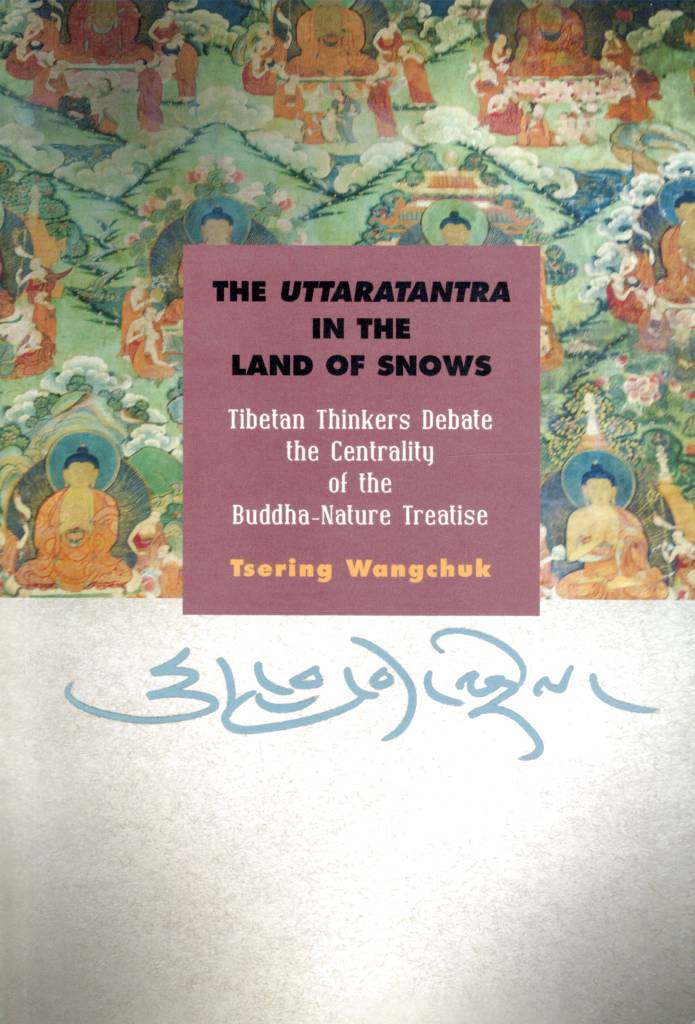
| |BookEssay=Tsering Wangchuk's The Uttaratantra in the Land of Snows is a clear and concise introduction to the history of the Uttaratantra and buddha-nature theory in pre-modern Tibet. It is an ideal introduction for anyone not yet familiar with the buddha-nature debate in Tibet. Wangchuk summarizes the writings and views of several of the most important Tibetan philosophers who weighed in on buddha-nature between the eleventh and fifteenth centuries from Ngok Lotsāwa through Sakya Paṇḍita to Dolpopa and Gyeltsabje. | | |BookEssay=Tsering Wangchuk's ''The Uttaratantra in the Land of Snows'' is a clear and concise introduction to the history of the Uttaratantra and buddha-nature theory in pre-modern Tibet. It is an ideal introduction for anyone not yet familiar with the buddha-nature debate in Tibet. Wangchuk summarizes the writings and views of several of the most important Tibetan philosophers who weighed in on buddha-nature between the eleventh and fifteenth centuries from Ngok Lotsāwa through Sakya Paṇḍita to Dolpopa and Gyaltsap Je. |
|
| |
|
| The book is divided into three main sections: early Kadam thinkers who attempted to fold the Uttaratantra's positive-language teaching on buddha-nature into mainstream Madhyamaka doctrine of non-affirming negation. They did so by asserting that buddha-nature was in fact a synonym of emptiness, and was therefore a definitive teaching. The second stage was reactions during the thirteenth century. Sakya Paṇḍita, for example, rejected the conflation of buddha-nature and emptiness and declared the teaching to be provisional; early Kagyu thinkers revived the positive-language teachings and asserted that such statements were definitive; and Dolpopa taught "other-emptiness," the strongest expression of positive-language doctrine ever advocated in Tibet. Finally, in the fourteenth century a number of mainly Geluk thinkers such as Gyeltsabje reacted against Dolpopa and all synthesis of Yogacāra and Madhyamaka thought, relegating the Uttaratantra again to provisional status. | | The book is divided into three main sections: early Kadam thinkers who attempted to fold the Uttaratantra's positive-language teaching on buddha-nature into mainstream Madhyamaka doctrine of non-affirming negation. They did so by asserting that buddha-nature was, in fact, a synonym of emptiness, and was, therefore, a definitive teaching. The second stage was reactions during the thirteenth century. Sakya Paṇḍita, for example, rejected the conflation of buddha-nature and emptiness and declared the teaching to be provisional; early Kagyu thinkers revived the positive-language teachings and asserted that such statements were definitive, and Dolpopa taught "other-emptiness," the strongest expression of positive-language doctrine ever advocated in Tibet. Finally, in the fourteenth century, a number of mainly Geluk thinkers, such as Gyaltsap Je, reacted against Dolpopa and all synthesis of Yogācāra and Madhyamaka thought, relegating the Uttaratantra again to provisional status. |
|
| |
|
| The advantage of Wangchuk's historical frame is that all assertions are placed in easy context of an opponent or supporter's writing, thus reminding the reader that buddha-nature theory in Tibet is an ongoing conversation, a debate between the two fundamental doctrinal poles of positive and negative descriptions of the ultimate. | | The advantage of Wangchuk's historical frame is that all assertions are placed in the easy context of an opponent or supporter's writing, thus reminding the reader that buddha-nature theory in Tibet is an ongoing conversation, a debate between the two fundamental doctrinal poles of positive and negative descriptions of the ultimate. |
| |BookToc=*{{i|Acknowledgments|xi}} | | |BookToc=*{{i|Acknowledgments|xi}} |
| *{{i|Introduction|1}} | | *{{i|Introduction|1}} |
| Line 18: |
Line 16: |
|
| |
|
| *{{i|Part I. Early Period: Kadam Thinkers Rescue the Treatise|13}} | | *{{i|Part I. Early Period: Kadam Thinkers Rescue the Treatise|13}} |
| **{{i|Chapter 1. Rise of the Uttaratantra in Tibet: Early Kadam Scholars Revitalize the Newly Discovered Indian Exegesis|13}} | | **{{i|Chapter 1. Rise of the Uttaratantra in Tibet: Early Kadam Scholars<br>Revitalize the Newly Discovered Indian Exegesis|13}} |
| ***{{i|Introduction|13}} | | ***{{i|Introduction|13}} |
| ***{{i|Ngok and Chapa on the Pervasive Nature of the Buddha-Body|15}} | | ***{{i|Ngok and Chapa on the Pervasive Nature of the Buddha-Body|15}} |
| ***{{i|Ngok and Chapa on Definitive or Provisional Nature in the Uttaratantra |18}} | | ***{{i|Ngok and Chapa on Definitive or Provisional Nature in the<br>Uttaratantra |18}} |
| ***{{i|Ngok and Chapa on the Uttaratantra as a Last Wheel Treatise |19}} | | ***{{i|Ngok and Chapa on the Uttaratantra as a Last Wheel Treatise |19}} |
| ***{{i|Buddha-Element as a Conceived Object|20}} | | ***{{i|Buddha-Element as a Conceived Object|20}} |
| Line 29: |
Line 27: |
| ***{{i|Introduction |25}} | | ***{{i|Introduction |25}} |
| ***{{i|Sapen, the Dissenter |26}} | | ***{{i|Sapen, the Dissenter |26}} |
| ***{{i|Rikrel, the Third Karmapa, and Sangpu Lodrö Defend the Uttaratantra |29}} | | ***{{i|Rikrel, the Third Karmapa, and Sangpu Lodrö Defend the<br>Uttaratantra |29}} |
| ***{{i|Rinchen Yeshé’s Proto Other-Emptiness Presentation of the Uttaratantra, and Butön’s Reply|34}} | | ***{{i|Rinchen Yeshé’s Proto Other-Emptiness Presentation of the<br>Uttaratantra, and Butön’s Reply|34}} |
| ***{{i|Conclusion|38}} | | ***{{i|Conclusion|38}} |
| *{{i|Part II. The Pinnacle Period: the Other-Emptiness Interpretation Spreads |43}} | | *{{i|Part II. The Pinnacle Period: the Other-Emptiness Interpretation Spreads |43}} |
| Line 43: |
Line 41: |
| ***{{i|Introduction |55}} | | ***{{i|Introduction |55}} |
| ***{{i|Sazang Follows in His Master’s Footsteps|55}} | | ***{{i|Sazang Follows in His Master’s Footsteps|55}} |
| ***{{i|Two Fourteenth-Century Kadam Masters’ Uttaratantra Commentaries |59}} | | ***{{i|Two Fourteenth-Century Kadam Masters’ Uttaratantra<br>Commentaries |59}} |
| ***{{i|Longchenpa’s View on the Uttaratantra|63}} | | ***{{i|Longchenpa’s View on the Uttaratantra|63}} |
| ***{{i|Conclusion|65}} | | ***{{i|Conclusion|65}} |
| *{{i|Part III. The Argumentation Period: Self-Emptiness Proponents criticize Other-Emptiness Approach |69}} | | *{{i|Part III. The Argumentation Period: Self-Emptiness Proponents criticize<br> Other-Emptiness Approach |69}} |
| **{{i|5. Challenges to the Purely Definitive Nature of the Uttaratantra: Zhalu Thinkers Criticize Dölpopa |69}} | | **{{i|5. Challenges to the Purely Definitive Nature of the Uttaratantra: Zhalu<br>Thinkers Criticize Dölpopa |69}} |
| ***{{i|Introduction|69}} | | ***{{i|Introduction|69}} |
| ***{{i|Butön’s Ornament |70}} | | ***{{i|Butön’s Ornament |70}} |
| ***{{i|Dratsépa’s Commentary|72}} | | ***{{i|Dratsépa’s Commentary|72}} |
| ***{{i|Conclusion|80}} | | ***{{i|Conclusion|80}} |
| **{{i|6. Challenges to the Supremacy of the Uttaratantra: Rendawa and Tsongkhapa on Tathāgata-essence Literature |83}} | | **{{i|6. Challenges to the Supremacy of the Uttaratantra: Rendawa and<br>Tsongkhapa on Tathāgata-essence Literature |83}} |
| ***{{i|Introduction|83}} | | ***{{i|Introduction|83}} |
| ***{{i|Rendawa on the Uttaratantra and the Tathāgata-Essence Literature|83}} | | ***{{i|Rendawa on the Uttaratantra and the Tathāgata-Essence Literature|83}} |
| Line 71: |
Line 69: |
| *{{i|English Language Works Cited|186}} | | *{{i|English Language Works Cited|186}} |
| *{{i|Index|191}} | | *{{i|Index|191}} |
| | |QuotesTabContent={{GetBookQuotes}} |
| | |PublisherLogo=File:SUNY Press logo.jpg |
| | |StopPersonRedirects=No |
| |AddRelatedTab=No | | |AddRelatedTab=No |
| |QuotesTabContent={{GetBookQuotes}} | | |BookParentPage=Research/Secondary Sources |
| |PostStatus=Needs Copy Editing
| |
| }} | | }} |